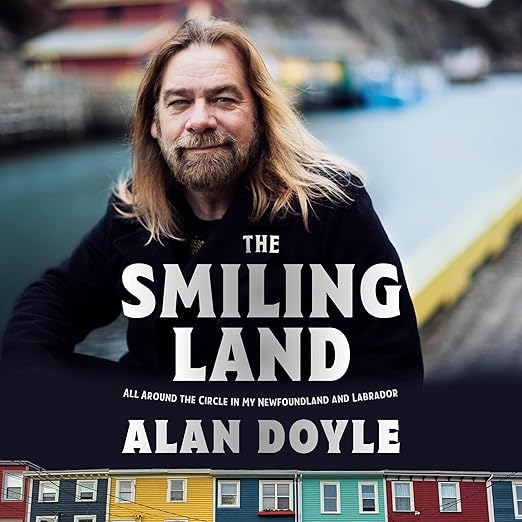
Foley's Shed is a live-music pub in some guy named Foley's shed. That sentence appears in the publisher's own description, and it says more about this audiobook than any plot summary could. Alan Doyle once worked as a tour guide, and here he takes the job back up, driving a listener around Newfoundland from Fogo Island to the Southwest Coast, Labrador to Ferryland, stopping wherever the story turns out to be better than the scenery. Seven hours and ten minutes, none of it spent on anything that would survive being printed in a brochure.
Ninety-eight ratings produce a 4.6, and all five responses a browser can read award five stars. That gap deserves arithmetic rather than a shrug. A 4.6 across ninety-eight votes requires a total between 446 and 455, from the 490 on offer. Subtract the twenty-five stars visible in the column and the remaining ninety-three votes have to total somewhere between 421 and 430, an average close to 4.5. Nothing improper is happening: the written responses simply run warmer than the silent majority behind them, which is the ordinary condition of a review column and worth holding onto before treating five glowing paragraphs as the verdict.
Newfoundland is the subject and also the method. The itinerary in the copy is genuinely specific: ancient Viking and Basque fishing settlements, cliffside hikes among flocks of ocean-plunging puffins, a pilgrimage to the home of the late great auk, and more lighthouses than the description can be bothered to count. Beside those sit the practical instructions, including how to obtain fish and chips and a free ride in St. John's by climbing into the delivery driver's car, and how an aspiring rum smuggler moves bottles from Saint-Pierre and Miquelon across to the Burin Peninsula. A guidebook written by somebody with no interest in being useful in the ordinary sense.
What Works
Alison S. Coad has been paying attention to this voice since 1996, first coming across Great Big Sea after a move to Montreal and catching the band three times over the following eight months. That December 2025 five-star describes the front man as friendly, amiable, interested in everything and, incidentally, a talented singer and songwriter, which is a fair account of the persona doing the tour-guiding here. The same response calls this Alan's third book about his travels and hedges it with an I think, which is the honest way to handle an uncertain claim and the way it deserves to be passed along.
Icebergs that look like things is an actual section of this book, and it makes a fair sample of the register. The copy promises an illustrious history taking in an exact replica of the Virgin Mary that once drifted into St. John's, plus a more recent and conspicuously less holy specimen that made international news. This is the sort of material a place generates about itself and almost never writes down. Doyle's advantage is that he is not explaining Newfoundland to outsiders so much as showing what the people who live there find funny about it, which is a different and considerably better book.
Weak Spots in The Smiling Land
Advance copies complicate this column, and the record shows it plainly. The five-star filed on November 4, 2025, the day of release, opens by thanking NetGalley, the publisher and the author for an advance copy, and goes on to describe reading the book rather than hearing it. That response is worth having: thirty years of following the music, an observation that the voice is audible on the page, and the discovery of song lyrics scattered innocuously through the text. It remains a reading verdict sitting inside an audio panel, which is exactly what a buyer comparing formats needs to spot.
Alan Doyle records his own pages, which changes what these seven hours are. An author-read travel book is not a performance of a text so much as a return to the thing the text was written down from, and for a writer who arrived at books by way of songs and stages that distinction carries real weight. The risk runs the other direction too, since performers reading their own prose sometimes push, and a joke that landed in a room can arrive overcooked in headphones. The sample is where the calibration gets checked, and on a book like this a minute is enough.
Who It's For
Travelers planning a Newfoundland trip are the sharpest use case, and the January 9 five-star puts the argument directly: anyone who has been will enjoy the reminiscing, and anybody who has not will end up booking. That response suggests the provincial tourism board ought to hand the thing out, praises the stories and the presentation in the same breath, and signs off loving the Rock. The word presentation is doing real work in that sentence, because it grades what a listener hears rather than what a reader reads, which is rarer on a page like this than it should be.
Regional shorthand runs through the whole thing, and anyone with no prior interest in the province should know the book assumes affection rather than building it from nothing. Place names arrive fast, the humor is local, and a listener carrying no map in their head will spend part of the ride pleasantly lost. Anybody wanting a practical guide with opening hours and prices is in the wrong aisle altogether, since this is a companion rather than an itinerary. One listen to the sample settles whether the voice is company you want for an afternoon.
Before You Listen
Does Alan Doyle narrate the audiobook himself?
Yes. The record lists him in both the author and narrator fields, with no co-reader and no supporting cast anywhere on it. Doubleday Canada released the recording in November 2025 at seven hours and ten minutes. Nothing else about the production appears on the page at all.
Is this audiobook a practical travel guide?
Not in the conventional sense. It names real places, from Fogo Island to Ferryland to the Burin Peninsula, and hands over genuine insider advice, but it carries no opening hours, no prices and no logistics. Treat it as a companion for planning a trip rather than the document you travel with.