Quick Take
- Performance: Attkisson narrates her own reporting, so the firsthand account arrives in the voice of the reporter who lived it.
- What it covers: Opposition research, media manipulation, the anatomy of a political hit piece
- Feel: Combative, methodical, unmistakably argued from a side
- Our call: Buy it as a practitioner's brief on technique, not as a neutral survey of the American press.
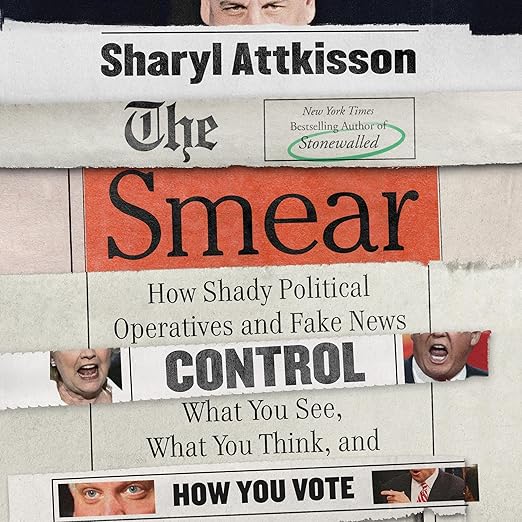
The word smear does a great deal of work in this audiobook, and Sharyl Attkisson uses it as a proper noun. The Smear, capital S, is her term for an industrial process: opposition researchers, spin doctors and outside interests working to destroy an idea or a person, usually by building the attack on 'some shred of truth' so that it cannot be waved away. Eleven hours and nineteen minutes, narrated by Attkisson herself.
That last detail matters more than it normally would. Attkisson is a working investigative reporter, and the publisher's description points to years of being 'pitched hit jobs and puff pieces' before she began writing about the mechanism instead of the stories it produces. When a journalist delivers her own account of how journalism gets played, the choice of voice stops being a production decision and becomes part of the argument.
At its spine this book is a taxonomy. Attkisson separates the smear into stages, identifies who performs each one, and then names practitioners, including Clinton confidant Sidney Blumenthal and, above all, the political operative David Brock, along with the Media Matters for America empire the copy attaches to his name. Harper published the recording in 2017, and the promotional copy borrows National Review's description of Brock as a 'right-wing assassin turned left-wing assassin', which gives you a fair reading of the temperature.
I found the mechanical chapters genuinely useful. Attkisson is precise about sequencing, about how a narrative gets seeded and then laundered through outlets that appear independent of one another, and about the operator's requirement to stay invisible. Taken as craft description rather than as verdict, that material holds up regardless of where a listener sits politically, and it does change how you read a news cycle afterward.
One further point about method. Attkisson builds her case out of named individuals and documented episodes rather than anonymous impressions, which makes the taxonomy checkable in principle. A listener who wants to argue with the book has something concrete to argue with, and that is more than most titles in this category offer. Whether the selection of episodes is representative is a separate question, and one the account does not especially invite you to ask. I would want a second source on several of the specific claims before repeating them, which strikes me as a reasonable posture toward any book about how narratives get manufactured.
What the book will not do is pretend to neutrality about who does this and to whom. It argues from a position, its examples are chosen accordingly, and a listener who rejects the author's diagnosis of the press will spend eleven hours inside an argument rather than a briefing. I do not count that as a defect so much as a label that belongs on the tin, and it is worth knowing before committing the time.
Highlights
Self-narration is the strongest reason to choose this edition. The material is a reporter's account of her own working life, including the pitches she was offered and the ones she turned down, and having it delivered by the person who lived it strips out a layer of mediation the subject can ill afford. A hired voice reading a first-person account of manipulated voices would sit oddly, whatever its quality.
The framework also travels further than the American case studies imply. A five-star reader in the United Kingdom wrote that 'the techniques exposed here will be familiar to any UK resident who takes an interest in our political life', which is a useful signal. The value sits in the method being described, not only in the specific fights it draws on, and that portability is why the book still reads years after those fights ended.
Geography supports the point as well. Five notices sit on the listing and they come from three countries, two filed in the United States, two in the United Kingdom and one in Canada, between 2017 and 2022. All five award five stars. One reader came to the book after watching a television interview with the author, another opens by describing a grandfather who edited two Chicago dailies and a mother who ran a local newsletter, which suggests an audience that already cares about how news gets assembled.
What to Watch For in The Smear
Start with the arithmetic on the score. The 4.7 average rests on a ratings sample of two, which is smaller than the number of written notices on the same page. That mismatch turns up often on older listings and it means one thing only: the star figure has not settled and should carry no weight in your decision. Read the notices, and read the sample, and ignore the number entirely.
The second caution is structural and specific to audio. Eleven hours move through a dense population of operatives, organizations, outlets and incidents, and the argument depends on you holding the connections between them in your head. Print offers an index and a page to turn back to. A recording offers a scrub bar. Anyone planning to use this as a reference rather than a single sitting should expect to bookmark heavily.
One reviewer names the gap I would name as well. A UK reader who otherwise gives it five stars wished for more on social media, and specifically on how a small 'Twitter Storm' gets read as a majority opinion by politicians. Published in 2017, the book predates a great deal of what that mechanism became, and the platform-era material a listener might want most is the thinnest part of the account.
Is This One for You?
This fits listeners who follow media criticism closely and want a practitioner's account rather than an academic one. It fits people working in communications, public affairs or campaigning who want the process described from the receiving end. It also fits anyone who has ever watched coverage of a person they know personally and registered the gap between the story and the human being.
It is a poor purchase for a listener after a balanced survey of American political media, or for someone hoping to extract the mechanics without the politics attached. Those two things are not separable here. Every written notice on the listing is sympathetic to the author's premise, which suggests the visible audience largely agreed before pressing play.
Approach it, then, as a strongly argued brief from a reporter with direct experience of the trade she is describing, and keep your own judgment in the room throughout. The taxonomy is the part that will still be useful to you in five years. The named verdicts are the part to test against other sources. On those terms, eleven hours and nineteen minutes is a fair investment of attention.