Quick Take
- Narration: Virtual Voice AI narration. Functional but flat; no tonal variation for emphasis when discussing critical risk disclosures.
- Themes: Mechanical options trading, rules-based income strategies, backtesting and verification
- Mood: Confident and instructional, with a few notable rough edges
- Verdict: A short, focused options strategy guide that delivers a clear method, though listeners should scrutinize the backtesting assumptions carefully before committing capital.
I should say upfront that this audiobook uses an AI Virtual Voice narrator, which is worth knowing before you start. At two hours and forty-two minutes, the runtime is short for the category, and the narration is functional without being engaging. For listeners primarily interested in the strategic content, that may not matter much. For anyone who needs a voice that conveys the weight of a risk disclosure or the significance of a methodology caveat, the flatness will occasionally work against the material.
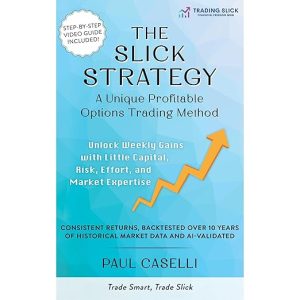
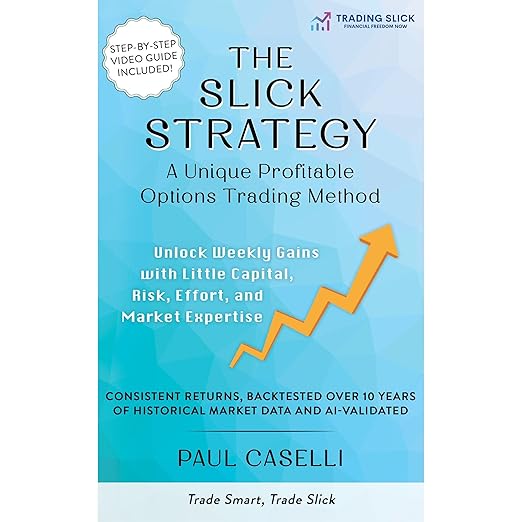
Paul Caselli’s The Slick Strategy presents a mechanical options trading method focused on weekly trades using the SPX index. The core pitch is accessibility: a rules-based system designed to generate consistent returns with minimal time investment, which Caselli claims requires ten to twenty minutes per week to implement. That is a significant promise in a genre that tends to either oversell simplicity or bury practical guidance under theoretical scaffolding. Caselli’s book does neither, which is a genuine virtue.
Our Take on The Slick Strategy
The strategy itself is presented clearly. Caselli walks through the setup criteria, the entry and exit conditions, and the monitoring process with step-by-step instructions that experienced options traders will find easy to evaluate and beginners will find accessible, if not fully contextualized. One reviewer coded the strategy into TradingView and ran their own performance testing, finding the numbers held up. Another found it to be their primary trading strategy. Both are credible endorsements from people who engaged with the mechanics seriously.
The book claims a success rate of over 88 percent based on ten years of historical market data. That is the number most likely to draw scrutiny, and it has. One reviewer with options trading experience noted a specific discrepancy: the strategy specifies that trades should not be placed when SPX is below the 200-day moving average, but the backtest data in the book appears to show the strategy active during periods in 2020 when SPX was below that threshold. The reviewer identified the same pattern across other years. This is not a trivial observation. It is the kind of assumption gap that can produce significantly different live performance from historical results.
Why Listen to The Slick Strategy
For its brevity alone, the audiobook has value. Caselli does not pad his content, and the step-by-step structure means listeners can return to specific sections without losing their place in an argument. The bonus video guide mentioned in the book provides additional implementation support beyond what the audio alone can deliver, which is a sensible design choice for a trading strategy that depends on precise execution.
The risk management section is competent. Caselli explains the rationale behind the position-sizing logic and the conditions under which trades should be paused, which is more discipline than many short trading guides offer. His acknowledgment that the strategy is designed for traders who want a low-complexity, rule-following approach rather than active discretionary trading is honest about the audience and the method.
What to Watch For in The Slick Strategy
The backtesting discrepancy flagged in the reviews deserves serious weight. A strategy whose backtest data does not consistently match its own stated entry rules has a credibility problem that no amount of positive performance statistics can fully resolve. Listeners with quantitative backgrounds or prior options trading experience should review the backtest tables carefully rather than accepting the headline numbers. The 88 percent claim needs to be tested against your own verification, not taken on the strength of the author’s research alone.
The AI narration also creates a subtle problem specific to this genre. When a human narrator reads a risk caveat or a methodology qualification, there is vocal texture that signals importance. The Virtual Voice reads disclaimers and core strategy descriptions with identical inflection. Listeners will need to bring their own critical attention to the material rather than relying on audio cues to flag what requires extra scrutiny.
Who Should Listen to The Slick Strategy
Listeners who already trade options and are looking for a structured mechanical system to test and paper-trade before committing capital will get the most from this. The clarity of the methodology and the short runtime make it easy to evaluate. Complete beginners to options trading will need supplementary resources to understand the instruments themselves before the strategy details become actionable. Those who found the backtest concerns compelling from the reviews would benefit from running their own data verification on the SPX moving average filter criteria before making any trading decisions based on the book’s claims.
Frequently Asked Questions
Is The Slick Strategy suitable for complete beginners to options trading?
Caselli presents the method accessibly, but the audiobook assumes basic familiarity with how options contracts work. Complete beginners will likely need a foundational options trading resource before the specific strategy instructions become fully actionable.
What does the 88 percent success rate claim actually mean?
It refers to the percentage of weekly trades that closed profitably based on Caselli’s ten-year historical backtest of the SPX index. However, at least one reviewer identified discrepancies between the stated entry rules and the backtest data, specifically around the 200-day moving average filter, which calls the headline number into question.
Does the AI narration affect understanding of the trading strategy?
For pure informational content, the narration is adequate. The risk is that Virtual Voice delivers risk disclosures and critical methodology caveats with the same flat inflection as routine instructions, so listeners need to bring their own critical attention rather than relying on vocal emphasis to flag what matters most.
How long does the strategy take to implement each week?
Caselli claims ten to twenty minutes per week for monitoring and trade execution. Several reviewers who implemented the strategy confirmed this estimate, though active market conditions may require more attention during volatile periods.