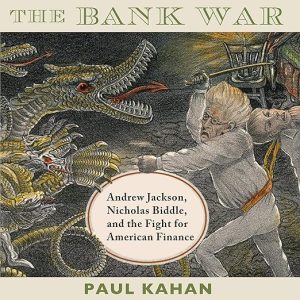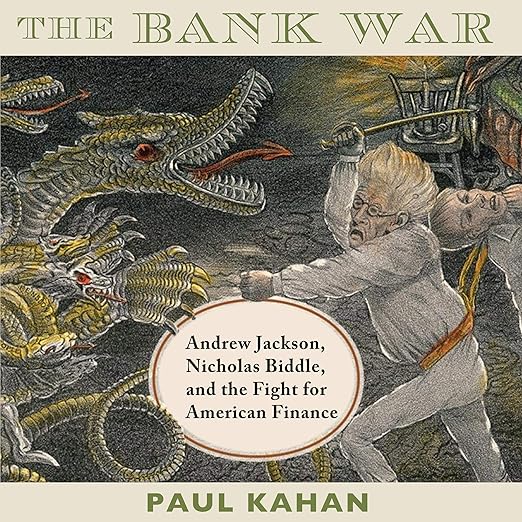
Andrew Jackson and Nicholas Biddle are both named in this book's real title, and neither appears in the title on this page. What the listing calls The Bank War is sold in full as The Bank War: Andrew Jackson, Nicholas Biddle, and the Fight for American Finance, which tells a browser in one line that the audiobook is about two men rather than about monetary policy. The shortened version says nothing, and the shelf it sits on actively misleads.
Paul Kahan is writing constitutional history that happens to be about a bank. The description makes the claim directly: the fight over the Second Bank was a continuation of arguments started at the Constitutional Convention about the role of the executive branch and the reach of the federal government, arguments the book says still divide the country. Read that way, the charter fight stops being a technical episode and becomes a case study in how institutional questions get settled by personality. Kahan states the evidence base openly in the description, a mix of primary and secondary source material, which is a modest claim compared with the archival boasts most popular histories lead on and a more honest one.
J. Elias, filing five stars in January 2016, put the appeal better than the sales copy does by asking who on earth wants to read a history of banking, then answering the question: this is really the story of two people fighting over conflicting American principles, democracy set against good government. That account calls the writing thorough without being tedious, which is a precise compliment for a book that could easily have been neither.
Shelving is where the record does the book a disservice. This sits under money and finance with a Banks and Banking tag, categories otherwise full of titles offering portfolio advice and retirement planning. What arrives is a work of nineteenth-century political history with no investment content whatever. A listener shopping the category will be baffled; a listener shopping for history will never see the page.
Cram Must Land Charter and Specie on First Hearing
Consequences are the argument, and the written record makes it. Thomas M Glasoe, writing five stars in March 2016, calls this a mostly forgotten episode with long-term ramifications for American banking, and notes that questions about the relationship between government and banks came back to the center of public argument after the recent recession. Knowing how the first fight went, that account argues, clarifies a relationship most people encounter only during crises.
Range is the second reason. The description tracks the whole arc, from the idea of centralized banking and the First Bank of the United States through Jackson's triumph, into the era of free banking, and out the other side to the creation of the Federal Reserve System. Compressing a century of institutional history into a single volume means the causal chain stays visible, which longer treatments often lose in the detail. Mark, another five-star account writing in April 2024, describes the payoff in the narrowest possible terms: a thorough and detailed background to the chartering of the Second Bank and to the failure to recharter it. Anyone who wants only that specific episode gets it complete.
The reading credit goes to Jared Cram, and the demand this material makes is unusual. Two publishers are involved by the description's own account, the print house and the university press behind the audio, and the text carries the vocabulary of the academy: charter, recharter, specie, the technical furniture of banking argument. Every one of those has to land cleanly on first hearing, because a listener has no way to glance back at the previous paragraph.
Josh Calls the Language a Little Wonkish
Josh, grading four stars in August 2020, describes the exact problem this format creates. That account calls the language a little wonkish and says the book assumes a reader's familiarity with the basics of banking then and now, and admits to growing tired of flipping back to a reference site every time an unfamiliar term or concept appeared. Flipping back is trivial with a page open. With a recording running, it is a genuine interruption.
Tone is the second caution and it comes from the least enthusiastic response on the page. Ken Blakely, at three stars in June 2017, judges the book closer to a master's thesis in history than to a history book, drier and more pedantic than it needed to be, and offers a comparison to Barbara Tuchman that the book does not survive. Worth a read, that account concludes, which is faint praise honestly given.
Pool composition deserves a glance too. Fifty-seven graders, five written accounts, and three of those five posted before the audio edition existed at all, in 2016 and 2017 against a 2019 recording. The five visible grades average slightly above the 4.2 the page displays, so the silent majority is marginally cooler than the vocal minority. Neither number tells you anything about the listening. Length is the last practical consideration and it cuts in the book's favor: five hours and thirty-eight minutes is short enough to take in two or three sittings, which suits a narrative that depends on holding a chain of causes in view from one end to the other.
This Book Rewards a Second Pass
American political history is the natural home for this, and the presidency as an office that grew through particular fights rather than through theory is the thread to follow. Students needing a compact treatment of the Second Bank will find the length an advantage over the standard monographs. Anyone who followed arguments about central banks after the last financial crisis gets the deep background in a single sitting.
Investors who found this through the finance category should leave now, because nothing here is about managing money in the present. Listeners without any banking vocabulary hit the second obstacle, and the four-star account describes exactly how that goes. A lively popular narrative this is not, by the three-star account's reckoning, so anyone wanting the Tuchman experience should take that comparison seriously rather than as a throwaway.
Given the length, this is a strong candidate for a second pass. A single run gets you the narrative shape, and a second gets the constitutional argument underneath it, which is the part that actually justifies the book's existence. Come prepared to look up two or three terms afterward rather than during, and the wonkishness stops being an obstacle and starts being the point.
Key Details
- Narrator: The reading credit goes to Jared Cram, on a text one reviewer had to keep leaving in order to look terms up, which audio makes considerably harder.
- Subjects: Executive power against federal institutions, the Second Bank and its charter fight, arguments from the Constitutional Convention that never closed
- Tone: Dry, documented, argumentative
- Bottom line: A solid short history of a fight that still shapes American finance, sold under a shelf label that misrepresents it.