The Short Version
- Read by: Steven Ross narrates his own audiobook, and the personal conviction in his voice gives the prospecting philosophy the earned quality it requires.
- At its heart: Real estate prospecting, intentional business-building, mindset and work ethic
- Vibe: Direct and grounded
- Short version: Ross writes for the agent who is working hard but not getting traction, and his framework is more honest about why that happens than most real estate books allow themselves to be.
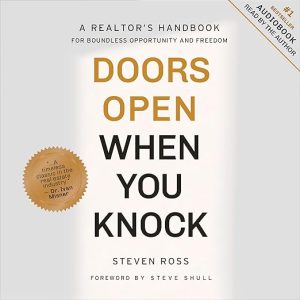
Kyle is a real estate agent two years into his career, working seven days a week, running the campaigns, doing the open houses, listening to the podcasts, and still not growing his business at the rate the effort should justify. He knows the tips. He has the scripts. What he does not have is a sustainable way to structure his time and his thinking so that he is building something with direction rather than simply staying busy under pressure. Steven Ross's audiobook, Doors Open When You Knock, narrated by the author at three hours and thirty-four minutes, begins with that problem and refuses to solve it with the motivational version of an answer. Ross is direct about what he is not offering before he describes what he is, which is itself a signal about the book's orientation.
Ross opens by explicitly dismissing the category his own book might appear to occupy. He has no tips or tricks that will double your business overnight. He does not have a secret to success, and he says so plainly. What he offers instead is a framework for understanding why real estate can take people by the horns and toss them around even when they are working hard, and how to wrestle control back from that dynamic by building a business that functions on purpose rather than swinging between chaos and survival. The title's metaphor is not decorative. Ross built his career through physical door-knocking, literal prospecting that one reviewer describes as reaching a million doors, and that unglamorous foundation is the credibility from which everything else in the audiobook extends.
The problems Ross names in the early chapters are uncomfortably specific to the real estate agent's experience. No time off. Always on-call. Anxiety about where the next commission check is coming from. Working genuinely hard without getting to where the effort should be taking you. Being overwhelmed by the volume of tasks that real estate demands and the absence of structure that independent contractor status provides. These are framed not as motivational challenges to be overcome with the right attitude but as structural problems that require structural responses. Ross's thesis is that agents who sustain long careers in real estate have a different relationship to their business, to time, and to outcomes than those who burn out inside three years, and that relationship is cultivated deliberately rather than innately possessed.
Ross Sounds Like He's Lived the Conversations
Self-narration was the right choice for this material. Ross sounds like someone who has had the conversations he is describing rather than someone who has read about them and organized the knowledge into chapters. His voice carries conviction without the sales-pitch energy that would undermine an audiobook about selling, and that distinction is meaningful. At under four hours, the audiobook is compact in a way that reflects its own philosophy about eliminating what does not serve the purpose. Ross does not expand the framework to justify a longer runtime; he covers the territory he needs to cover and stops, which gives the material a credibility the runtime alone does not provide.
The sections on developing patience and gratitude alongside the more tactical material on time management and business structure are what separate this audiobook from a prospecting guide. Ross is making a case that agents who sustain long careers have a different relationship to time and outcome, and that the cultivation of patience and intentionality alongside strong work ethic is what makes the difference between someone who prospected their way to a short-term income and someone who built something that outlasted the prospecting seasons. Reviewers who feel compelled to describe the book in terms that extend beyond real estate are responding to that wider argument.
No Scripts Here, Just a Working Philosophy
Listeners hoping for detailed door-knocking scripts, specific objection-handling techniques, or tactical prospecting systems will find this audiobook operating at a higher level of abstraction than those resources. Ross writes philosophy of practice more than operational manual. He addresses mindset, intentionality, patience, and responsibility as the foundations from which the tactical elements should flow, but the tactics themselves are not the focus of the audiobook. Agents who want specific language for specific scenarios will need to supplement this listen with more operationally detailed resources.
The real estate context is consistent throughout, and the audiobook's value is calibrated specifically to the commission-based independent contractor environment of real estate practice: the income volatility, the always-on-call dynamic, the blurred boundary between personal and professional time that the industry makes standard. Some of the principles Ross articulates apply to other commission-based fields, but the specificity of his examples and the texture of the environment he is writing from make this most directly useful to people navigating real estate specifically.
For Agents Working Hard Without a Framework
This audiobook is for real estate agents who are working hard without commensurate results, and who suspect the problem is not insufficient effort but a missing framework for directing that effort with intention over time. Newer agents who have absorbed the tactical training programs common in the industry but lack a longer-term philosophical orientation for sustaining a career will find Ross's perspective fills a real gap. Experienced agents navigating burnout from the always-on dynamic will find the autonomy and boundaries Ross describes worth revisiting from a position of experience. Listeners who want a real estate book grounded in actual prospecting practice rather than personal branding strategy or social media optimization will find this audiobook a useful counterweight to most of what currently occupies the genre. The compact runtime means the investment is low and the re-listen value, particularly when motivation is running thin, is high.