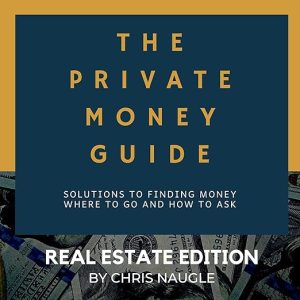
Private lending is the part of real estate investing that beginners hear about last and need first. A bank says no, or says yes slowly, and the deal moves on without them. Chris Naugle spends three hours and thirty-six minutes on the people who say yes faster: how to find them, how to talk to them, and what paperwork sits between a handshake and a funded purchase. As an audiobook in this category it is unusually short and unusually specific about the mechanics.
Naugle Wrote and Reads His Own Conversational Pitch
Pete's January 2020 response is the one I would read first, because it comes from somebody who did not need the book. That account had been funding deals for years through bank financing and creative methods, and still found the lender-facing material useful, singling out the part about setting up arrangements that work for both sides. An experienced investor finding new ground in a beginner's guide is the strongest recommendation a short book of this kind can collect.
Scope is deliberately narrow. The guide covers identifying private lenders, the do's and don'ts of securing funds, and how to analyze the deals those lenders bring you, then walks through the documents the process demands. Nothing here concerns finding property, estimating rehab costs or managing tenants. That narrowness is why the whole thing fits inside an afternoon, and it is also why it will never be the only book you need on the subject. The title promises a line rather than a one-off, since Real Estate Edition implies other editions somewhere, yet the listing carries no series name and no volume number, so a buyer who wants the next one has nowhere to look.
Byline and reader credit belong to the same person, which is common enough in self-published guides but still worth naming. Chris Naugle wrote this and reads it. A response from May 2019 already described the author as passionate and the book as speaking to its readers in the first person, so the conversational register was there before anybody switched a microphone on, and the recording inherits it rather than inventing it.
Overwhelm Killer, Kept Short and Ordered
Loren Gill's August 2021 response calls the book a real estate overwhelm killer, and the phrase earns its place. Funding conversations are where new investors freeze, because the vocabulary arrives all at once and every term implies three more. Breaking the process into ordered steps is the entire value proposition, and that account describes going back over sections repeatedly to absorb them, which is a compliment and a warning in one sentence.
Concision is the second argument, and two separate responses raise it without prompting. Short, straight to the point, clear despite being brief: that is roughly the consensus on the page. In a category where writers pad to justify a price, a guide that says what it came to say and then stops is doing its reader a favor, particularly a reader still deciding whether private lending suits them at all.
Framing is upfront, which I appreciate. The description states the purpose without hedging: teach you to identify and secure private money lenders, lay out the do's and don'ts, then explain how to weigh whatever those lenders put in front of you. Nothing here pretends neutrality about whether private lending is a good idea. Take the confidence as part of the package, and keep the document walkthrough as the section that pays for the purchase. The final stretch of the stated syllabus is the part beginners underestimate: leveraging the financing you secure, then growing a portfolio at a pace the debt can survive. Naming sustainability as a goal in a category that usually sells speed is a small act of honesty.
Four Reviews Sit Ahead of the 2020 Release
Shelly, an investor writing in March 2019, praised something this edition cannot deliver: good physical representations of the forms an investor should be using. The description makes the same promise from the other direction, saying the audio will cover in detail the various documents needed during the private moneylending process. Documents described aloud are not documents you can look at, and this is where the format works against the content.
Only one response, dated August 2021, was posted after this recording existed. The other four were written between March 2019 and January 2020, ahead of the February 2020 release from Flipout Academy. Everything readable on the page is therefore a verdict on the text, and none of it tells you anything about the edition you would actually be buying.
Arithmetic offers the other caution. Five visible responses all award five stars while the page reports 4.2 from sixty ratings, which means roughly fifty-five graders whose words you cannot read pulled the average down by close to a full point. The written record here is the flattering end of a distribution, and a confident short guide with a single thesis is precisely the kind of book that divides an audience.
Newcomers Learn That Struggling to Find Money Is Normal
Newcomers are the core audience and they know it. AJ's response says the useful part out loud: relief at learning that struggling to find money is a normal condition rather than a personal failing, followed by a plan that spells itself out. If you are still at the stage of wondering whether a deal without a bank is even a legitimate structure, this is a sensible first stop. The description claims the book suits seasoned investors and first-timers equally, and the written record is more mixed than that, since two responses come from people who describe themselves as already investing while the rest read as first encounters with the subject.
Regular raisers of private capital can pass, since the material starts at the beginning and the beginning is most of it. Anyone who wants the documents themselves is also in the wrong place, because the version that shows them to you is not this one. And if you prefer a book that argues with its own model, look elsewhere, because this is a how-to rather than a debate.
Everybody else gets a straightforward proposition. A short, ordered account of how private money actually moves, delivered by the person who wrote it, with no padding at all. Pair it with something you can read on a screen when the paperwork section arrives, and you will have covered the subject in less time than a single bank appointment takes to schedule.
Can the audiobook actually convey the forms it describes?
The description promises detailed coverage of the paperwork required during private lending, and one investor praised the printed edition specifically for its physical representations of those forms. Audio can describe a document but cannot show it. Assume you will need a written copy or your own templates open alongside the listening.
Is this useful for someone who already invests in real estate?
Partly. The guide starts from first principles, so an experienced buyer should expect familiar ground before the lender-facing material arrives. Two of the five written responses come from people already investing, and both still found something worth keeping, which is the strongest signal a page this small can produce.
How current is the advice, and do the reviews describe this audiobook?
Four of the five predate the February 2020 recording, so they judge the text rather than the edition. The mechanics of private lending are structural rather than rate-dependent, but anything touching market conditions deserves a check against the present day before you act on it.