Quick Take
- Narration: Shaun Chamberlin, Fleming’s collaborator and the editor of this distillation, narrates with the authority of someone who spent years inside this material, giving the prose an organic quality.
- Themes: Post-growth economics, localism and community resilience, culture as economic alternative
- Mood: Cerebral and hopeful in equal measure, with a calm urgency underneath
- Verdict: A dense but genuinely visionary work that offers something rare in collapse literature: a future that sounds worth living in.
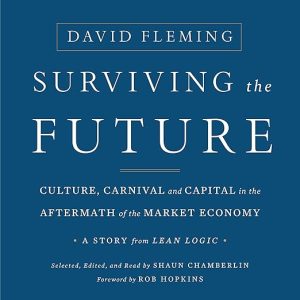
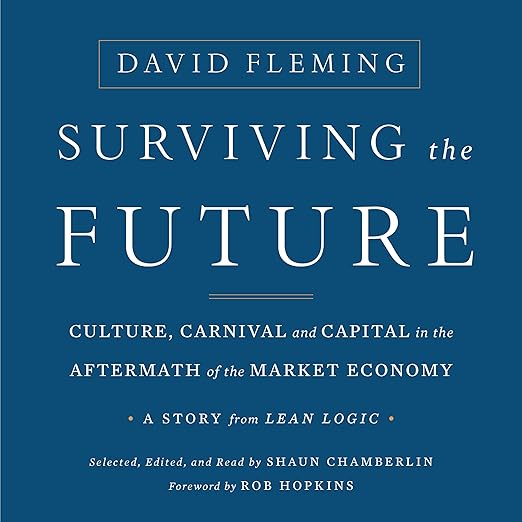
I came to this one having heard about Lean Logic, Fleming’s massive dictionary-format original, from a few different directions over the years. The sheer scale of that project, 404 interlinked dictionary entries available only in hardcover, had always felt like a reason to defer rather than engage. Surviving the Future, edited by Chamberlin from Fleming’s lifetime of thought, is the entry point that project needed. I listened over several evenings, often stopping to sit with a passage before moving on, and by the end I understood why readers describe this as the most concrete and descriptive look into a post-capitalist future they have found.
Chamberlin narrates his own editorial work, which means the voice reading this book spent years selecting and shaping its content. The result is narration with unusual depth of conviction, a quality that no hired professional could quite replicate for this particular material.
Our Take on Surviving the Future
Fleming’s core argument is that the market economy, as currently structured, is heading toward some form of collapse, and that this is not primarily a technological or policy problem but a cultural one. His response is not to propose a political program but to articulate what the texture of a post-growth life might actually feel like, grounded in play, conversation, reciprocal obligation, and what he calls the rich culture that local communities produce when not organized around eternal productivity growth. The economic framework, sometimes called Lean Logic, draws on systems thinking, ecology, and the history of pre-industrial communities. It is not anti-technology or primitivist. It is specific about what the market economy has squeezed out of human life and what recovering it might require. Fleming’s biography reinforces this seriousness: he played significant roles in the genesis of the UK Green Party, the Transition Towns movement, and the New Economics Foundation, and was one of the early voices on oil depletion and the designer of the TEQs carbon rationing system.
Why Listen to Surviving the Future
What distinguishes Fleming from most writers in the sustainability and post-growth space is his prose. He is funny, sometimes deliberately lightening the weight of his own arguments in ways that other thinkers in this space would not allow themselves. One reviewer called the book beautifully and lightly written about very grim future prospects, and that tension is key to understanding why it has maintained a readership across editions. Another reader described it as a smoke signal around which to gather, which is reaching for the same quality: this is a book that makes the alternative feel like something worth moving toward rather than falling back to. The vision of Transition Towns and local economies is not presented as either utopian fantasy or grim necessity but as something genuinely attractive. Fleming’s conviction that humor, play, and ceremony are not luxuries but foundations of a functioning community is one of the more quietly radical arguments in contemporary economics writing.
What to Watch For in Surviving the Future
Fleming’s thinking is systemic, which means his arguments loop back on themselves and build through accumulation rather than linear progression. One reviewer noted that this takes some effort to follow as it goes in systems thinking, and that is an accurate description of the listening challenge. The audiobook format requires more active attention for this kind of material than a print reader can manage with margin notes and re-reading. Chamberlin’s narration is strong, but the density of some passages means that extended listening sessions require genuine concentration. This is also a book written from a specifically British intellectual context, shaped by Fleming’s institutional history with UK environmental movements. Listeners from other cultural contexts may find some illustrative examples require translation.
Who Should Listen to Surviving the Future
This audiobook is ideal for anyone engaged with post-growth economics, Transition Town philosophy, or climate-focused social thought who wants a book that takes culture seriously as an economic variable. It is also for readers who find conventional sustainability literature too either/or in its framing and want something that sits with complexity. Those looking for a practical action guide or a policy manifesto will not find it here. This is a book of ideas, and the action it calls for is primarily imaginative before it is practical.
Frequently Asked Questions
Do I need to read Lean Logic to get value from Surviving the Future?
No. Chamberlin designed Surviving the Future specifically as a standalone entry point for readers and listeners who find the 404-entry dictionary format of Lean Logic daunting. The essential ideas are here in conventional narrative form without requiring the original.
How does Chamberlin’s narration compare to what a professional audiobook narrator would bring?
Chamberlin brings something a professional narrator cannot: deep editorial familiarity with the material. The trade-off is that his delivery is occasionally more lecturer than performer. For this content, that quality feels appropriate rather than limiting.
Is this book relevant to listeners outside the UK context in which Fleming developed his ideas?
Yes, broadly. The intellectual framework travels well. Some institutional references are rooted in British policy context, but the core arguments about local economies, cultural resilience, and the post-growth transition apply across national contexts.
How does Surviving the Future compare to other books in the degrowth or post-capitalist space?
It is more literary and less polemical than most. Where writers like Jason Hickel or Kate Raworth work from economic data toward policy prescription, Fleming works from cultural theory toward vision. It is closer in spirit to Ivan Illich than to conventional economics writing.