Quick Take
- Narration: Ward Paxton's clean, declarative delivery suits Morrison's argumentative style, though it leaves little room for nuance when the rhetoric heats up.
- Themes: American manufacturing decline, tariff policy, economic nationalism
- Mood: Urgent and polemical, written from a clear ideological position
- Verdict: A detailed economic argument for tariff policy that will energize its intended audience and test the patience of those who disagree with its premises.
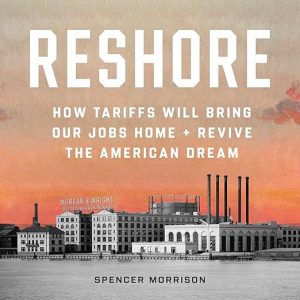
I approach economic policy books with a particular interest in how authors handle complexity: whether they represent the strongest version of opposing arguments or construct easier targets. Spencer Morrison's Reshore is an unambiguous advocate's book, and it is worth being clear about that from the outset. At eight hours and twenty-six minutes narrated by Ward Paxton, this is a sustained case for tariffs as the mechanism to reverse American manufacturing decline, and it does not present itself as a balanced survey of the debate.
That is not necessarily a criticism. Advocacy books serve a purpose, and Morrison's argument is more historically grounded than many in this genre. The case he builds through economic history, from the 19th-century American manufacturing era through deindustrialization and its social consequences, is detailed enough to reward engagement even from readers who come in skeptical of the overall thesis.
Our Take on Reshore
Morrison's strongest material is historical. His account of how a robust manufacturing base supported broad middle-class prosperity, and how its erosion tracks with specific policy decisions rather than inevitable economic forces, is well constructed. Reviewers have noted that the book goes well beyond simple tariff advocacy to examine downstream effects: wage stagnation, the shift from homeownership to renting, declining marriage and birth rates in affected communities, and the public health consequences of economic precarity in rural America. One reviewer described it as a masterclass in economic history that went well beyond what they expected on those broader consequences. Whether you accept Morrison's causal framework or not, the breadth of the diagnosis is serious and the historical evidence is marshaled with care.
Why Listen to Reshore
Listeners who are new to tariff economics have consistently reported that Morrison makes the subject accessible. One reviewer noted that everything was explained very well despite expecting technical density. Paxton's narration is direct and functional, pacing the argument without dramatic embellishment. The book is most useful as an introduction to the economic nationalist position on trade, articulated by someone who has clearly read deeply in the relevant history. For listeners who want to understand why tariff arguments have gained significant political traction in recent years, Morrison provides the most detailed popular account of that intellectual tradition currently available in audiobook form.
What to Watch For in Reshore
The book's framing is explicitly partisan. The opening endorsement from Steve Bannon signals the political positioning, and Morrison does not attempt to engage seriously with counterarguments from economists who hold different views on trade. The Austrian school of economics is dismissed rather than debated. Listeners who come from economics backgrounds or who hold free-trade views will find the argumentation selective. That is not unusual for advocacy work, but it is worth knowing before you commit eight and a half hours to the project. The historical material stands more independently of the political framing than the prescriptive chapters do, and readers primarily interested in the economic history can find considerable value there even if the policy prescriptions do not persuade them.
Who Should Listen to Reshore
This book will appeal most strongly to listeners already broadly sympathetic to economic nationalism who want a detailed historical and economic framework for those instincts. It will also work for listeners who want to understand the strongest version of the tariff argument, regardless of their own position. One reviewer recommended it specifically as a resource for refuting globalist arguments, which accurately captures the rhetorical purpose the book is designed to serve. Those who prefer books that model intellectual rigor through engagement with opposing views will find this disappointing. The historical sections are the most durable part of the listening experience; the prescriptive chapters are where the advocacy is least restrained.
One reviewer who came to the book primarily for economic history described feeling surprised by how much Morrison addresses the quality of everyday consumer goods as a downstream consequence of offshoring, not just wages or employment levels. This ground-level analysis of how trade policy affects daily life is where the book feels most original. Whether you accept the broader tariff prescription or not, the argument that the shift from domestic to imported goods has affected product quality across household categories is supported with more specificity than most policy books at this level.
Frequently Asked Questions
Does Reshore engage seriously with arguments against tariffs?
Not in depth. Morrison presents the case for tariffs as decisive and dismisses free-trade arguments without fully working through the strongest versions of opposing economic positions. This is an advocacy book rather than a balanced policy analysis.
Is this accessible to listeners without an economics background?
Yes. Reviewers consistently note that Morrison writes for a general audience, and Ward Paxton's narration keeps the explanations clear. The historical sections in particular are accessible without prior economics knowledge.
How does the book handle the social consequences of deindustrialization?
In considerable detail. Morrison's account covers wage stagnation, declining homeownership, changes in family formation rates, and public health consequences. This social analysis is more expansive than listeners expecting a narrow tariff argument might expect.
Is the political framing upfront, or does the book present itself as ideologically neutral?
The framing is explicit from the beginning. The Steve Bannon endorsement in the opening material signals the political positioning clearly. Morrison writes from an economic nationalist perspective and does not present this as neutral analysis.