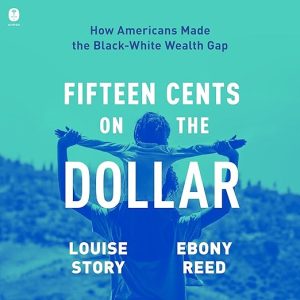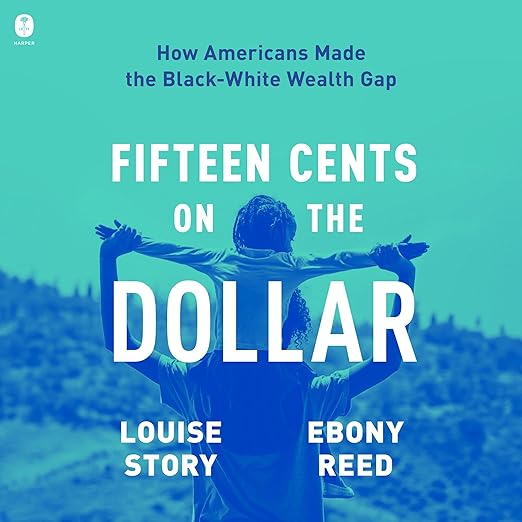
Quick Take
- Narration: Tovah Ott handles a complex, multi-strand narrative with skill, giving distinct texture to the book’s individual profiles while maintaining the connective tone required for serious investigative nonfiction.
- Themes: Systemic financial discrimination, the Black-white wealth gap, the limits of corporate racial equity initiatives
- Mood: Urgent and illuminating, with the controlled anger of deeply researched journalism
- Verdict: Louise Story and Ebony Reed have written the most thorough account of the Black-white wealth gap available in audio form, the kind of book that changes how you understand financial systems, not just racial ones.
There is a particular kind of book that makes you pause mid-listen and stare out the window for a minute. Not because it is confusing, but because what it is saying is registering somewhere deeper than the narrative brain. I had several of those moments with Fifteen Cents on the Dollar, most of them during the passages about housing discrimination, a subject I thought I understood reasonably well, and which this book systematically revealed I understood only at the surface.
Louise Story and Ebony Reed are both journalist-academics, which means the book operates in two registers simultaneously: it is rigorously documented and it is narratively propulsive. The spine of the book is the story of Greenwood, a fintech company founded with the explicit mission of closing the Black-white wealth gap, named deliberately after the Greenwood district in Tulsa, Black Wall Street, destroyed by white mob violence in 1921. The founders include Ryan Glover, Killer Mike (Grammy-winning rapper Michael Render), and Andrew Young, the Civil Rights leader and former Atlanta mayor. Their story is fascinating and complicated, raising questions about whether corporate structures can actually produce equity or merely mirror existing power dynamics in new clothing.
Our Take on Fifteen Cents on the Dollar
The Greenwood narrative is the frame, but the book’s emotional core is its four individual profiles: a female tech employee from rural North Carolina making her way in a major city; a rising NAACP leader whose father is incarcerated; an Atlanta BBQ stand owner fighting to keep his home; and a Black man in a biracial marriage grappling with his roots after his father is shot by police. These are not illustrative examples inserted to humanize statistics. They are fully reported stories that carry the book’s argument in their specificity. One reviewer described the book as combining gripping narrative with meticulous research, and that combination is exactly what makes the audio version work as well as it does across nearly fifteen hours.
Why Listen to Fifteen Cents on the Dollar
Tovah Ott’s narration is one of the book’s underappreciated assets. Fifteen hours of investigative nonfiction spanning historical analysis, personal narrative, corporate backstory, and policy argument is a demanding listen, and Ott manages the tonal shifts without flattening the book into academic monotone. The passages about Greenwood’s founders are rendered with the energy of reported drama; the historical sections on redlining and banking discrimination are read with the steadiness that complex information requires. The result is a listen that sustains attention across a long runtime.
What to Watch For in Fifteen Cents on the Dollar
The book’s timeline extends into the mid-2020s, when the push for racial equity that followed George Floyd’s killing began to polarize and reverse. Story and Reed do not offer a tidy resolution, because there is not one. Some listeners may find this unsatisfying; others will find it the most honest thing a book on this subject can do. One reviewer called it both fascinating and infuriating, and that dual response is probably the appropriate one. This is not a book that ends with solutions. It ends with a clearer picture of what the obstacles actually are, which is a different kind of value.
Who Should Listen to Fifteen Cents on the Dollar
This audiobook is essential listening for anyone trying to understand American financial history from a perspective that most standard economic histories omit. Listeners who have read works like Richard Rothstein’s The Color of Law or histories of Black Wall Street will find this a powerful companion that brings those structural histories into the present. At nearly fifteen hours, it asks for serious engagement, and it rewards it. Listeners looking for a lighter treatment of the subject will want something shorter; those ready to sit with a complex, fully reported account of an ongoing American problem will find few better options in audio form.
The title itself is worth sitting with: fifteen cents on the dollar represents the approximate ratio of Black to white median household wealth in the United States. That number is the book’s argument in compressed form, and Story and Reed spend fourteen hours making sure readers understand exactly how it got there and why it persists.
Frequently Asked Questions
Is Fifteen Cents on the Dollar primarily about Greenwood the fintech company, or is it a broader history of the Black-white wealth gap?
Both. The Greenwood company and its founders provide the narrative frame, but the book uses their story to explore the full historical arc of financial discrimination against Black Americans, from enslavement through redlining to contemporary banking practices. The individual profiles of four Black professionals anchor the broader analysis in lived experience.
How does Tovah Ott handle the shift between reported narrative and historical analysis?
Very well. Ott maintains tonal consistency while adjusting her pace and register appropriately between the dramatic personal narratives and the more analytical historical sections. At nearly fifteen hours, her ability to sustain listener engagement across that range is one of the audiobook’s genuine strengths.
Does the book take a political position, or does it present the wealth gap as a systemic analysis?
The book is firmly analytical rather than partisan. It documents systemic discrimination with specific evidence and traces its consequences through policy and institutional practice. The later sections, which cover the reversal of corporate racial equity initiatives in the mid-2020s, are reported with the same empirical rigor as the historical material.
Is there a supplemental PDF with this audiobook?
Yes. A supplemental enhancement PDF accompanies the audiobook and is available in your Audible Library. Given the density of the book’s research and references, it functions as a useful companion for listeners who want to follow citations or revisit specific data points.