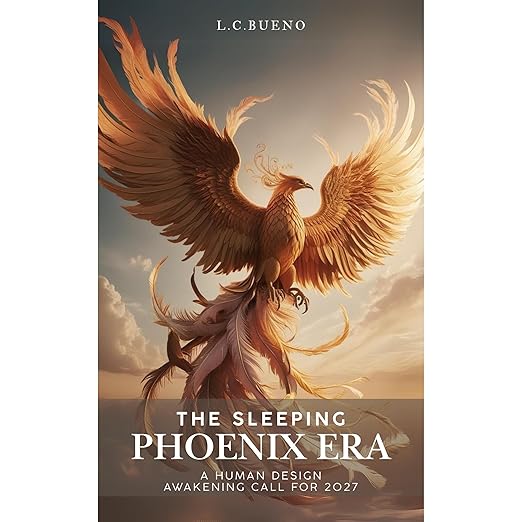
Quick Take
- Narration: Virtual Voice AI narration; functional for the material but lacks the warmth a human narrator would bring to spiritual content.
- Themes: Human Design, cosmic cycles, collective transformation
- Mood: Earnest and visionary, occasionally dense with metaphysical vocabulary
- Verdict: Worth the listen if you already orbit the Human Design world and want a framework for the 2027 shift; skeptics will find little here to challenge their doubts.
I came to this one on a quiet weeknight, the kind where you are looking for something that asks a bigger question than whatever you were doing before you sat down. I had been browsing the Human Design space loosely for a couple of years, mostly out of curiosity rather than conviction, so when L.C. Bueno framed the 2027 transition around the Cross of the Sleeping Phoenix, I was in a receptive enough state to follow him through it. The audiobook runs just under eight hours, and I finished it in two sittings, which tells you something about the pacing, if not about whether I agreed with all of it.
Bueno’s central argument is that February 15, 2027 marks the end of 412 years of what Human Design calls the Planning Era and the beginning of a Phoenix Era defined by authentic individual expression. It is a bold cosmological claim, and the book commits to it fully. Whether you find that thrilling or exhausting will depend heavily on where you stand before you press play.
Our Take on The Sleeping Phoenix Era
What sets this apart from the average new-age audiobook is Bueno’s effort to root the Phoenix Era concept in historical patterns. He traces 2,500 years of what he calls cosmic cycles, arguing that these cycles shaped civilizations with what one reviewer called stunning precision. The historical framing gives the book a scope that feels larger than personal development fare, even if the evidence for those cycles is framed through a spiritual-mechanical lens rather than anything a conventional historian would recognize. Dennis J, one of the early reviewers, noted that the book presents itself as a multi-layered system rather than a straightforward personality guide, and that is accurate. You are not just getting Type, Strategy, and Authority mechanics. You are getting a species-level argument about where human consciousness is headed.
Why Listen to The Sleeping Phoenix Era
The most rewarding sections are the ones dealing with what Bueno calls Rave Children: the new generation of souls he argues will be calibrated specifically for the Phoenix Era and its values. Whether or not you buy the metaphysics, the chapter raises genuinely interesting questions about how we educate children, what conformity has cost us, and what an education system designed around authenticity rather than standardization might look like. Reviewer Noelle A described the book as a beautiful reminder of the transformation we are going through as a collective, and that captures the emotional register well. This is ultimately an optimistic book. It frames the turbulence of the current moment not as collapse but as necessary reorganization, and there is something useful in that framing even if you strip away the cosmic machinery around it. The sections on practical tools for navigating the transition are the most grounded, and one reviewer specifically flagged those chapters as the most immediately useful.
What to Watch For in The Sleeping Phoenix Era
The narration is handled by a Virtual Voice, which is the elephant in the room for this kind of material. Spiritual and philosophical content depends on cadence, warmth, and pacing in a way that most AI narration still cannot replicate. The voice is intelligible and even-paced, but it does not lean into the text the way a skilled human narrator would. This is not a dealbreaker if you are already fluent in Human Design vocabulary, but if you are coming in cold, the combination of dense metaphysical terminology and a flat delivery may require patience. Edwin, a reviewer who came in with some skepticism, noted that the tone felt grounded and not over the top on the page, but audio is a different medium and the Virtual Voice does sand down some of that nuance. A harder issue for listeners who are not already in the Human Design world is that the book assumes a significant amount of prior familiarity. Terms like Cross of the Sleeping Phoenix, G Center, and Deconditioning are used without much scaffolding for newcomers.
Who Should Listen to The Sleeping Phoenix Era
This audiobook is best suited to listeners who already have some grounding in Human Design and want a bigger-picture framework for how that system relates to collective evolution. If you have spent time with Ra Uru Hu’s original material or other Human Design authors and are curious about what the 2027 shift means in practice, this is a focused and earnest treatment. If you are new to Human Design and drawn to the Phoenix Era concept, you might consider pairing this with a more foundational guide first. Committed skeptics of new-age cosmology will find the book’s premises untestable in ways it does not acknowledge, which is a genuine limitation. But for listeners open to the framework, Bueno offers something that several reviewers described as hopeful, practical, and thought-provoking in equal measure.
Frequently Asked Questions
Do I need to know Human Design before listening to The Sleeping Phoenix Era?
Some familiarity helps considerably. Bueno uses terminology like Type, Strategy, Authority, and Cross mechanics without extended definitions, so newcomers may find the first few chapters disorienting. If you are starting fresh with Human Design, a basic primer would make this experience significantly richer.
Is the Virtual Voice narration a significant problem for this audiobook?
It is a limitation worth knowing about. Spiritual content benefits from expressive delivery, and the AI voice is functional but flat. Listeners who are already engaged with the subject matter tend to adapt quickly, but if you are on the fence about the material, the narration will not help convince you.
What does the book say about the Rave Children concept?
Bueno devotes meaningful attention to a generation he believes will be born already calibrated for the Phoenix Era’s values of authenticity and individuality rather than conformity. He frames this as a new spirituality rather than a continuation of existing religious or metaphysical traditions. One reviewer called this section mind-blowing, though it is also the most speculative part of the book.
How practical is The Sleeping Phoenix Era compared to other Human Design audiobooks?
More than you might expect from the cosmic framing. The later chapters include specific tools for what Bueno calls consciously co-creating the new reality, including guidance on using your Type and Authority during the transitional period. Multiple reviewers highlighted this practical grounding as what separated it from purely theoretical new-age content.