Quick Take
- Narration: Lisa Flanagan narrates with measured gravity; she does not dramatize or sentimentalize, which is exactly the right choice for material this serious.
- Themes: Wartime female resistance, solidarity under extreme conditions, postwar justice and memory
- Mood: Devastating and ultimately defiant, with moments of startling dark humor
- Verdict: Lynne Olson has written a book about Ravensbrück that goes beyond the horror to document the organized resistance, postwar activism, and collective survival of a group of women history repeatedly tried to forget.
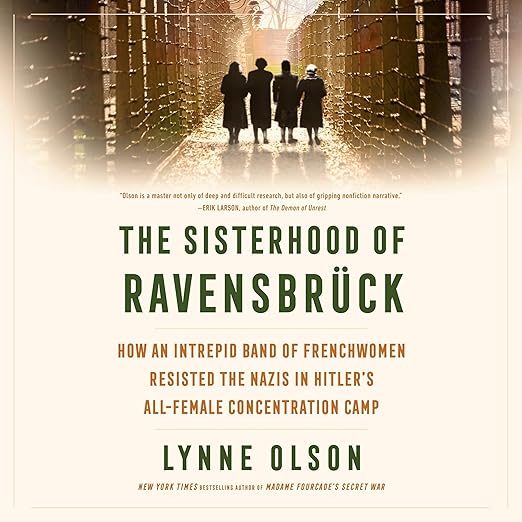
I came to The Sisterhood of Ravensbrück already knowing Lynne Olson’s work from Madame Fourcade’s Secret War, which is among the best World War II nonfiction I have encountered in the last decade. That prior familiarity meant I came with high expectations. Olson met them without straining.
The book focuses on a specific group within the population of Ravensbrück, the notorious all-women’s concentration camp that most contemporary readers know primarily through Martha Hall Kelly’s Lilac Girls. Olson’s subject is a cohort of French Resistance women who arrived already trained in subversion, already practiced in defying the German occupation, and who redirected those skills toward surviving and undermining their captors inside the camp itself. The distinction between general concentration camp history and the organized, purposeful resistance these women mounted is the book’s organizing principle.
Our Take on The Sisterhood of Ravensbrück
Olson’s research is meticulous. The book does not simply document what the Nazis did to these women, which is itself an important and harrowing record. It documents what the women did in response, including refusing assigned forced labor despite the risk of death, organizing a satirical musical revue mocking the SS, maintaining networks of information and support, and in the postwar period, refusing to be silenced about what they had endured when much of France preferred to move forward without looking back.
That postwar section is where the book distinguishes itself most sharply from comparable titles. The sisterhood’s continuation after liberation is not a brief epilogue. It is a substantive part of the story. These women fought for recognition, compensation, and justice for decades after the war ended. Their efforts had repercussions for French law and for international understanding of war crimes. Olson gives this material the weight it deserves, and in doing so she makes an argument implicit but present throughout: the story of what happened at Ravensbrück is not only a story of Nazi atrocity. It is a story of organized female power, before, during, and after the horror.
Why Listen to The Sisterhood of Ravensbrück
Lisa Flanagan’s narration is a crucial part of why this audiobook works. She reads with steadiness and respect. The material is relentlessly difficult, and Flanagan does not use vocal expressiveness to guide listeners toward their responses. She trusts the facts to do that work. The result is narration that feels like testimony, which is entirely appropriate. At just under eleven hours, the book demands sustained attention, and Flanagan makes that attention easy to sustain.
One reviewer who had previously visited the Ravensbrück site in person, shortly after the Berlin Wall fell, described finding the book’s account meticulous and emotionally honest about the atrocities. That kind of informed, on-the-ground perspective is worth noting. Olson’s research stands up to scrutiny from people who have personal or professional knowledge of the site and its history.
What to Watch For in The Sisterhood of Ravensbrück
The book enters through individual profiles of specific women, building up the sisterhood through biography before documenting what they collectively endured and accomplished. This approach requires patience in the early chapters. You are meeting a significant number of people before the narrative action of the camp experience begins. The biographical investment pays off once the women are inside Ravensbrück, because you understand what each of them is risking and what each of them is losing. But listeners who find slow starts difficult should know that the book earns its opening pace.
The medical experiment sections, which Ravensbrück was particularly notorious for, are covered with appropriate gravity and detail. These are among the most disturbing passages in the book. Olson does not sensationalize, but she does not soften either. Listeners who find detailed descriptions of medical atrocities difficult should pace themselves accordingly.
Who Should Listen to The Sisterhood of Ravensbrück
This is the right book for readers who engage seriously with World War II history and want more than a record of suffering. The active resistance, the postwar organizing, and the long fight for recognition give the story a different shape from most Holocaust and concentration camp narratives. The women at the center of it are agents throughout, even when their circumstances were most constrained.
Readers who loved Madame Fourcade’s Secret War or Lilac Girls will find this satisfying for different reasons. Olson’s work is more rigorously historical than Kelly’s fiction, and the documented reality of what these women accomplished is, in several moments, more extraordinary than anything fiction would dare invent.
Frequently Asked Questions
Does The Sisterhood of Ravensbrück require prior knowledge of Ravensbrück or WWII history to follow?
No. Olson provides sufficient historical context for readers unfamiliar with Ravensbrück or the broader history of the French Resistance. The book works both as an introduction to the subject and as a deeper dive for readers already familiar with the period.
How does this book relate to Martha Hall Kelly’s novel Lilac Girls, which is also set at Ravensbrück?
Olson’s book is nonfiction and predates Kelly’s novel in the historical record though Kelly’s novel preceded this specific book. Olson draws from primary documents, survivor testimony, and archival research, while Kelly’s work is fiction inspired by actual events. Fans of Lilac Girls looking for the documented history behind the story will find this book a direct complement.
Does Lisa Flanagan’s narration suit the severity of the subject matter?
Yes. Flanagan reads with measured gravity and resists the temptation to dramatize the most difficult material. Her steady delivery creates a witnessing quality that multiple listeners found more appropriate to the subject than an emotionally expressive performance would have been.
Does the book cover the women’s lives before and after the camp, or only the Ravensbrück experience itself?
Olson structures the book in three phases: the women’s lives and Resistance activities before capture, their experiences inside Ravensbrück including the organized resistance, and their postwar activism for recognition and justice. The postwar section is a substantial part of the book and one of its most distinctive contributions.