Quick Take
- Narration: Kate Winkler Dawson reads her own work with the authority of a journalist and podcaster who has inhabited this material for years, the delivery is confident and the pacing suits the investigative structure.
- Themes: Historical injustice and gender, the origins of American true crime, reinvestigation across centuries
- Mood: Methodical and morally urgent, with the procedural energy of a cold-case investigation
- Verdict: A serious piece of historical true crime that uses modern forensic tools to revisit a 19th-century murder that shaped American literary history, Dawson narrating her own work is the right choice.
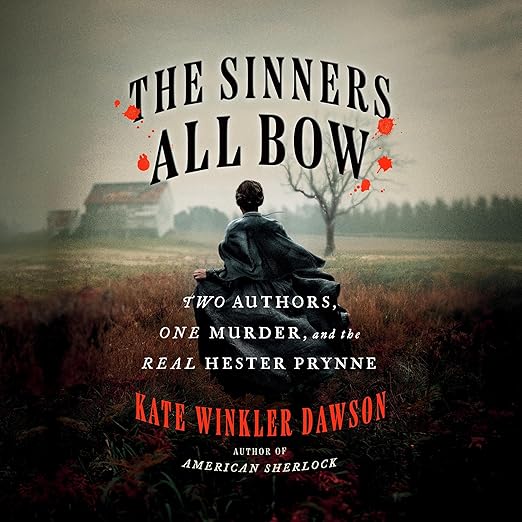
I came across The Sinners All Bow by a route that will be familiar to anyone who has disappeared into Kate Winkler Dawson’s podcast world: one episode of Tenfold More Wicked led to another, and then I was looking at a book that promised to connect an 1832 murder in rural New England to both Nathaniel Hawthorne and the origins of American true crime writing. That is a lot of promise. The book largely keeps it.
The case itself is extraordinary as historical material. On a cold morning in December 1832, Sarah Maria Cornell was found hanging in a farmyard in Fall River, Massachusetts. The investigation that followed uncovered her correspondence with Reverend Ephraim Avery, a charismatic Methodist minister who became the primary suspect. What should have been a straightforward murder trial became a public spectacle that divided the country, with Avery’s acquittal leaving questions that a Victorian writer named Catharine Read Arnold Williams tried to answer by publishing what many consider the first true-crime book in America. Dawson’s project is to finish what Williams started, using forensic tools unavailable in the 1830s to examine the evidence that contemporary investigators had to work with.
Our Take on The Sinners All Bow
Dawson narrates her own book, and it is the right call. She has been living inside this case for years through her podcast work, and that intimacy comes through in the delivery. She knows exactly where the tension points are and how to pace toward them. The confidence of her narration suits the investigative structure, where she is simultaneously reconstructing the 19th-century investigation and conducting her own modern analysis.
The framework that gives the book its title and its moral center involves three women: Sarah Cornell, the victim; Catharine Williams, the first writer to pursue justice; and Dawson herself, completing the work two centuries later. That generational through-line works well as an organizing principle. Reviewer Burns notes the book is both a whodunnit and a story-behind-the-story, and that framing captures why it holds interest beyond the purely criminal. The Scarlet Letter connection is not incidental; Dawson makes a credible case that Hawthorne drew on the trial’s dynamics of public shame and female vulnerability, which adds a layer of literary history to what is already a genuinely gripping cold case.
Why Listen to The Sinners All Bow
The forensic knot analysis and criminal profiling elements are what distinguish this from a simple historical true crime retelling. Dawson is explicit that criminal profiling as a discipline did not exist until fifty-five years after Cornell’s death, and she applies it to the 1832 evidence with care and appropriate qualification. This is not forensic science as television shorthand; it is a genuine attempt to understand what the physical evidence could and could not tell investigators at the time, and what it can tell us now.
For listeners who care about women’s history specifically, the book does something valuable: it refuses to reduce Sarah Cornell to her victimhood or her complicated reputation. Reviewer Cindi Rose, who had been a Dawson podcast listener before coming to the book, notes the visceral frustration of watching a guilty man walk free, and that frustration is part of what Dawson is documenting. The trial’s outcome says something specific about how 19th-century America weighted the word of a minister against the life of a woman with a troubled past, and Dawson does not shy away from that context.
What to Watch For in The Sinners All Bow
Reviewer Tequilahal raises a fair concern: the book is thorough and exhaustive but occasionally lacks a quality that compels the reader urgently forward. This is the tension in any historical true crime project that takes its methodology seriously. Dawson is not interested in manufacturing suspense through withheld information or narrative tricks; she is interested in honest investigation. That rigor is admirable and occasionally comes at the cost of propulsive momentum. Listeners who want a thriller-paced experience will find this more measured than they might expect.
The ending also leaves some listeners wanting more resolution than the evidence permits. That is not a failure of the book; it is a feature of honest true crime work. Dawson arrives at conclusions, but she cannot offer certainty where certainty is not available. Anyone hoping for a tidy close will need to make peace with the limits of 19th-century evidence, even when viewed through 21st-century forensic tools.
Who Should Listen to The Sinners All Bow
Listeners who already follow Dawson’s podcasting work will find this a natural extension of everything that makes Tenfold More Wicked compelling: rigorous research, a genuine moral commitment to victims, and a confident investigative voice. Fans of historical true crime, women’s history, and early American literary history will find overlapping reasons to engage. Anyone who has read The Scarlet Letter and wondered about its biographical and social origins will find the Hawthorne thread genuinely illuminating.
Readers looking for fast-paced crime narrative may want to pair this with more propulsive titles. The Sinners All Bow rewards patience and rewards most when the listener cares about the why of the investigation, not just the who.
Frequently Asked Questions
Do I need to be familiar with Kate Winkler Dawson’s podcasts Tenfold More Wicked or Buried Bones before reading this book?
No. The book stands entirely on its own. Podcast familiarity adds an extra dimension of appreciation for her investigative approach, but everything you need to understand the case and Dawson’s methodology is in the book.
How does this book connect to Nathaniel Hawthorne’s The Scarlet Letter specifically?
Dawson argues that the Fall River murder trial of 1832, with its dynamics of public shaming, ministerial hypocrisy, and the vulnerability of a woman with a complicated past, directly informed Hawthorne’s fictional exploration of those themes. She builds the case with period documentation rather than speculation.
Does the modern forensic analysis, including the knot analysis and criminal profiling, arrive at a definitive conclusion about what happened to Sarah Cornell?
Dawson arrives at a clear conclusion about who she believes was responsible, but she is honest about the evidentiary limits. The analysis is presented as the strongest possible reading of the available evidence, not as courtroom-standard proof.
Is this suitable for listeners who do not usually gravitate toward true crime?
It may appeal more broadly than standard true crime because of its strong literary history and women’s history dimensions. If you are interested in how 19th-century American society treated women and how that found expression in both journalism and literature, this delivers on both fronts.