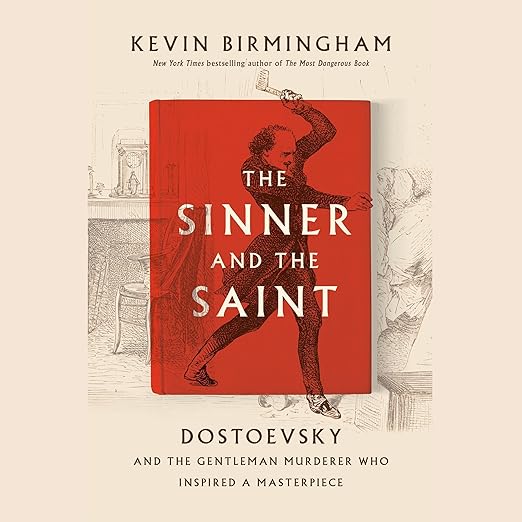
Quick Take
- Narration: Robert Petkoff brings both historical sweep and intimate literary analysis to Birmingham’s dual biography, sustaining authority across fifteen-plus hours without losing the narrative thread.
- Themes: The genesis of literary greatness, suffering as creative fuel, the intersection of biography and fictional imagination
- Mood: Dense, immersive, and quietly thrilling for lovers of literary history
- Verdict: An essential listen for anyone who loves Crime and Punishment or wants to understand how a great novel gets made under impossible personal conditions.
I had just finished a reread of Crime and Punishment when I picked this one up, which turned out to be nearly ideal preparation. Kevin Birmingham’s The Sinner and the Saint is not a biography of Dostoevsky in the conventional sense, though it covers his life with considerable depth. It is more precisely an archaeology of a single novel: how a Siberian prison, a glamorous French murderer, a devastating gambling addiction, a predatory publishing contract, and a young stenographer named Anna Grigorievna all converged into one of the most structurally audacious narratives in world literature. Birmingham treats the novel’s creation as a historical event with real causes and traceable consequences.
Birmingham did this once before with The Most Dangerous Book, his account of the creation and legal persecution of James Joyce’s Ulysses. That book was exceptional, and The Sinner and the Saint operates with the same methodology and the same quality of attention: treat the creation of a masterpiece as something that happened in the world and could have gone differently, and then reconstruct those circumstances with the rigor of a historian and the sensitivity of a critic who genuinely loves the work being examined.
Our Take on The Sinner and the Saint
The central structural conceit of this audiobook is the parallel between Dostoevsky and Pierre François Lacenaire, the glamorous Parisian murderer whose 1836 trial captivated French society and planted a seed that would take decades to germinate. Birmingham traces how Lacenaire’s nihilism, his charisma, his contempt for society, and his articulate self-justification became the raw material for a character both more psychologically complex and more morally anguished than his real-world counterpart. Raskolnikov is what happens when you take Lacenaire’s pose seriously enough to follow it all the way to its logical conclusion and then ask what it costs.
The story of Anna Grigorievna is equally compelling. Hired as a stenographer to help Dostoevsky meet a predatory contract deadline, she became his first reader, most trusted critic, and eventually his wife. Birmingham’s account of how she shaped not just the circumstances of the novel’s completion but Dostoevsky’s entire subsequent career is one of the audiobook’s quiet revelations.
Why Listen to The Sinner and the Saint
Robert Petkoff is excellent here. Birmingham’s prose is dense with historical detail and literary analysis, and Petkoff navigates the transitions between biography, social history, and close reading with steady authority that never feels labored. The fifteen-and-three-quarter-hour runtime is appropriate for the scope of the project. This is not a book that can be condensed without losing the texture that makes it genuinely valuable rather than merely interesting.
Robert Petkoff is excellent here. Birmingham’s prose is dense with historical detail and literary analysis, and Petkoff navigates the transitions between biography, social history, and close reading with steady authority that never feels labored. The fifteen-and-three-quarter-hour runtime is appropriate for the scope of the project. This is not a book that can be condensed without losing the texture that makes it genuinely valuable rather than merely interesting. Petkoff brings a quality of measured attention to the material that suits Birmingham’s own approach: careful, thorough, and deeply respectful of the subject without being reverential to the point of losing critical distance.
What to Watch For in The Sinner and the Saint
Reviewers consistently recommend this audiobook to listeners who have already read Crime and Punishment, and that guidance is worth taking seriously. Birmingham’s insights are most resonant when you already know the novel intimately enough to hear Raskolnikov’s voice in your head. The analysis of how the character’s psychology maps onto Dostoevsky’s own crisis of self-consciousness lands differently, and more powerfully, when you bring that knowledge with you. Listeners coming to this audiobook without having read the novel first will understand it, but will miss the deepest layer of what Birmingham is doing.
Who Should Listen to The Sinner and the Saint
This audiobook is for readers with a genuine interest in literary history and in the relationship between biography and the fictional imagination. It works beautifully alongside or immediately after Crime and Punishment and pairs well with Birmingham’s earlier book on Ulysses for listeners interested in how great novels are actually forged under impossible conditions. Skip it if you want a straightforward biography without literary analysis, or if nineteenth-century Russian intellectual history does not interest you on its own terms.
Frequently Asked Questions
Do I need to have read Crime and Punishment before listening to this audiobook?
Reviewers strongly recommend it. Birmingham includes enough summary that uninitiated listeners can follow the narrative, but the analysis lands most powerfully when you already know the text intimately. Reading the novel first deepens the experience significantly.
How does The Sinner and the Saint compare to Kevin Birmingham’s earlier book on Joyce’s Ulysses?
Birmingham uses the same methodology in both books: treat the creation of a literary masterpiece as a historical event with traceable causes. Reviewers who loved The Most Dangerous Book consistently find The Sinner and the Saint equally accomplished and comparably rewarding.
Who is Pierre François Lacenaire, and why does he matter to this story?
Lacenaire was a French murderer executed in 1836 who became a celebrity for his articulate self-justification and theatrical charisma. Birmingham argues that Lacenaire was the original model for Raskolnikov, and tracing how Dostoevsky transformed him is one of the audiobook’s central intellectual pleasures.
Is the audiobook accessible to listeners without a literary studies background?
Yes. Birmingham writes for a general educated audience rather than academic specialists. The historical and biographical sections are accessible throughout, and the literary analysis is explained rather than assumed. Reviewers across a wide range of backgrounds have found it readable and genuinely rewarding.