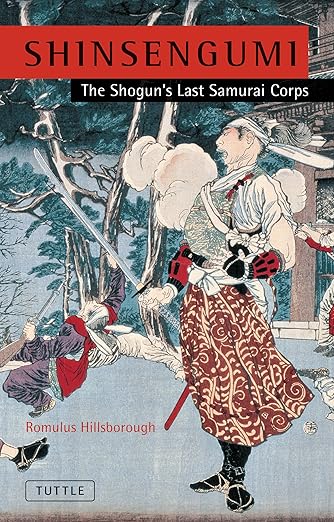
Quick Take
- Narration: Eric Michael Summerer handles the material with a brisk energy that suits the subject. This is a story of swordsmen and political assassins, and Summerer keeps it from turning into a dry recitation of factions and dates.
- Themes: Loyalty and its costs under political transformation, the collision of feudal values with modernizing power, the mythology and reality of samurai identity
- Mood: Vivid and historically absorbing, with the propulsive quality of a story that knows it is heading toward tragedy
- Verdict: The only book-length English treatment of the Shinsengumi, and a compelling one. Hillsborough earned this subject.
I came to The Shogun’s Last Samurai Corps through an unexpected route: I had been watching a Japanese historical drama with my partner and found myself frustrated by how little context I had for the Bakumatsu period – the violent decade-and-a-half leading up to the Meiji Restoration of 1868. Most English-language histories of Japan jump from Perry’s arrival in 1854 to the modernization of the Meiji era with relatively little attention to the chaos and bloodshed in between. Romulus Hillsborough fills that gap with a specificity I had not expected to find in a single-volume treatment.
The Shinsengumi were a corps of expert swordsmen assembled in 1863 to restore order in Kyoto, where pro-imperial ronin had turned the streets of the emperor’s capital into what Hillsborough calls a sea of blood. The two men at the center of the story – Kondo Isami, a charismatic commoner who rose to lead the corps through force of personality and extraordinary swordsmanship, and Hijikata Toshizo, his friend and enforcer whose severity made him one of the most feared men in Japan – are among the great figures of the period. This is the only sustained English-language account of their lives and work, which makes it an important book independent of how well it is written. The answer to that question is: quite well.
The Ferocity That Made Them Necessary
Hillsborough opens with a full account of the political situation in Kyoto before the Shinsengumi’s formation, and it is necessary context. The ronin who terrorized the city in 1862 and 1863 were not merely criminal elements; they were politically motivated samurai who believed the shogun’s opening of the country to Western powers was a betrayal of Japan’s sacred sovereignty. Their violence was ideological, their methods were brutal, and the shogunate’s existing police forces were entirely unable to contain them. The Shinsengumi were formed from a different class of swordsmen – many of them commoners rather than hereditary samurai – and they responded to political violence with what Hillsborough does not flinch from describing as licensed terror.
This context matters because it keeps the Shinsengumi from being either romanticized or simply condemned. They were instruments of a government defending its survival, and they operated with a ruthlessness that their situation arguably required. Hillsborough draws on Japanese-language primary sources – letters, memoirs, journals, eyewitness accounts – to give this period texture rather than relying solely on later historical synthesis.
Kondo and Hijikata: Two Kinds of Loyalty
The biographical core of the book is the friendship and partnership between Kondo and Hijikata. Kondo was the inspirational leader: physically imposing, politically shrewd, genuinely loved by his men. Hijikata was the enforcer, the author of the Shinsengumi’s iron code of conduct, a man whose severity made the corps function but who carries in Hillsborough’s account a melancholy that complicates the martial image. The book follows both men through the collapse of the Bakufu in 1867-68 and into the subsequent resistance – a final, doomed campaign that ended with Kondo’s execution and Hijikata’s death in the last battle of the civil war.
Hillsborough’s writing is occasionally described in reviews as heavy-handed, and there is some justice to that. He is clearly in love with his subject, and that love sometimes produces passages that feel more like historical romance than historical analysis. But the archival grounding saves him from the worst tendencies of the genre, and the primary source material gives the book a reality that purely narrative accounts of the period cannot match.
Summerer and the Pacing Problem
At just under seven and a half hours, this is an efficient listen for the scope of material covered. Summerer moves through the factional politics and the operational details of specific engagements with a clarity that keeps the narrative from bogging down. He is particularly good at conveying the intensity of the period without overplaying it – a temptation this material must constantly present to any narrator who engages with it seriously.
Who Should Listen, Who Should Skip
For anyone interested in the Meiji Restoration, the culture of the samurai in its final operating generation, or Japanese history between Perry and modernization, this is the primary English-language resource and a genuinely good one. Skip it if you need a broader introduction to the period. Hillsborough assumes some familiarity with the basic political geography of Bakumatsu Japan. For listeners coming to the subject cold, spending an hour with a general overview of the period before starting this book will pay dividends.
Frequently Asked Questions
Is Hillsborough’s account of the Shinsengumi the same material covered in anime and manga adaptations like Hakuoki?
The same historical figures appear in Hakuoki and other popular adaptations, but Hillsborough’s book is historical nonfiction based on primary sources, not a fictional treatment. The historical Shinsengumi shares names and some broad outlines with the fictional versions, but the characters in adaptations are substantially romanticized. This book is the history.
Does the book cover the entire history of the Shinsengumi, through their final battle?
The book follows the Shinsengumi through the collapse of the shogunate and into the resistance that followed, including the final campaigns of both Kondo and Hijikata. It does not end with their peak power but with their defeat and deaths, which gives the account a genuine tragic arc.
How does Hillsborough handle the violence the Shinsengumi were known for?
Hillsborough does not minimize the corps’ violence, including the internal enforcement of their own code of conduct through forced suicide and execution of members who violated it. He treats this as historically significant and contextualizes it within the political violence of the period rather than either celebrating it or retrospectively condemning it.
Hillsborough drew primarily on Japanese-language sources – has later scholarship revised any of his main arguments?
The book’s core narrative has held up reasonably well to later scholarship. Some biographical details have been refined, and the political analysis has been enriched by subsequent work on the Bakufu’s institutional collapse, but Hillsborough’s account remains the standard English-language treatment of the Shinsengumi.