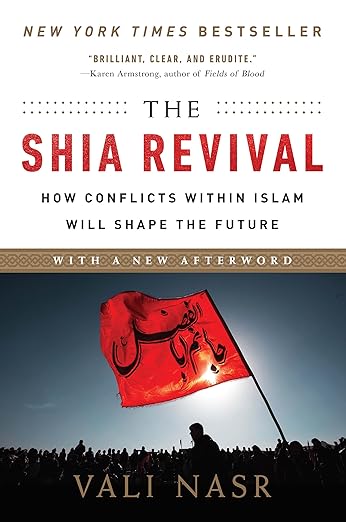
Quick Take
- Narration: Seth Andrews delivers Nasr’s dense scholarship with steady authority, keeping the analytical prose accessible without flattening its complexity.
- Themes: Shia-Sunni theological conflict, geopolitical power shifts in the Middle East, Islamic identity and modernity
- Mood: Scholarly and urgent, dense with historical weight
- Verdict: Essential listening for anyone trying to make sense of Middle East conflicts beyond the headlines.
I came to this one during a particularly heavy news cycle, the kind where every broadcaster was using the words Shia and Sunni interchangeably with Iran and Saudi Arabia as if the 1,400-year history between those terms could be compressed into a three-minute segment. I had owned the print edition of Vali Nasr’s The Shia Revival for years but never finished it. The audiobook, narrated by Seth Andrews, finally got me through it, and I finished the last chapter on a grey Tuesday morning, feeling like I finally had a map for something I had always treated as fog.
Nasr, an Iranian-born scholar who served as a senior adviser to the US State Department, writes from a position of unusual authority. He is neither a dispassionate outsider nor an advocate. He is something rarer: a deeply educated insider capable of explaining the stakes to people who were not raised inside them. This updated edition, which includes a new epilogue addressing the rise of ISIS and the ongoing Iran-Saudi rivalry, confirms that the original 2006 analysis was prescient in ways that should embarrass quite a few Western pundits.
Our Take on The Shia Revival
What Nasr accomplishes here is genuinely difficult. He traces a theological and political schism that began in 632 CE at the death of the Prophet Muhammad, a dispute over succession that crystallized into two distinct traditions, and then maps how that ancient wound operates in contemporary geopolitics. The book’s central argument is that the Shia revival is not a recent phenomenon manufactured by the Iranian Revolution of 1979, but a long-building reassertion of a community that had been politically marginalized for centuries across most of the Arab world. One reviewer called it the best book on Shia-Sunni rivalries they had read, and having now consumed a fair amount of this literature, I would struggle to argue otherwise.
The chapters covering Iraq after 2003 are particularly striking. Nasr anticipated how the removal of Saddam Hussein would restructure the regional balance of power in ways the Bush administration clearly had not. His analysis of Iranian strategy, Lebanese Hezbollah, and the Gulf monarchies feels less like history and more like a skeleton key that unlocks the logic behind events that otherwise appear random or fanatical.
Why Listen to The Shia Revival
Seth Andrews reads this material cleanly and without the performative gravity that sometimes plagues nonfiction narration. His pace is measured, which suits Nasr’s writing style well. The prose is analytical rather than poetic, and Andrews respects that by not over-emoting. One reviewer noted the book is dense and fact-packed but readable, and the audiobook preserves that quality. You will want to listen with some attention; this is not background listening. But the 8 hours and 47 minutes feel well-organized, with each chapter functioning as a distinct unit that can be revisited.
Where some readers have pushed back is on perceived political slant. One reviewer complained of getting an earful of slanted political views rather than pure education. I think that criticism misunderstands the book’s project. Nasr is making an argument about geopolitical structure and historical pattern, not cheerleading for any faction. He is critical of multiple parties, including US foreign policy, Saudi Wahhabism, and Iranian theocracy. Readers who want a purely neutral survey of events may find the analytical frame uncomfortable, but that frame is precisely what gives the book its intellectual value.
What to Watch For in The Shia Revival
Pay particular attention to the section on the Kadyrovtsy, which was added in the updated edition and connects the Chechen conflict to the broader pattern of sectarian militia deployment. It is easy to miss in a single listen, but it reframes several later chapters about the geography of Shia political mobilization. The epilogue on ISIS is brief but sharper than most standalone analyses of that organization, precisely because Nasr situates ISIS within the longer Sunni crisis of legitimacy rather than treating it as an aberration.
Nasr’s comparison of Shia-Sunni tensions to Western religious wars, specifically to the Catholic-Protestant conflicts of early modern Europe, is one of the most clarifying analogies in contemporary religious studies. A reviewer in their reading group used the book as discussion material and found it generated exactly the kind of nuanced conversation that simplistic media coverage forecloses. That seems exactly right.
Who Should Listen to The Shia Revival
This is essential listening for anyone who reads foreign policy news and wants to stop being confused by it. Students of international relations, journalists covering the Middle East, and general readers who felt lost during any of the major regional conflicts of the past two decades will find this transformative. Readers who want casual, non-demanding listening should look elsewhere. But anyone who has wondered why Iran and Saudi Arabia seem to be in permanent conflict, why Iraq fragmented the way it did, or what sectarian identity actually means in political practice will find Nasr’s framework indispensable.
Frequently Asked Questions
Do I need to read the original 2006 edition, or is this updated version sufficient?
The updated audiobook edition is self-contained. It includes a revised introduction and a new epilogue covering ISIS and post-2014 developments, so it supersedes the original for most readers.
Is Seth Andrews a good fit for this kind of dense scholarly material?
Yes. Andrews reads with measured authority and does not editorialize. He keeps the analytical prose clear without the overdramatic delivery that can make nonfiction audiobooks feel like documentary narration.
Is prior knowledge of Islam required to follow this book?
Nasr writes for a general educated audience and explains theological and historical background as he goes. No prior specialist knowledge is required, though basic familiarity with modern Middle East geography will help.
How does the book handle the Iran nuclear issue and US foreign policy?
Nasr is critical of US policy without being polemical. He argues that American decision-makers repeatedly misread sectarian dynamics, and his analysis functions more as structural diagnosis than political advocacy.