- Performance: John Morgan takes on sixty-two years of correspondence at a measured, unhurried pace, though none of the attached reviews single out his specific delivery to confirm the finer details.
- What it covers: primary-source biography, the Little House books' real-life origins, mother-daughter literary collaboration
- Feel: intimate, occasionally scholarly, warm rather than nostalgic
- Our call: A rich primary-source deep dive for devoted Wilder readers, not the place to start for someone new to the Little House books.
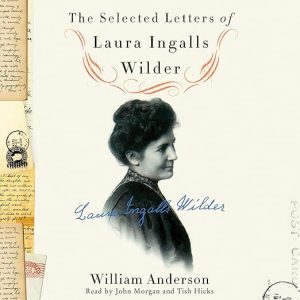
Letters spanning sixty-two years of Laura Ingalls Wilder's adult life, from 1894 to 1956, are collected here for the first time in one place, and this audiobook opens not with the familiar Little House prairie but with Wilder the working businesswoman, already corresponding with editors and readers. William Anderson, a longtime Wilder biographer, gathered these letters from museums, archives, and personal collections across twelve hours and forty-seven minutes, tracing her from the final days of covered-wagon travel through farm life, journalism, and eventual fame.
A Glimpse Like No Other Book Out There
The scope here is genuinely rare: correspondence with her legendary editor Ursula Nordstrom, exchanges with fans, and letters to her daughter Rose Wilder Lane sit alongside Wilder's own political opinions and reminiscences of frontier childhood, giving listeners a portrait built from her actual words rather than a biographer's paraphrase of them. Reviewer Kris Phillips captures this directly, calling it 'a glimpse into Laura Ingalls Wilder's real life like no other book out there.'
An Adult Life That Kept Moving Too
William Anderson's credentials as an established Wilder biographer shape the whole project's organizing intelligence, since assembling sixty-two years of scattered correspondence into a coherent listening experience requires real editorial judgment about sequence and context. Narrator John Morgan takes on that six-decade span at a measured, unhurried pace suited to correspondence rather than narrative fiction, though none of the attached reviews single out his specific delivery choices to confirm the finer details.
The letters trace a working life most casual Wilder fans know only in outline: her years as a country journalist writing for regional publications well before the Little House books existed, the Depression-era pivot into fiction, and eventually the fame that followed, each phase documented here in her own contemporaneous words rather than reconstructed after the fact by a biographer working backward from her later success.
The synopsis promises insight into Wilder's travels and philosophies alongside her more commonly documented family life, and that travel dimension is genuinely underexplored territory even among devoted fans; a woman famous for chronicling covered-wagon childhood journeys had an adult life that kept moving too, and letters written en route or reflecting on specific trips add a dimension the fixed, settled Little House farmhouse image does not fully capture.
Rose Wilder Lane's Role as a Silent Editor
Reviewer Matthew Dobeck puts his finger on the collection's sharpest value: these letters let listeners 'get to know the real Laura Ingalls Wilder in a time when things were quite different from the stories she wrote about her childhood.' That gap between the fictionalized Little House books and the documented adult life behind them is exactly what makes primary-source material like this worth the twelve-hour commitment for anyone who already loves the novels.
The letters to Rose Wilder Lane raise one of the more substantive threads in Wilder scholarship directly: Lane's role as an editor and collaborator during the Little House books' composition, described here as a silent one, is a detail that reshapes how listeners might think about where Wilder's famous voice on the page actually came from. Engaging with that complexity honestly, rather than skating past it, is one of the collection's real strengths.
A Sequel to Her Beloved Books, Per Anderson
Anderson notes many of these letters are available in one place for the first time, drawn from scattered private and institutional sources rather than a single existing archive, which gives the collection real weight beyond just novelty; listeners are hearing correspondence that, in many cases, has simply never been broadly accessible before this release.
Wilder's identity as a wife and as a friend gets equal billing here alongside businesswoman and author, and that balance matters: letters to friends and her husband Almanzo round out a picture that pure literary biography, focused on her writing career, tends to flatten into a single professional narrative.
Wilder's political opinions, shared directly in her own letters rather than inferred by a biographer from her fiction, add a dimension many readers of the gentle, values-driven Little House books do not expect; hearing her actual stated views in her own words, whatever they turn out to be, is a different and more complicated experience than encountering her only through carefully crafted children's fiction.
Anderson frames the collection, in the synopsis's own words, as 'a sequel to her beloved books, and a snapshot into twentieth-century living', a description that captures exactly why longtime fans respond to it so strongly.
Morgan Paces Through Recurring Salutations and Sign-Offs
Reviewer noir fan, careful to note she does not consider herself a Wilder scholar, still pushes back against what she calls the misunderstandings and misinformation circulating about Wilder online. That framing suggests this collection functions partly as corrective, scholarly material aimed at getting the record straight, which means listeners wanting only warm, nostalgic prairie content should expect some genuinely argumentative or myth-correcting stretches as well.
At twelve hours and forty-seven minutes covering sixty-two years with no single narrative throughline, this reads closer to a reference collection than a driven story, and letters as a form demand real patience from a listener used to the propulsion of the Little House novels themselves. No plot pulls listeners forward here, only the accumulated texture of one woman's actual correspondence.
Her reminiscences of frontier childhood, written decades later as an adult looking back, sit in interesting tension with the childhood she actually published in the Little House books; listeners hoping the letters simply confirm the novels' version of events should be prepared for a more complicated, occasionally contradictory relationship between the lived memory and the published story.
Letters as an audio format also present a small but real structural repetition: dozens of salutations and closings accumulate across twelve hours and forty-seven minutes in a way a printed collection lets a reader's eye simply skip past, so narrator John Morgan's pacing through those recurring formal openings and sign-offs matters more here than it would in a single continuous narrative.
Start With the Little House Novels First
Devoted Little House readers and anyone following Wilder scholarship closely, wanting primary-source material rather than another biography filtered through someone else's narrative voice, have the strongest reason to press play here. Listeners specifically curious about the Rose Wilder Lane collaboration question will find real, direct engagement with that history here.
Listeners who already enjoy collected-letters and correspondence as their own nonfiction genre, not just Wilder specifically, will appreciate the format here, since the appeal of reading, or hearing, someone's actual unfiltered voice across decades is a distinct pleasure from biography regardless of the subject.
Casual fans hoping for prairie nostalgia alone, or anyone completely new to Laura Ingalls Wilder looking for a first introduction, should start with the Little House novels themselves rather than here; this collection assumes real background knowledge and rewards listeners who already love her fictionalized work enough to want the documented reality behind it.
Does this audiobook reveal how much Rose Wilder Lane helped write the Little House books?
Yes, the collection addresses Lane's role as an editor and collaborator during the books' composition, a detail longtime Wilder readers often find surprising.
Is this audiobook a good starting point for someone who has never read the Little House books?
No, it works best for listeners already familiar with the novels, since the letters assume background knowledge of Wilder's fictionalized childhood.
How is this audiobook different from a standard Laura Ingalls Wilder biography?
It presents her own letters directly rather than a biographer's narrative summary, so listeners hear her actual voice rather than someone else's interpretation of it.