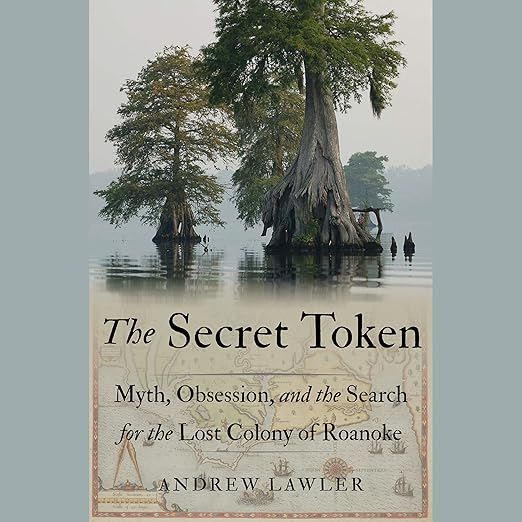
Quick Take
- Narration: David H. Lawrence XVII brings a journalist’s pace to this journalistic history, clean and consistently engaging across fourteen-plus hours without ever feeling rushed.
- Themes: The uses and misuses of historical mystery, American identity through origin myths, the archaeology of national narrative
- Mood: Scholarly but propulsive, with the feel of a long investigative feature that earns its length
- Verdict: The definitive lay reader’s guide to the Lost Colony of Roanoke, and more interestingly, a serious examination of why America keeps needing the story to mean something specific.
There’s a particular pleasure in listening to a book about an unsolved historical mystery when you already suspect the mystery will remain unsolved at the end. The enjoyment has to come from the quality of the search rather than the resolution, which means the book has to be good enough to sustain fourteen hours without the promise of a payoff. Andrew Lawler’s The Secret Token manages this more successfully than almost any other book in the lost-history genre I’ve encountered in years of reading in this space.
I was about two hours in, somewhere between the chapter on Hatteras Island descendants and the section on competing archaeological teams, when I realized I had stopped being interested in what happened to the 115 colonists and started being fascinated by the cast of contemporary characters who have devoted significant portions of their lives to finding out. That shift in interest is exactly what Lawler seems to intend, and it’s the book’s most interesting structural move.
The Colonists and Four Centuries of Obsession
The setup is familiar to most: Queen Elizabeth I’s charter, John White’s colony on Roanoke Island, the resupply mission delayed by the Spanish Armada, and White’s return in 1590 to find only the word CROATOAN carved into a tree and the settlers gone. What Lawler adds to this well-traveled ground is a systematic accounting of every serious theory advanced in four hundred years of searching, assessed against the current state of archaeological and documentary evidence. He accompanies competing researchers in the field: credentialed archaeologists with institutional backing and rival funding, amateur sleuths with metal detectors and theories, and Hatteras Island families who believe they carry the colonists’ blood in their DNA.
The dynamics among these competing groups tell their own story about who gets to make historical claims and what kinds of evidence are accorded authority. Lawler handles these contemporary politics of knowledge with the skill of a journalist who has learned that the people pursuing the mystery are as interesting as the mystery itself. He neither romanticizes the amateurs nor dismisses them; he neither defers to the professionals nor accepts their conclusions uncritically. The result is a portrait of how historical knowledge is actually made, which is messier and more politically entangled than popular accounts of archaeology usually admit.
The Political Weight the Mystery Carries
The most intellectually substantive sections of The Secret Token deal with how the Lost Colony story has been weaponized across American history. Lawler traces how the Roanoke narrative has functioned as a vehicle for white nationalist mythology, as a symbol of English primacy in the New World, and as a projection screen for whatever anxieties about race, identity, and national belonging are most acute in a given era. The outdoor drama that has been performed on Roanoke Island for decades turns out to be a surprisingly rich site for examining how communities construct usable versions of history.
This dimension of the book distinguishes it sharply from conventional historical mystery writing, which tends to treat the unsolved puzzle as an intrinsic value and its solution as the goal. Lawler’s argument, which he builds gradually and persuasively, is that the Lost Colony’s meaning has always been constructed, and that the construction tells us more about the constructors than about what actually happened to those 115 people in the late sixteenth century. That’s a more interesting claim than most books in this genre are willing to make, and Lawler has the reporting and the analytical range to support it.
What David H. Lawrence XVII Brings to Fourteen Hours of Complex History
This is the kind of nonfiction audiobook that requires a narrator who can handle gear-shifting between historical narrative, contemporary reportage, academic debate, and authorial reflection, often within the same chapter and sometimes within the same page. David H. Lawrence XVII handles this with a journalist’s fluency, finding the appropriate register for each mode without the transitions feeling mechanical or the overall performance feeling inconsistent.
His handling of the more propulsive passages, when Lawler is accompanying researchers to active archaeological sites or observing the political maneuvering over access and credit, has enough energy to feel genuinely engaged without sensationalizing material that is, at its core, about ambiguity and the limits of historical knowledge. At fourteen hours and twenty-three minutes, this is a serious commitment, but Lawrence makes it feel less effortful than the length would suggest. He’s particularly good at keeping the book’s considerable cast of contemporary characters distinct, which is a real service to the listener given how many overlapping researchers and theorists Lawler introduces.
Who Needs This Book and What They Should Expect From It
Readers with a serious prior investment in the Lost Colony scholarship, who have already worked through the academic literature on Roanoke, may find that the book functions better as synthesis and contextualization than as a contribution of original archival discovery. Lawler’s strength is in making the current state of the field legible and in drawing out its cultural implications, not in advancing a new theory of what happened. One reviewer noted that despite having read extensively on the subject, they found the discussion of the cultural mythology, and particularly its relationship to white supremacist narrative, genuinely illuminating even with prior background.
For listeners who have a casual or developing interest in the Lost Colony, or who are curious about how historical mysteries function in American culture more broadly, The Secret Token is both starting and ending point. Lawler is honest that solid answers remain out of reach, and he makes that honesty itself feel like a worthwhile destination: what you come away with is not the answer but a much clearer map of why the question has mattered so differently to so many different people over four hundred years.
Frequently Asked Questions
Does The Secret Token reveal what actually happened to the Lost Colony of Roanoke?
No, and Lawler is transparent about this. The book assesses the current state of evidence across multiple competing theories but does not arrive at a definitive conclusion, because the evidence doesn’t support one. The search and its cultural implications are the genuine subject.
How does David H. Lawrence XVII handle the book’s range of tones, from historical narrative to contemporary reportage?
Very effectively. Lawrence shifts between the book’s modes without the transitions feeling abrupt, and his pacing through the more complex historical passages keeps the material accessible without oversimplifying it.
Is this book appropriate for someone who already knows the basic Roanoke story and wants to go deeper?
Yes, though serious scholars of the topic may find the synthesis more useful than revelatory. The book’s particular value for informed readers is in its accounting of competing contemporary research efforts and its analysis of the political and cultural uses of the Roanoke myth across American history.
Does the book address the connection between the Lost Colony mythology and race and white nationalism?
Yes, directly and seriously. Lawler traces how the Roanoke story has been used as a vehicle for claims about English primacy in the New World, and examines how the outdoor drama tradition on Roanoke Island has participated in constructing racialized versions of the colonial origin narrative.