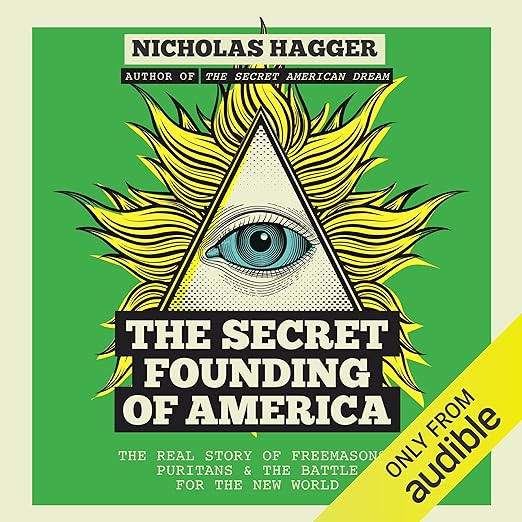
Quick Take
- Narration: Grover Gardner brings his characteristic authority to Hagger’s dense historical argument, keeping the pacing steady through long expository passages without ever sounding like a lecture.
- Themes: Freemasonry and American founding mythology, secret societies and political power, the tension between Christian settlement and Enlightenment governance
- Mood: Conspiratorial but earnest, dense with historical detail
- Verdict: A genuinely researched alternative reading of American origins that rewards listeners who approach it as intellectual provocation rather than settled fact.
I listened to the first two hours of this one on a rainy Saturday afternoon with a pot of coffee and no particular agenda, which turned out to be exactly the right conditions for it. Nicholas Hagger is not a fringe pamphleteer. He is a historian with a long publication record, and The Secret Founding of America feels like the work of someone who has spent decades building toward a single argument. That argument, stated plainly, is that the United States was not simply born of colonial discontent and Enlightenment philosophy, but that Freemasonry shaped its architecture at every critical juncture, from the earliest settlements to the drafting of the Constitution.
Whether or not you find that argument convincing, and I found myself somewhere in the undecided middle, the book is worth your time if you have any interest in the period. Hagger’s sourcing is extensive enough that one reviewer with a degree in American History specifically noted the 55 pages of notes and citations as evidence of credibility. That’s not nothing. It means you can argue with the book rather than simply dismiss it.
Our Take on The Secret Founding of America
What Hagger does well, and what Grover Gardner’s narration amplifies, is the distinction between the Planting Fathers and the Founding Fathers. This framing is not new exactly, but Hagger uses it with precision. The Jamestown settlers of 1607, led by figures like Bartholomew Gosnold and John Smith, are cast as essentially Christian in motivation and structure. The later Founding Fathers, Washington, Jefferson, Franklin, are cast as Masonic operatives whose conception of liberty was filtered through the Enlightenment and, Hagger argues, through the lodges. The book insists these are not the same project, and that conflating them has blurred American self-understanding for centuries.
The Candace Owens Book Club selection designation will inevitably color how some listeners approach this title. I mention it not to praise or undercut the association but because it signals the audience the publisher is targeting and, frankly, because it matters for context. Hagger’s thesis is not inherently partisan, but it has been taken up by readers with particular political investments. The ideas themselves deserve evaluation on their own terms.
Why Listen to The Secret Founding of America
Gardner is a veteran narrator whose voice carries a natural gravitas that suits historical nonfiction. He does not editorialize or perform the material. He reads it straight, which is exactly right for a book that already carries considerable argumentative weight. His pace is measured, which helps when Hagger moves through complex chains of connection between, say, the German Illuminati and the framers of the republic. Some of these chains are convincing. Others require the listener to do generous interpretive work. Gardner does not tip his hand either way, which I appreciated.
The section on Civil War and Masonic influence is where the book becomes most speculative, and where I found myself most alert as a listener. Hagger is tracing a very long thread, and at points the connections feel asserted rather than demonstrated. A reviewer called the book “imperfect” even while rating it five stars, and that strikes me as an honest summary. The architecture of the argument is sound. The supporting beams are sometimes load-bearing assumptions rather than documented fact. That said, the book raises questions worth sitting with, particularly around what the phrase “conceived in liberty” actually meant to the men who wrote it.
What to Watch For in The Secret Founding of America
The PDF companion mentioned in the Audible listing is worth downloading before you start. Hagger relies heavily on visual elements, including Masonic symbolism on currency and in architectural plans, and some of the references in the audio feel slightly unmoored without the images. This is a real limitation of the audiobook format for this particular title. Gardner reads the descriptions clearly, but a diagram of the Washington DC street grid, which Hagger returns to as evidence of Masonic design, is much easier to absorb visually.
Listeners should also know that this is a long intellectual argument spanning from 1607 to the modern era. At nine hours and seventeen minutes, it does not rush. The early chapters on the Jamestown colony and the competing visions of Gosnold versus the Virginia Company are among the strongest, grounded in well-documented history before Hagger begins layering his Masonic interpretation. If you start to feel the argument thinning in the later chapters, it is worth returning to those early sections to remember how solid the foundation actually is.
Who Should Listen to The Secret Founding of America
This audiobook is for listeners who enjoy sitting with historical revisionism that takes its evidence seriously. If you want a clean, conventional narrative of the American founding, this is not that book. But if you are curious about what the Founding Fathers actually believed, who they associated with, and how ideas about secret fraternal orders intersected with the project of building a republic, Hagger offers a sustained and unusually detailed case. History readers who have enjoyed work by writers like Gordon Wood or Bernard Bailyn will find Hagger’s thesis worth engaging with, even where they push back. Readers who want conspiracy without documentation may find this too careful. Listeners who want documentation without any interpretive ambition will find it too bold. It lands somewhere usefully in between.
One further note on format: Hagger’s book was originally published in 2007 and has since been updated. The Blackstone audiobook release for 2026 incorporates these revisions, including updated commentary on contemporary global politics that Hagger connects to his Masonic thread. Listeners familiar with the original print edition will encounter some new material, particularly in the later chapters addressing the twenty-first century dimensions of the argument.
Frequently Asked Questions
Does the audiobook include access to the PDF companion mentioned in the listing?
Yes. Audible’s listing specifically notes that the accompanying PDF is available in your Audible Library alongside the audio. It is worth downloading before you begin, since Hagger references visual elements including architectural diagrams and symbolic imagery that are harder to follow from audio description alone.
Is Hagger’s argument anti-Christian, given his emphasis on Masonic rather than Christian founding?
Not straightforwardly. Hagger distinguishes carefully between the Planting Fathers, who he presents as genuinely Christian in motivation, and the Founding Fathers, whom he reads as Masonic and Enlightenment-influenced. The book is not an attack on Christianity but rather an argument that two distinct founding traditions have been improperly merged in popular American mythology.
How does this differ from other books about Freemasonry and the American founding?
Hagger’s distinguishing feature is his sourcing, including 55 pages of notes and citations, and his breadth. He traces Masonic influence from 1607 through the Civil War to contemporary global politics. Most comparable books focus narrowly on the Constitutional period. His scope makes the argument both more ambitious and, in places, more difficult to fully substantiate.
Is the Candace Owens Book Club connection significant to the content of the book?
The content predates that association significantly. The original text was published in 2007, long before any modern political endorsement. The ideas stand independently of that framing. The recent Blackstone audiobook release simply coincided with the Book Club selection, which has driven renewed interest and a fresh wave of listener reviews.