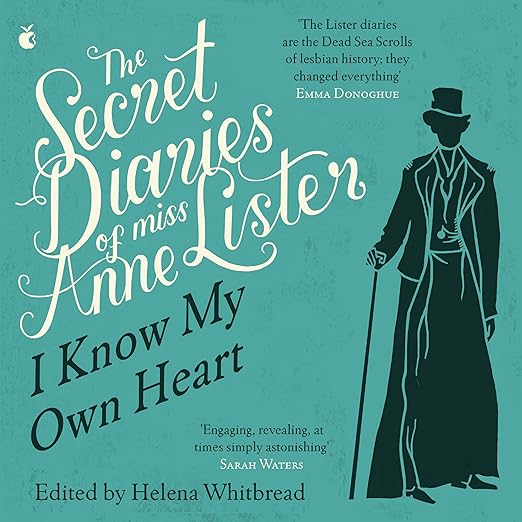
Helena Whitbread is named once on this audiobook's page, as the editor who spent years researching and transcribing a private code, and then never appears again. The author field carries Anne Lister alone. That is accurate as far as it goes, since Lister wrote every word, but nobody could have listened to a syllable of it without the decoding, and the record files that labor as a footnote to a blurb.
A Cipher Called Crypthand Turned Private Habit Public
Anne Lister is described here as a landowner, an industrialist and a woman who lived on her own terms in a century that offered no template for it. The journals were kept partly in what she called her crypthand, an elaborate cipher that let her set down the intimate and at times explicit detail her life actually contained. That is the reason these pages survived as evidence rather than as rumor: the code was the safety mechanism, and breaking it is what turned a private habit into public history.
Proximity Replaces Momentum After Two or Three Hours
Bea Trice, at four stars, files the sharpest complaint in this column, and it is not about the writing. The headline reads that the editorial choices are unclear. The body describes reading as a voyeur, a researcher and a cozy reader all at once, learning a great deal about a period the reviewer already knew well, and then wanting more: more detail, more of the diary, more of whatever was left out. That is a reader asking to see the selection principle, and this listing does not supply one. Fifteen hours of a life that ran to millions of words means somebody chose, and the page will not say who or how.
Fifteen hours and sixteen minutes is a serious commitment for a text with no plot to pull you through. Diaries do not build; they accumulate. Amfern puts it plainly, having never read anything like it before, and puts the reason down to its being more journal than authored book, with even the mundane entries holding attention. That is the correct expectation to bring. Nothing is being shaped for you here beyond the choice of what to include, and a listener who wants momentum will have to supply it personally. Proximity replaces momentum, and after two or three hours the accumulation starts doing work no summary of the period could.
One Voice Carries Every Shift, With No Signposting
Jay-Jay's entry contains the strangest thing on this page. The headline objects that the edition stops at 1824 and demands the rest of the story. The body, four lines later, describes following its subject through life, business, love, education and an untimely death. Both cannot be true of a volume the description limits to the years 1816 through 1824, and the reviewer does not appear to notice. What that same entry gets absolutely right is the passage worth waiting for: the visit to the Ladies of Llangollen, two women who moved to the north of Wales to get away from their families and their neighbors' opinions.
Kristin Atherton reads all of it, and the credit lists no one else. That is a heavier assignment than the runtime suggests, because a diary has no dialogue tags, no scene breaks and no narrator standing outside it to explain a shift in tone. Every register change, from a business note to a coded confession, has to be carried by one voice with no signposting. Not one of the five entries evaluates how that goes, which is a shame, because it is the only genuinely open question about the edition.
Filed under biographies and memoirs, which is fair, and simultaneously under literature and fiction, which is not. These are real journals by a real woman, first published in 1988 and hailed then as recovered lesbian history. Whatever else a reader deserves, it is not a shelf label suggesting the material was invented. Small mistake, large implication, and precisely the sort of thing this book spent two centuries fighting.
Two Votes Cannot Produce a 4.6 Average
Two logged votes support an average of 4.6, which is not a figure two whole-star votes can produce between them. Underneath sit five written responses, all of them graded, four of them at the top. The counter is simply older than the page it sits on, and it undercounts by at least three. Nothing sinister, but if you are the kind of buyer who reads the number before the reviews, read them in the other order here.
Four of the five entries were written before this recording existed. The oldest carries an April 2012 date, more than eleven years ahead of the October 2023 audio edition, and the newest of the four is from September 2019. Only Sourdough, writing in April 2024, could plausibly have heard Kristin Atherton. Everything else in the column is a verdict on a printed edition of a text first published in 1988, which is a long chain of objects to be judging through.
None of the entries mention what a fifteen-hour reading does to the explicit passages. The description promises intimate and at times explicit detail, and Bea Trice's voyeur remark suggests it delivers. Listening changes the temperature of that material in a way reading does not, particularly in a shared room, and nobody here has flagged it. Stay away from it if you want the historical significance without the diary being a diary, because the two are not separable in this book.
Whitbread's Work Lives in One Sentence of a Blurb
History listeners, readers of queer history in particular, and anyone who arrived through Gentleman Jack or Emma Donoghue's Learned By Heart will find the source rather than another retelling of it. In LA's response makes the case more persuasively than the marketing copy manages, arguing that a woman doing all of this two hundred years ago is itself an argument for anyone told today that they should not exist. That is what a primary document offers and no adaptation can. Expect daily life at close range, business and land and money running alongside the love affairs, and expect to do a fair amount of the connective work yourself, because nothing here has been arranged for narrative convenience.
Approach it as a document and it will reward fifteen hours; approach it as a story with an arc and you will spend those hours waiting for one. Whitbread's work is the reason any of this can be heard at all, and the credit for it lives in one sentence of a blurb.