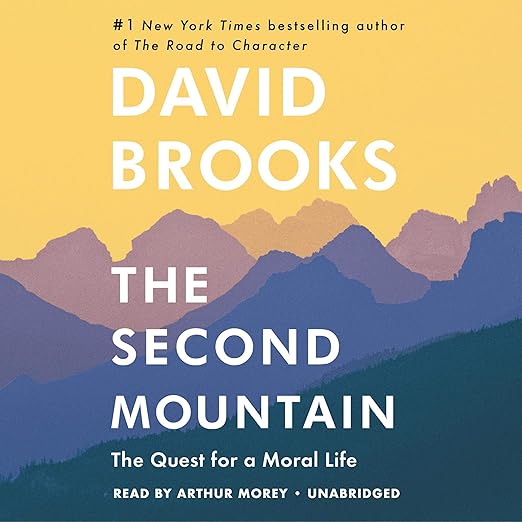
Quick Take
- Narration: Arthur Morey reads with a steady, thoughtful authority that suits Brooks’s essayistic style without pushing the material toward sermon.
- Themes: Commitment, meaning, the limits of individualism, community and faith
- Mood: Reflective and quietly urgent
- Verdict: A sincere and well-argued case for a life built around commitment rather than self-advancement, most resonant for listeners who have achieved professional success and found it insufficient.
I came to The Second Mountain at an odd moment, somewhere between finishing a project I had worked toward for two years and finding the satisfaction of completion unexpectedly thin. The metaphor Brooks builds his book around, the first mountain of career and status versus the second mountain of commitment and purpose, landed with a directness I was not entirely prepared for. That is not a common experience with self-improvement adjacent nonfiction, and it says something real about the quality of Brooks’s argument.
Brooks is a New York Times columnist, and the book is recognizably his register: wide-ranging, essayistic, drawing on philosophy, biography, and personal experience without pretending to be academic. He structures The Second Mountain around four commitments he argues define a life of meaning: to a spouse and family, to a vocation, to a philosophy or faith, and to a community. Each section examines what genuine commitment in that domain looks like, using real people as examples alongside intellectual frameworks.
Our Take on The Second Mountain
The book’s central diagnosis is that American individualism has been taken to an extreme that has made people less happy and their communities less coherent. This is not a new argument, but Brooks makes it with more specificity and personal honesty than most. He draws on his own divorce and subsequent personal upheaval, which gives the abstract argument about commitment a concrete weight. One reviewer described the book as deeply moving, frequently eloquent, and extraordinarily incisive, which oversells the emotional temperature slightly but captures the analytical seriousness.
Arthur Morey’s narration is well-matched to the material. He delivers Brooks’s essayistic passages with the steady confidence of someone comfortable with long-form argument, and the memoir sections with enough warmth to distinguish them from the philosophical exposition. This is a book that asks a lot of its listener in terms of sustained engagement with complex ideas, and Morey’s consistent pacing helps rather than hinders.
Why Listen to The Second Mountain
The book is most effective when Brooks resists the pull toward prescription. His portraits of people who have made the second-mountain transition, and what those transitions actually looked like in practice, are more persuasive than his more schematic passages about how to choose a partner or define a vocation. The section on community is particularly strong, and it connects the book’s personal argument to a broader social diagnosis about the fragmentation of civic life in ways that feel current without being polemical.
One reviewer made the practical suggestion of skipping the final two chapters of the religion section, noting they felt like a detraction. That is a reasonable flag. Brooks’s treatment of faith is the most polarizing part of the book for secular readers, and those sections lean more prescriptive than the rest. The book’s overall argument does not depend on accepting his religious framing, but those chapters do require some patience if that is not your territory.
What to Watch For in The Second Mountain
Brooks is a generalist writer, and the book shows both the strengths and limitations of that mode. He synthesizes across psychology, philosophy, sociology, and biography with fluency, but specialists in any of those fields will find the individual threads less rigorous than they might prefer. The self-help adjacent framing of some passages sits somewhat awkwardly alongside the more genuinely philosophical sections, and the book never fully resolves that tension.
This is also not a book for listeners who are early in their careers or feel content with the conventional markers of success. Its argument is most useful to people who have already climbed one mountain and found themselves wondering what the view should mean. One reviewer noted it hits home most strongly in middle age, and that tracking seems accurate.
Who Should Listen to The Second Mountain
Listeners navigating a significant life transition, those who have achieved conventional career success and found the result unexpectedly hollow, and readers interested in the intersection of personal ethics and social philosophy. Less suited to those looking for practical career guidance or a strictly secular framework for life decisions.
Frequently Asked Questions
Do you need to have read David Brooks’s previous book The Road to Character to follow The Second Mountain?
No. The Second Mountain stands alone. Brooks references his earlier thinking, but the arguments here develop independently and the book works as a standalone.
How explicitly religious is the book, and does the faith framework dominate the argument?
Faith is one of the four commitments Brooks examines, and he writes from a perspective sympathetic to religious community. However, the book’s overall argument about commitment and meaning is accessible to secular readers. Some reviewers found the final religion chapters less compelling than the rest.
Arthur Morey narrates a lot of nonfiction. Does his style work particularly well or poorly for Brooks’s essayistic writing?
Morey’s steady, authoritative register suits Brooks’s writing well. He handles the transition between personal memoir passages and philosophical argument without jarring shifts, which helps over nearly thirteen hours.
Is the book more of a personal memoir or a social argument, and which approach does Brooks use more convincingly?
Both modes are present throughout. Brooks uses personal experience to ground his social argument, and most reviewers found the combination more persuasive than either element would be alone. The social commentary on individualism is probably the book’s strongest thread.