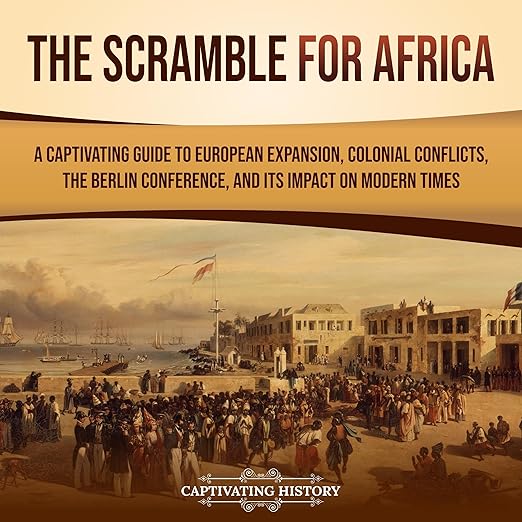
Quick Take
- Narration: Jay Herbert delivers the Captivating History house style cleanly, authoritative enough for the material, though the production does not reach for anything beyond competent.
- Themes: European colonial partition of Africa, African resistance movements, the Berlin Conference and its legacy
- Mood: Brisk and informative, efficiently organized but not deeply layered
- Verdict: A useful 3.5-hour orientation to the Scramble for Africa that serves curious newcomers well, just know going in that depth is not the goal.
I have used Captivating History books as entry points before, usually when I want a quick orientation before committing to a longer, more demanding treatment of the same subject. The Scramble for Africa fits that pattern. At three and a half hours, it is a brisk, efficiently organized overview of one of the most consequential and brutal episodes in modern history: the period roughly from 1880 to 1914 when European powers divided the African continent between them, drawing borders that disregarded existing political, ethnic, and ecological realities and whose consequences are still being lived out today.
The book follows the Captivating History format, which means it moves quickly through the major events and key figures, pausing to explain context without spending long enough in any one place to develop genuine depth. That is not a complaint, it is a description of what this type of audiobook does and does not do. The question is whether the author has chosen the right material to highlight and organized it clearly enough that a newcomer comes away with a genuinely useful framework, and on both counts this one largely succeeds.
The Berlin Conference as Organizing Event
The book opens with the 1884 to 1885 Berlin Conference, convened under Bismarck’s guidance, as its organizing event. This is the right choice. The conference, at which representatives of 14 European nations met to formalize the rules of African partition without a single African representative present, is the conceptual heart of what the Scramble actually was: not a series of individual colonial adventures, but a coordinated geopolitical project premised on Africa as a resource to be divided rather than a continent of peoples with their own political histories.
The treatment of King Leopold II’s Congo Free State is appropriately disturbing. The book does not sanitize the rubber terror, and it correctly identifies this as one of the most concentrated episodes of deliberate mass atrocity in the colonial record. Arthur Conan Doyle’s written protest against Leopold’s regime gets a mention, which is a slightly unusual detail, most overviews do not pause to note the literary response, and it adds a small dimension to what could otherwise feel like a purely political narrative.
The Resistance the Standard Narrative Tends to Undercount
The book gives meaningful attention to African resistance, which many older treatments of this period minimized or ignored entirely. Cetshwayo of the Zulu kingdom, Samori Toure of the Wassoulou Empire, and the Maji Maji rebellion in German East Africa all receive discussion. This is important not merely for representational reasons, but because the resistance movements demonstrate something the purely European-centered narrative obscures: that the Scramble was not a smooth administrative process but a series of violent contests that Africans fought against, often for decades, with considerable sophistication.
One reviewer noted that the book informs us effectively and entertains us while wishing for more detail. That tension between the breadth of the subject and the compression of the format is real, and there is no way around it in 3.5 hours. The mention of technological enablers, the iron-hulled steamboat, the Maxim gun, quinine as a prophylactic against malaria, is efficient and correct, but readers who want to understand the full dynamics of the Maji Maji uprising or the specific economic mechanisms of Leopold’s rubber system will need to go elsewhere.
Herbert’s Narration and What the Format Asks Of It
Jay Herbert narrates in the Captivating History house style: clear, measured, competent. There is no particular distinction in his delivery, and the production does not attempt anything beyond professional reading of a clearly structured text. For a book this short and this densely packed with names and events, the lack of vocal embellishment is probably the right choice. Herbert moves through the material at a pace that allows information to register without lingering long enough to deepen any single point.
The audio-only accessibility of this book is genuinely high. No maps, no footnotes, no apparatus that requires the print edition to follow. The narrative is self-contained and the timeline is clear. This is one area where the Captivating History format genuinely works, the books are designed to function in audio, and this one does.
Who Should Listen / Who Should Skip
Listen if you want a quick, reliable orientation to the Scramble for Africa before tackling more comprehensive treatments like Thomas Pakenham’s full history, Adam Hochschild’s King Leopold’s Ghost, or any of the country-specific histories that deal with individual colonial experiences in depth. Listen if you are a student who needs a broad framework quickly.
Skip if you already have meaningful background in this period, there is nothing here that will add to what you know, and the compression will frustrate you. Skip if you want the texture and complexity that 3.5 hours simply cannot provide. This is a map, not a journey.
Frequently Asked Questions
How does this book compare to Adam Hochschild’s King Leopold’s Ghost for listeners specifically interested in the Congo?
They are not comparable in depth. Hochschild’s King Leopold’s Ghost is a full-length investigative history focused entirely on the Congo Free State and the international campaign to expose Leopold’s atrocities, it is one of the definitive books on the subject. This Captivating History title covers the Congo in a chapter or two as part of its broader survey. If the Congo specifically is your interest, Hochschild is the essential text; this book is an orientation, not a destination.
Does the book cover the legacy of the Berlin Conference borders in modern Africa?
Briefly. The Captivating History format focuses primarily on the historical period itself rather than its long-term consequences. There are closing remarks on the contemporary impact of partition-era borders, but this is not an analytical treatment of postcolonial Africa, it is a historical survey of the partition process itself.
Is Jay Herbert’s narration easy to follow for listeners new to African place names and political figures?
Yes. Herbert pronounces the key names clearly and consistently, and the book’s prose does not assume prior familiarity with the geography or political history. For a first encounter with figures like Cetshwayo, Samori Toure, or the major European actors, the narration is accessible enough that the material registers without confusion.
Does this Captivating History title need to be listened to in series order, or does it stand alone?
It stands completely alone. Captivating History produces individual audiobooks on specific topics within broad subject areas, but each title is self-contained and does not depend on others in the series. You can listen to this without having heard any other Captivating History title.