In Brief
- Narration: Paul Heitsch takes on twenty-five hours of comparative scholarship where letters, memoirs and Reid's own argument have to stay distinguishable by ear.
- Themes: Sherman's making and unmaking, depression and command, the Lost Cause and reputation, Civil War strategy.
- Mood: patient and scholarly, argumentative rather than dramatic.
- Verdict: a superb second or third Sherman biography, and a poor first one, with an atlas effectively required.
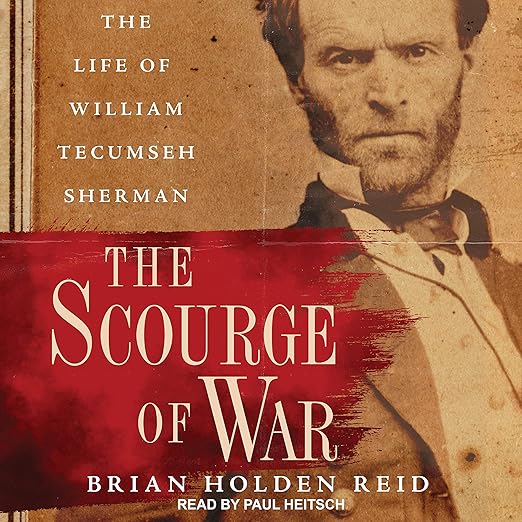
Sherman still splits a room, and a reviewer on this listing frames the split better than any jacket copy could: "The most accomplished general in American history by some accounts or a war criminal by others". Brian Holden Reid's The Scourge of War runs twenty-four hours and fifty-three minutes as an audiobook, holds 4.5 across 262 ratings, and sets out to find the man underneath both verdicts. The reviews are unusually substantive for military history, and two of them hand a prospective listener a decision that has nothing to do with quality.
How the Lost Cause Hardened a Villain Image
Reid's method is biography as long approach. The publisher calls it "a deeply researched life-and-times account", and the early chapters spend their time on everything that argues against the general Sherman became: the childhood and schooling, the California business ventures, the antebellum command of a military college in Louisiana, and what the copy candidly labels "numerous career false starts". The family gets real weight, "particularly his wife's intervention during the war", and the professional making of the man is traced through his "crucial friendships with Henry W. Halleck and Ulysses S. Grant".
Two arguments give the book its spine. The first is developmental: that Sherman "overcame both his weaknesses as a leader and severe depression" to become a strategist, which makes the depression part of the professional story rather than a footnote to it. The second is reputational. Reid contends that hostility toward the South was not a constant across Sherman's life, and that the image of him as "a villain who practiced barbaric destruction" hardened afterward, alongside the rise of the neo-Confederate Lost Cause and his own decision to publish an early personal narrative of the conflict. That is a historiographical argument as much as a biographical one, and it accounts for a good deal of the book's length.
Readers who know the field respond to the sourcing. One five-star review credits Reid with "comparing all the sources available to him, to include personal correspondence, journals, Sherman's memoirs, Grant's memoirs, and Liddell Hart's book on Sherman". Another praises the command analysis while grading it honestly, calling Reid "excellent on strategic and probably operational, weak on tactical engagements". Another says the book finds "the real man behind the myth", answering the madness question as a bout of depression and treating the Marches as far less atrocious than legend holds, in the context of their time.
Twenty-Five Hours That Survive Being Heard
Paul Heitsch is the credited voice on a text that makes marathon demands. Twenty-five hours of scholarly prose built by comparing correspondence against memoirs against a later historian's interpretation requires a reader who can keep the layers distinct by ear: whose letter is being quoted, which memoir is being tested, where Reid stops reporting and starts arguing. Proper nouns arrive constantly and the names matter, since half the analysis turns on who Sherman was writing to. A listener needs the seams between evidence and interpretation to register in the reading, because a footnote cannot.
The case for audio on a book this size is nevertheless strong. Twenty-five hours is a month of commutes and an unappealing evening prospect in print, and narrative biography is the genre that most reliably survives being heard, because chronology does the organizing work for you. The two long stretches a chronological life has to get through, the false starts before the war and the institutional career afterward, are exactly the passages a steady reading carries best. My own preference with a book of this length is to hear the life and read the analysis, and this one is generous enough with both that the trade works.
In This Format, No Maps at All
Maps are the audio-specific problem, and the print reviews make it unusually concrete. A four-star notice carries the complaint in its own title, that the book lacks good maps, and says plainly that "you'll need a good atlas of Civil War battles", noting the volume includes "only a few maps" and rarely places them near the text they serve. A five-star reviewer who read an electronic edition found the same maps unreadable at that size. In audio the question resolves itself in the worst possible way: no maps at all. Anyone who wants to follow the Marches as military movement rather than as reputation should have an atlas open, and I would treat that as a requirement here rather than a refinement.
The prerequisite question is even more important, and it comes from the pool's bluntest reviewer, who opens with "This is not a good first biography of Sherman". That reviewer's complaint is that Reid skips many well-known relationships with staff and opposing generals, and the accompanying recommendation is specific: this is a good read once you have already worked through three or four Sherman biographies. The same review credits the book for handling Sherman's mental health seriously and for acknowledging his womanizing without prurience. Take the warning at face value. This is a book in conversation with a shelf you are assumed to have read.
Weigh the analytical unevenness too. The reviewer who praised the strategic and operational chapters graded the tactical engagements as the weak part, which is worth knowing if battle narrative is why you buy Civil War history. Combined with the missing maps, that means the hours you might most want to hear rendered vividly are the hours the book itself handles least well, and no reading can fix a structural preference in the source.
Get the Atlas Before You Get the Credit
This is for the reader who already has Sherman opinions. Civil War listeners with several campaign histories behind them, students of command and generalship, and anyone drawn to the historiography of how reputations get built will find the twenty-five hours well spent. It should also appeal strongly to listeners interested in leadership under psychological strain, since Reid treats the depression as part of the professional record rather than as color.
For a newcomer, a single-volume introduction to Sherman lies outside what Reid set out to write, and the sharpest reviewer on the page says so first. Anyone meeting the man for the first time should start with something shorter and more narrative and come back. Listeners who want the Marches recounted as vivid battlefield storytelling will also be reading against the grain of a book whose strengths sit at the strategic level.
Practical advice for buyers of this edition: get the atlas before you get the credit. Two independent reviewers flagged the maps while holding a physical or electronic copy that at least contained some, and this format contains none, so the supplement is not optional if geography matters to your understanding. Beyond that, close to twenty-five hours at 4.5 from 262 ratings is a well-supported commitment, and Reid's central revision of the Sherman-as-villain story is worth hearing argued at full length rather than summarized.