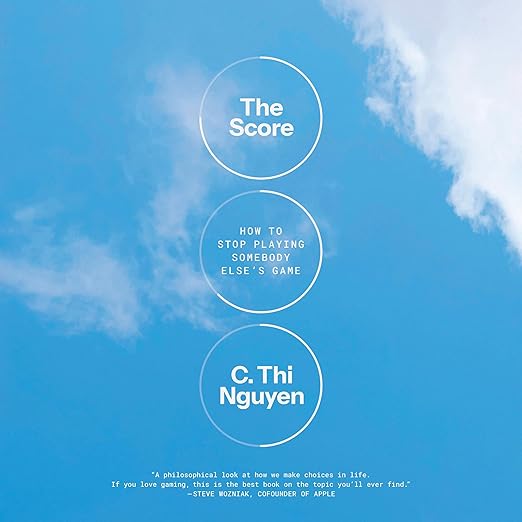
I started The Score on a Thursday evening with the specific intention of listening for an hour before bed. I finished the first four chapters standing in my kitchen, having lost track of time entirely. C. Thi Nguyen is a philosopher of games, and the question he is asking in this book is deceptively simple: what happens when the systems that make games fun are applied to the parts of life where fun is not the point? What happens when metrics and rankings start shaping what we want rather than just measuring what we do?
That question has been sitting at the edge of my thinking about technology and culture for years, and Nguyen gives it a philosophical structure I did not know I was missing. His background, combining the philosophy of games with the philosophy of data, turns out to be exactly the right intersection from which to approach this problem. The Score is the kind of book that makes you feel, as one reviewer put it, that it is 'so exuberant and readable that the depth and seriousness of its insights almost sneak up on you.'
Games, Metrics, and the Trap of Value Capture
The central distinction Nguyen draws is between games, where scoring systems help you inhabit a set of values temporarily and play with different ways of engaging the world, and the bureaucratic metrics applied to corporations, universities, social media platforms, and professional assessments. In games, the score is a tool you pick up and put down. In institutional life, the score becomes the environment. It shapes what you desire, not just what you measure.
The argument builds carefully in the first half. Nguyen is specific and concrete, working through examples from video games, sports, cooking competitions, and academic citation counts to show how the same mechanism, quantifying performance against a fixed external standard, produces very different effects depending on whether it is chosen or imposed. His discussion of 'value capture,' the process by which institutions encourage you to optimize for measurable proxies at the expense of the actual goods those proxies were meant to track, is the heart of the book and its most useful conceptual contribution.
Nguyen Narrates His Own Philosophy of Scoring
Nguyen narrating his own work is the right call. His academic register is clear without being dry, and his philosophical precision is genuine without becoming pedantic. There is something appropriate about hearing a philosopher of games and scoring deliver his own argument: the performance is part of the communication. He makes the academic material feel like a conversation you are part of rather than a lecture you are observing.
The reviewers who have engaged most deeply with this book reflect on it as personally transformative. One reader with sixty years of reading behind them describes having a copy go directly onto their 'top shelf.' Another describes Nguyen's ability to show how unconsciously we snap to external scoring systems, 'even The 5-star system of scoring products and books,' which is a deliberately recursive insight for a book whose own reviews will be expressed in star ratings. The New York Times, Washington Post, and Financial Times blurbs are not exaggerating. This is a significant intellectual contribution dressed in accessible prose.
Repetition Sets In After the Opening Chapters
The structural criticism is well-founded and comes from multiple directions. One reviewer notes that the first four to five chapters present the central ideas 'in a clear yet profound way,' after which 'the content becomes highly repetitive.' Another suggests the book could have been a tight 120-page argument rather than the sprawling version actually published. In an audio format, repetition is more pronounced than in print, because you cannot skim. The second half of The Score at nine hours and forty minutes is where attentive listeners will start feeling the drag.
This is not an unusual problem in academic philosophy crossover books. The pressure to demonstrate rigor and to address potential objections can extend a core argument well past its effective stopping point. The payoff of the early chapters is high enough that the later fatigue is survivable, but listeners who find repetition in non-fiction audio genuinely frustrating should be prepared.
Readers Feeling the Dissonance Between Values and Metrics
Anyone who has felt the dissonance between what they actually care about and what the metrics of their professional or digital life reward them for should listen to this. The framework Nguyen provides is genuinely useful for naming and diagnosing that dissonance. Students and academics in fields where citation counts and impact scores shape career trajectories will find the argument directly applicable. Readers with an appetite for philosophy that stays tethered to real-world examples, rather than abstract thought experiments, are the natural audience. Those who want tightly edited argument rather than the full academic treatment should perhaps read a long-form review of the book rather than the book itself, then decide if the full version is worth the investment.
At a Glance
- Performance: Nguyen narrates his own work, and his academic clarity makes the philosophy accessible without sacrificing precision, though the book's own structural repetition becomes more pronounced when you are hearing it rather than reading it.
- What it covers: Philosophy of games and scoring, how metrics colonize human values, the difference between intrinsic and outsourced desire
- Feel: Intellectually exhilarating in the first half, more demanding in the second, a genuinely important idea padded past its optimal length
- Our call: The core argument of The Score is among the most useful philosophical tools for understanding contemporary life I have encountered in years; the book is about forty percent longer than it needs to be to make that argument.
A Few Questions About The Score
Do you need a philosophy background to follow Nguyen's argument in The Score?
No. Nguyen writes for a general educated audience and grounds every philosophical concept in concrete examples from games, cooking, sports, and institutional life. The vocabulary is clear and he defines technical terms when he introduces them. Reviewers from nonphilosophical backgrounds consistently describe the argument as accessible.
Is the repetition critics mention severe enough to make the audiobook hard to finish?
For patient listeners who are engaged with the core ideas, the repetition is manageable. For listeners who lose tolerance quickly when an argument starts circling back on itself, the second half will be a genuine test. The first four to five hours contain the book's essential argument and are the strongest section.
Does The Score address social media specifically, or is it more broadly about institutional metrics?
Both. Social media platforms and their scoring systems, likes, follower counts, engagement metrics, are prominent examples throughout the book. But Nguyen's framework is broader, covering academic citation counts, health metrics, corporate performance reviews, and sports analytics as part of the same systemic analysis.
How does Nguyen narrating his own book affect the experience compared to a professional narrator?
His academic clarity is actually an asset here. Professional narrators can struggle with technical philosophical prose, sometimes emphasizing the wrong words or smoothing over distinctions that matter. Nguyen knows exactly where the conceptual weight sits in each sentence, and his delivery reflects that. The performance is not polished in a studio-narrator sense, but it is precise.