Quick Take
- Narration: James Lurie brings a measured, investigative-journalism quality to Hvistendahl’s prose , unhurried and precise, which suits the material’s documentary rigor.
- Themes: US-China economic rivalry, corporate influence on federal prosecution, xenophobia in counterintelligence
- Mood: Methodical, legally tense, and quietly infuriating
- Verdict: Exceptional investigative journalism in audio form , Hvistendahl turns a corn seed trespassing case into a window on US-China geopolitics, FBI overreach, and the human cost of great power competition.
I started The Scientist and the Spy on a Monday evening commute and found myself still listening when I got home, which does not happen often with nonfiction. Mara Hvistendahl is a Pulitzer Prize finalist, and this book shows why that recognition found her: she has the rare ability to make the procedural feel propulsive and the geopolitical feel human without sacrificing the rigor that makes either worth reading.
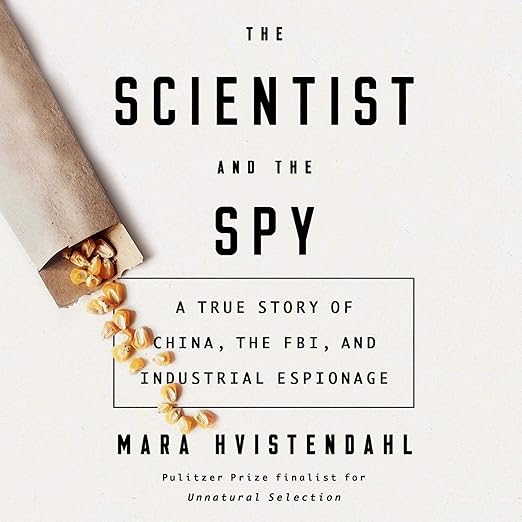
The story begins in September 2011, when sheriff’s deputies in rural Iowa encounter three ethnic Chinese men near a farm growing corn seed under contract with Monsanto. What sounds like a minor trespassing incident becomes the seed , to use the obvious metaphor , of a two-year FBI operation that includes bugged rental cars, surveillance aircraft over the Midwest, and a foreign-intelligence warrant applied to what may have been a commercial dispute. At the center of it is Robert Mo, a Chinese-born naturalized US citizen whose academic career had stalled and who accepted a questionable job with a Chinese agricultural company called DBN, and who became, as Hvistendahl puts it, a pawn in a global rivalry.
Our Take on The Scientist and the Spy
What Hvistendahl does that distinguishes this book from straightforward espionage journalism is the dual critique. She is interested not just in industrial espionage and Chinese agricultural competition , though she covers those subjects with depth and care , but also in what the US response reveals about American counterintelligence culture and the role of corporate influence in shaping federal prosecution priorities. Monsanto and DuPont Pioneer did not simply suffer a theft and call the FBI; their participation in and influence on the investigation is part of Hvistendahl’s story, and she is willing to make readers uncomfortable about what it means for multinational corporations to effectively deputize federal law enforcement for their commercial interests.
The xenophobia thread runs parallel. Hvistendahl documents a long history of racially tinged counterintelligence targeting of ethnic Chinese Americans that predates the Mo case significantly. The investigation of Mo is presented not as an isolated instance but as the latest expression of a pattern, which gives the book a structural argument that is more disturbing than any individual case detail. One reviewer described it as a master class in investigative journalism, and the comparison to how Tokyo prosecutors treated Carlos Ghosn , another case where institutional power operated coercively on a foreign-born individual , is illuminating.
Why Listen to The Scientist and the Spy
James Lurie’s narration is well-suited to documentary material of this precision. He does not editorialize or dramatize , the prose does that work on its own , and his pacing respects Hvistendahl’s sentence rhythms, which are tighter than most trade nonfiction. The eight-hour runtime feels well-calibrated to the material: long enough to develop the legal and geopolitical context fully, short enough that the story’s forward momentum is never lost.
The book is built on previously unreleased FBI files and extensive reporting from both the United States and China, and that documentary foundation gives the audiobook a quality of authority that more speculative China-threat narratives cannot match. Hvistendahl is not interested in making a simplified geopolitical argument; she is interested in what actually happened to specific people because of specific decisions made by specific institutions, and the specificity is what makes the book both readable and important.
What to Watch For in The Scientist and the Spy
At least one reviewer noted that the later sections of the book, where Hvistendahl broadens from the Mo case to the wider pattern of Chinese counterintelligence concern, felt like she was overextending her critique , pushing toward a verdict about discrimination that the evidence only partially supported. That is a fair reading, and listeners who prefer tighter case-specific analysis may find the book’s wider argument slightly underbuilt relative to its specific reporting.
The book was published in 2020, and the US-China trade relationship has evolved considerably since then. The specific legal and diplomatic context Hvistendahl describes is historically accurate for its moment, but readers should bring some awareness of subsequent developments to the geopolitical framing.
Who Should Listen to The Scientist and the Spy
Essential for anyone interested in US-China economic and political competition, corporate influence on federal law enforcement, or the specific vulnerabilities of Chinese-Americans in counterintelligence contexts. Equally important for listeners who enjoy true crime that is structurally sophisticated , this is not a whodunit but a how-and-why, and that makes it more interesting rather than less.
Listeners looking for a straightforward spy thriller will find this more legally and institutionally detailed than the genre usually accommodates. The material rewards patience and a genuine curiosity about how power operates at the intersection of corporations, governments, and individuals caught between them.
Frequently Asked Questions
Is The Scientist and the Spy primarily a spy thriller or investigative journalism?
Investigative journalism, though it reads with thriller propulsion. Hvistendahl is a Pulitzer finalist and science journalist; the book is built on FBI documents and extensive reporting, not narrative speculation. Several reviewers noted it reads like a spy thriller without sacrificing the rigor of documentary nonfiction.
What is the book’s position on Robert Mo’s guilt , does Hvistendahl think he was wrongly convicted?
Hvistendahl is more interested in the institutional context than in a simple verdict. She documents the corporate influence on the investigation, the xenophobic history of the counterintelligence apparatus, and Mo’s exploitation by his employer, while acknowledging the legal outcome. The book asks structural questions rather than straightforwardly exonerating Mo.
Does this audiobook require background knowledge of US-China trade relations to follow?
No. Hvistendahl builds the geopolitical context clearly for general listeners. The human story of Robert Mo and the investigation is accessible without prior expertise; the wider geopolitical argument is explained within the narrative.
How current is The Scientist and the Spy given the rapidly evolving US-China relationship?
Published in 2020, the book is historically accurate for its period. The specific legal and trade context has evolved since, but the structural arguments about counterintelligence culture, corporate influence on prosecution, and the vulnerability of ethnic Chinese Americans to racially tinged suspicion remain directly relevant.