Quick Take
- Narration: Raynor Winn reads her own memoir, and the effect is profound. The voice that carries this story is the one that lived it.
- Themes: Grief and displacement as catalysts, the healing properties of extreme physical effort, what home actually means
- Mood: Raw and luminous, with a landscape that is almost a third character in the story
- Verdict: A memoir that earns its reputation through the quality of its writing and the intimacy of Winn’s self-narration, though listeners should be aware of the journalistic controversy surrounding certain claims.
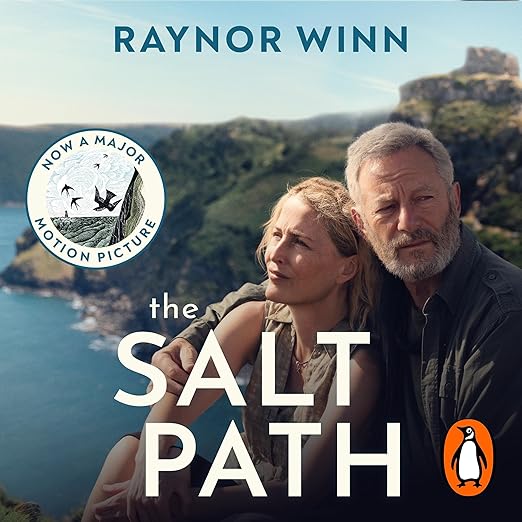
I listened to The Salt Path on a series of early morning walks that felt inadequate by comparison. Raynor Winn and her husband Moth walked 630 miles of the South West Coast Path of England carrying everything they owned, with no home to return to and a terminal diagnosis in their luggage. I walked around a city park. The contrast was not lost on me, but the beauty of this book is that it does not make the reader feel small for their comparatively ordinary life. It makes the ordinary feel worth noticing more carefully.
The circumstances that put Winn and Moth on the path are staggering in their combination. A court case ends with the loss of their farm, their home, and their livelihood in a single ruling. Days later, Moth receives a diagnosis of corticobasal degeneration, a progressive and terminal neurological condition. With no money, no fixed address, and no safety net, they make what sounds like an impulsive decision and turns out to be an act of profound and unconventional wisdom: they will walk the coast path, sleep rough, and see what happens.
Our Take on The Salt Path
Winn is a genuinely skilled prose writer, which is not something you can take for granted in a memoir driven primarily by the drama of its circumstances. She writes landscape with the kind of precision that makes you smell the salt and feel the path change underfoot, and her sentences have a rhythm that suits the walking itself. One reviewer described being able to feel the rain pelting against my skin and the wind moving me forward, which captures what Winn’s descriptive writing achieves. She is also honest about the humiliations of homelessness in ways that refuse to sentimentalize the experience. Being told they cannot camp here, being moved along, being read as homeless rather than as adventurers, these encounters carry genuine weight.
The relationship between Raynor and Moth is the emotional center of the book, and it is rendered with particular care around the question of what Moth’s diagnosis means for the walk and for his body. The chapters dealing with his decline and then his unexpected stabilization are the ones that reviewers keep returning to, and Winn handles them with a clear-eyed tenderness that avoids both cheap hope and cheap despair. There is something quietly remarkable about a book that is ostensibly about walking that ends up being primarily about what it means to be present for someone whose time is contracting.
Why Listen to The Salt Path
Raynor Winn reading her own memoir is a listening experience that justifies the audio format entirely. The intimacy is different from what a professional narrator’s rendering would be: not more polished, but more honest. There is a quality in her voice when she describes particular moments, specific shelters, specific encounters with kindness and hostility, that no actor could manufacture. The Guardian called it a beautiful, thoughtful, lyrical story, and the Sunday Times noted the shape-shifting seas and smugglers’ coves. Both of those qualities come through in the audio with an additional layer of authenticity.
A note that honest reviewing requires: some readers have raised questions about the factual accuracy of certain elements of the narrative, specifically relating to the legal and financial circumstances that preceded the walk. The Observer ran an investigation that some listeners found raised genuine concerns, and one reviewer here noted that this knowledge tainted their experience. I would not suppress this information in a review. The writing quality is real, the emotional core of the book is real, and the controversy is also real. Listeners should be aware of it and make their own judgment.
What to Watch For in The Salt Path
The Salt Path is not an adventure book in the sense that it measures itself by miles and obstacles conquered. Progress is slow, sometimes agonizing, and the drama is frequently internal rather than external. Readers expecting the pace of a thriller-inflected adventure memoir may find certain stretches demanding. The rewards are in the accumulation of detail and the quality of the prose, not in plot momentum.
The memoir is also explicitly a partnership story. Winn does not walk the path alone, and Moth is never a supporting player in someone else’s story. His presence is constant, his voice present in dialogue and in how Winn describes the world. Listeners who want a solo endurance narrative will find this something more complicated and, I think, more interesting.
Who Should Listen to The Salt Path
Nature writing readers and memoir listeners who value prose craft over plot will find this among the finest examples of British outdoor writing in recent years. It is also the right listen for anyone who has encountered impossible circumstances and wants to be in the company of someone who found a way forward without pretending it was easy. Listeners who need their memoirs to be unambiguously fact-checked should approach with awareness of the existing journalistic controversy.
Frequently Asked Questions
Does Raynor Winn’s self-narration create any quality issues for the audiobook?
Not in terms of technical quality. Penguin Audio produced this properly and Winn is a composed reader. The intimacy of her narration is one of the audiobook’s strongest qualities.
What is the journalistic controversy mentioned in some reviews of The Salt Path?
The Observer published an investigation raising questions about some of the financial and legal circumstances Winn describes as leading to their homelessness. The details are available publicly. Some readers find the controversy material to their enjoyment; others find the writing and emotional core stand independently.
Is The Salt Path primarily a walking or outdoor adventure audiobook?
It is as much a memoir about marriage, illness, and displacement as it is about walking. The coast path is the setting and structure, but the interior journeys are what the book is actually about.
How does Moth’s terminal diagnosis affect the pacing and tone of the audiobook?
It runs beneath the entire narrative as a quiet but constant presence. Winn does not dramatize it or use it for easy pathos. The chapters dealing with his unexpected stabilization during the walk are among the most moving in the book.