Quick Take
- Narration: Krishna Dharma narrates his own retelling with steady authority, bringing scholarly intimacy without becoming lecturing or dry.
- Themes: Spiritual wisdom across ages, the cyclical nature of time, transcendence through devotion
- Mood: Reverent, contemplative, and quietly luminous
- Verdict: A carefully rendered entry point into the Srimad Bhagavatam that serves both newcomers and returning readers equally well.
I came to The Sages of Naimishiranya on a quiet Sunday morning, which felt like the right context for it. There is something about this text that resists being rushed. Krishna Dharma’s retelling of the foundational canto of the Srimad Bhagavatam is not the kind of audiobook you press play on while doing other things. At just under five hours, it is one of the shorter listens I have reviewed this year, but it asks for a different quality of attention than runtime alone would suggest.
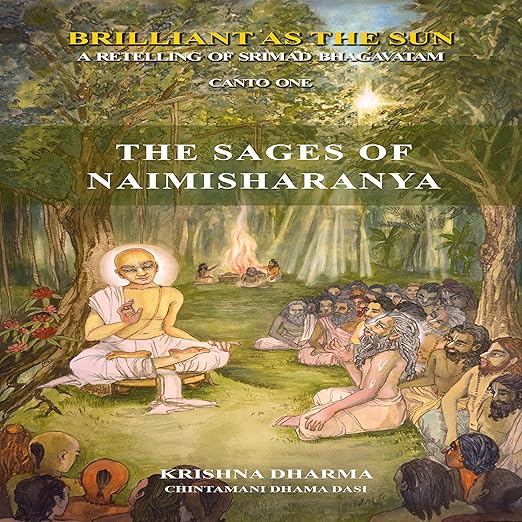
The Srimad Bhagavatam is the central Purana of the Vedic tradition, and its scope is extraordinary. This first volume introduces the frame story: a gathering of sages and yogis at the holy site of Naimisharanya, seeking a way to navigate the age of Kali Yuga, the era of quarrel and hypocrisy that the text identifies as the present age. One of their number, Suta Goswami, has encountered a dialogue between a cursed emperor and a great mystic, and from that encounter brings back the teachings that become the Bhagavatam itself. It is a structure of stories within stories, with enormous temporal and cosmological reach compressed into a single foundational conversation.
Our Take on The Sages of Naimishiranya
What Chintamani Dhama Dasi and Krishna Dharma accomplish together is an accessible retelling that preserves the philosophical substance of the original while making the story aspect legible to a modern English-language reader. One reviewer with strong knowledge of the Vedic tradition noted that this version allows one to dive directly into the text itself, freed from the weight of extensive purports that can interrupt the narrative flow in longer scholarly editions. That is an honest description of what this retelling offers. It is not a replacement for a full academic translation, but it is not trying to be. It is a genuine on-ramp, and a well-crafted one.
The description of Kali Yuga, the age of large-scale animal slaughter, environmental destruction, and the merciless behavior of governments toward civilian populations, will read to many listeners as uncomfortably contemporary. That is partly the point. The text argues that this age was foreseen, and that its antidote is comprehension of the science of God and the soul. Whether or not you share the theological framework, the diagnosis of the age is thought-provoking.
Why Listen to The Sages of Naimishiranya
The narration by Krishna Dharma is measured and unhurried, which suits the material exactly. He is the author of popular retellings of the Mahabharata and Ramayana, and the assurance that brings to this project is audible. The voice is warm without being performative, scholarly without becoming remote. One reviewer described his version as a companion to the full translation rather than a substitute, which is precisely the right framing. The audiobook format serves this kind of material well because the oral tradition is, in fact, how these texts were originally transmitted.
Reviewers with four-point-eight average ratings and deeply informed responses suggest a listener community that is already inside the Vedic tradition. But one reviewer made the specific point that this retelling is a good way to wet one’s taste buds before approaching the full Bhagavatam. For listeners coming from outside the tradition who are drawn to Hindu philosophy, this is a meaningful place to begin.
What to Watch For in The Sages of Naimishiranya
This is the first volume of a larger project, and it ends at the introduction of the frame story rather than delivering the full scope of the Bhagavatam’s teachings. One reviewer expressed the hope that the author would continue with the remaining cantos. That hope is understandable: the material is rich and the retelling is capable, but the sense of incompleteness is real. Listeners expecting a self-contained spiritual narrative may find it opens onto a much larger horizon than they anticipated.
Who Should Listen to The Sages of Naimishiranya
This audiobook is for listeners with an interest in Hindu philosophy, Vedic cosmology, or the bhakti tradition who want a readable introduction to the Srimad Bhagavatam. It also works for those already inside the tradition who want to revisit the foundational story in a more narrative form. Skip it if you are looking for practical meditation instruction or general introductory world religion content; this is a specific text in a specific tradition, and it does not soften that specificity.
Frequently Asked Questions
Do I need prior knowledge of Hinduism or the Vedic tradition to follow this audiobook?
Some familiarity helps, but the retelling is designed to be accessible. Krishna Dharma builds context into the narrative rather than assuming prior knowledge throughout.
How does this version of the Srimad Bhagavatam differ from the full Prabhupada translation?
The Prabhupada translation includes extensive Sanskrit, word-for-word breakdowns, and long philosophical purports. This retelling focuses on the narrative and philosophical essence, making it faster to absorb and easier for general listeners.
Is this a complete telling of the Srimad Bhagavatam or just an excerpt?
This volume covers only the first canto, introducing the frame story at Naimisharanya. It is the beginning of a larger project rather than a complete work.
How does the narration by Krishna Dharma compare to having a professional narrator read the text?
The author-narrated format works well here. Krishna Dharma brings genuine authority to the material, and the deliberate, unhurried pacing reflects the oral tradition in which these texts were originally transmitted.