Quick Take
- Narration: Pete Larkin handles the dense cast of Russian names with admirable consistency, maintaining narrative momentum through fifteen hours of complex political history.
- Themes: Revolutionary seizure of power, Bolshevik propaganda and violence, German financial complicity
- Mood: Rigorous and revelatory, reading at times like a political thriller constructed from archival documents
- Verdict: The most readable single-volume account of 1917-1922 available in audio, and the one most likely to change what you thought you already knew.
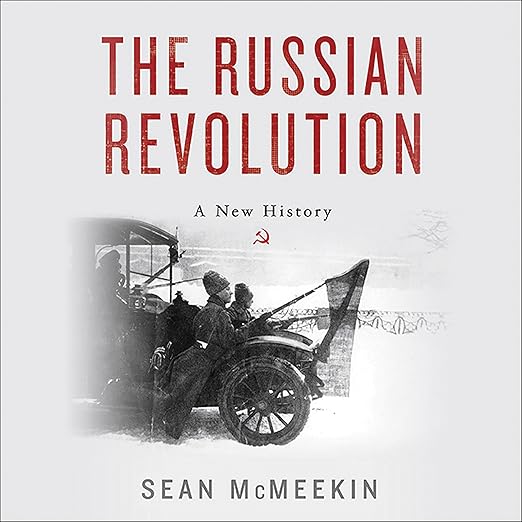
Fifteen hours is a long commitment, and I broke Sean McMeekin’s Russian Revolution history across ten days of morning commutes and late-evening walks. By the time Pete Larkin read the final pages I had covered more ground than I had in most graduate seminars on the period, and I found myself revising convictions I had held for years about how the Bolsheviks actually came to power. That revision is exactly what McMeekin is after.
This is the first comprehensive single-volume history of the Russian Revolution in twenty years, drawing on archives in Russia, Europe, Turkey, and the United States that previous scholars had not fully accessed. The period McMeekin covers runs from the collapse of Tsarist rule in 1917 through the consolidation of Bolshevik control in 1922, a five-year window that transformed not just Russia but the entire shape of twentieth-century politics.
Our Take on The Russian Revolution
McMeekin’s central argument will be unfamiliar to readers whose knowledge of the period comes from older Western scholarship: the Bolshevik seizure of power was a coup rather than a popular revolution, enabled significantly by German financial support that served Germany’s wartime strategic interests by undermining Russia’s military capacity. The German funding of Lenin’s operation, detailed with specific documentation from European archives, is not entirely new as a historical claim, but McMeekin establishes it with a thoroughness that makes it difficult to dismiss. One reviewer described discovering that Lenin played a minor role in pre-1917 events and that Germany’s sustained covert financial support after February 1917 effectively allowed Germany to use Lenin as a weapon against its wartime enemy – a framing that McMeekin’s evidence supports with unusual rigor.
The narrative covers the Tsar’s miscalculations, the provisional government’s fatal decision to continue fighting a war it could not sustain, the Bolshevik exploitation of army mutinies and mass desertions, and the brutal suppression of all resistance that followed consolidation. By the time the civil war ended in 1922, over twenty million people had died, and the Communist experiment had already required a temporary suspension of Communism itself in the form of the New Economic Policy. McMeekin does not editorialize about this; he documents it with a precision that renders the commentary unnecessary.
Why This History Reads Like a Thriller on Audio
Reviewers repeatedly noted that McMeekin’s prose achieves something rare in serious scholarship: it reads at times like fiction without sacrificing precision. One reviewer described it as feeling like a thriller at times, which is a response to McMeekin’s decision to organize his narrative around events rather than themes, maintaining chronological momentum through the full span of 1917 to 1922. Larkin’s narration serves this approach well. His pacing is consistent, his handling of Russian patronymics and place names is clear without being labored, and he brings the conversational quality of McMeekin’s prose through intact.
At fifteen hours, this is a substantial listen, but the structure rewards sustained attention. Each chapter advances the chronology while also introducing the archival evidence that differentiates McMeekin’s account from his predecessors. Listeners who have already read extensively on the period – Orlando Figes, Richard Pipes, Robert Service – will find this not redundant but genuinely additive, particularly on the German entanglement and the systematic violence of Bolshevik consolidation.
What to Watch For in McMeekin’s Archival Argument
The book’s most significant intervention is the documentation of Bolshevik arms procurement from capitalist neighbors – Germany and Sweden – who stood to benefit from revolutionary chaos in Russia. McMeekin’s argument is that the Bolsheviks’ survival was not primarily the result of popular support or ideological persuasion but of their monopoly on force, enabled by deals made with the enemies of the state they were dismantling. This is a revisionist claim in the technical scholarly sense: it revises the prevailing narrative with new evidence rather than simply expressing a political preference, which is why it has gained traction even among historians who do not share McMeekin’s broader interpretive tendencies.
One reviewer also praised the book for intellectual honesty about what the Bolsheviks actually represented: a small group using extreme violence to seize control of a vast state, eliminating political competitors of all persuasions. The book does not engage in the apologetics that characterized some Western scholarship on this period, particularly in the mid-twentieth century, and that directness makes it more useful as a historical account even if it frustrates readers who approach the period with political commitments in either direction.
Who Should Listen to The Russian Revolution
Listeners with a serious interest in twentieth-century history who want a single-volume account that incorporates current archival scholarship will find this essential. Those familiar with older standard histories of the period – particularly ones shaped by Cold War interpretive frameworks – should listen specifically for what McMeekin’s archive access adds to their existing understanding. Listeners new to Russian history should be prepared for a large cast of names; McMeekin is clear about the major figures, but the secondary cast is dense. Those who find fifteen hours of political history daunting should know that the pace is substantially faster than the runtime suggests.
Frequently Asked Questions
How does McMeekin’s account differ from older histories of the Russian Revolution?
McMeekin draws on previously untapped archives in Russia, Turkey, and Europe, and places particular emphasis on Germany’s financial support for Lenin and the Bolsheviks as a strategic wartime investment. He also frames the Bolshevik takeover as a coup enabled by force rather than a popular revolution, which revises some earlier Western scholarly interpretations.
Is this book politically biased, or is it a scholarly account?
McMeekin is an award-winning historian writing for an academic press, and his arguments are grounded in specific archival documentation. His interpretive emphasis on Bolshevik violence and German complicity differs from older apologetic Western accounts, but this reflects archival evidence rather than political advocacy. Reviewers across the political spectrum have engaged with it seriously.
How does Pete Larkin handle the Russian names and complex cast of figures?
Reviewers note that Russian names are difficult regardless of narrator, but Larkin handles them consistently throughout the fifteen-hour runtime, which is the most a narrator can reasonably do. McMeekin’s writing is clear enough about who the major actors are that the listener can follow the narrative without memorizing every patronymic.
Does the book cover the civil war period after 1917, or does it focus only on the revolution itself?
McMeekin covers the full period from the fall of the Tsar through Bolshevik consolidation in 1922, including the civil war against the White armies, foreign intervention, and the famine and economic collapse that followed. The 1917 revolution is the hinge, but the book’s account extends through the complete five-year transformation.