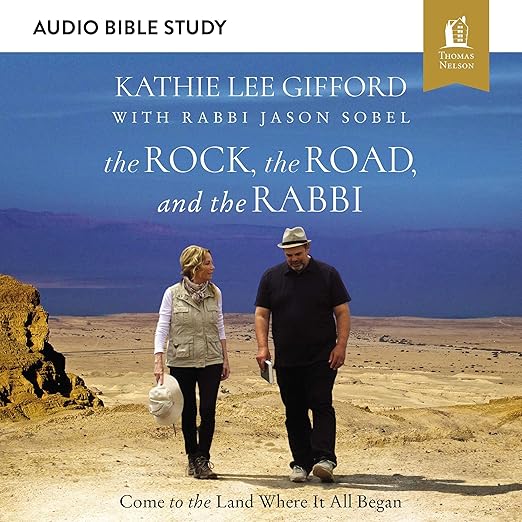
Quick Take
- Narration: Kathie Lee Gifford reading her own Bible study creates a personal, conversational tone that works well for group study material even in solo listening.
- Themes: Messianic Jewish context for Christian faith, Israel as sacred geography, personal testimony and transformation
- Mood: Warm and devotional, structured for reflection rather than passive listening
- Verdict: Works best as a companion to the study guide rather than a standalone audiobook, listeners who engage it as group curriculum will get considerably more from it than solo listeners.
I came to this audiobook from outside the tradition it is written for, which means my perspective on it is going to be different from the listeners who are its intended audience. The Rock, the Road, and the Rabbi is explicitly a Bible study companion, designed to accompany six group sessions exploring the land of Israel and what Kathie Lee Gifford calls the Jewish roots of her Christian faith. I listened straight through on a quiet Tuesday afternoon, which is almost certainly not the intended mode of engagement, and that gap between format and design tells you something important about who this audiobook is really for.
Gifford is a recognizable presence in American media, and her narration of her own material carries the warmth and directness her audience will expect. She reads with conviction rather than performance, and when she describes her personal relationship with what she calls the Lover of her soul, there is nothing calculated about it. Whatever you think of the theology, the devotional sincerity is evident and does not feel manufactured.
Our Take on The Rock, the Road, and the Rabbi
The study is co-authored with Rabbi Jason Sobel, a messianic Jewish rabbi, and that collaboration gives the content a texture that distinguishes it from standard evangelical Bible studies. Sobel’s contributions focus on what the sessions call going beyond Sunday school teaching, digging into original Hebrew and Aramaic languages, examining ancient rabbinical interpretive traditions, and grounding familiar New Testament narratives in their Second Temple Jewish context. For Christian listeners who have never engaged with these layers, the material genuinely opens up dimensions they may not have encountered in church.
Reviewers consistently praised the content for what it reveals about Jewish tradition in relation to Jesus’s life and teaching. One group described learning things they did not know about the life of Jesus and specifically about where he was born. That response is telling, the combination of Gifford’s accessibility and Sobel’s rabbinic depth is landing as genuinely informative for the audience it serves.
Why Listen to This Bible Study
The audio format is the study’s own stated purpose. The publisher explicitly describes this series as designed for listening rather than watching, positioning it as a way to access Bible study content on a commute or during a walk rather than sitting down with a video curriculum. For small group leaders and participants who want to prepare between sessions, the audio format makes the content portable in a way that video does not.
Gifford reading herself also adds something a professional narrator would not: the weight of personal testimony. When she describes her visits to specific sites in Israel and what they meant to her faith, it matters that the voice is hers. Listeners who have followed her career across decades of American television will find something recognizably personal in the narration, and that familiarity is part of what the format is designed to leverage.
What to Watch For in This Study
At one hour and twenty-six minutes, this audiobook is very short for the subject matter it covers. That brevity is by design, it is a companion to a separately sold study guide, not a standalone complete resource. Listeners who pick this up expecting full doctrinal coverage or comprehensive engagement with the history of Israel will find it too brief for those purposes. The audio is the appetizer; the study guide and group discussion are the meal.
The messianic Jewish framing, which treats Jesus as the fulfillment of Jewish prophecy, is the theological lens through which all the content is filtered. Listeners from other faith traditions or secular perspectives will encounter this as a specifically evangelical Christian reading of history and scripture. That is not a hidden agenda, the study is transparent about its framework, but it is worth knowing going in.
Who Should Listen to The Rock, the Road, and the Rabbi
Christian small group participants and individual believers interested in the Jewish historical context of the New Testament will find this genuinely enriching as a six-session complement to the study guide. Solo listeners who engage it without the accompanying materials may find the brevity unsatisfying. Kathie Lee Gifford’s existing audience will feel at home with her voice and perspective. Listeners from outside the evangelical Christian tradition should know they are entering a study shaped by specific theological commitments.
Frequently Asked Questions
Can this be listened to as a standalone audiobook or does it require the study guide?
The publisher recommends pairing it with the separately sold study guide for full benefit. Several reviewers and the book’s own description suggest the guide contains reflection questions and individual study exercises that the audio alone does not provide. As a standalone listen it is brief and somewhat incomplete.
What does Rabbi Jason Sobel contribute to this study?
Sobel provides the messianic Jewish rabbinic scholarship that distinguishes this study from standard Christian devotional material. His contributions include Hebrew and Aramaic language context, ancient rabbinical interpretive traditions, and historical background on the Israel sites Gifford visits.
Is this appropriate for non-Christian listeners interested in Israel’s history?
The study is explicitly Christian in its theological framework and treats Jesus as the fulfillment of Jewish prophecy. Listeners without that orientation will find the historical content interesting but filtered through a specific doctrinal lens that shapes every part of the material.
At under ninety minutes, is this among the shortest audiobooks on Audible?
It is notably brief. The short runtime reflects its design as a six-session study companion rather than a complete standalone work. Think of it as structured audio teaching within a larger curriculum, not a full-length audiobook.