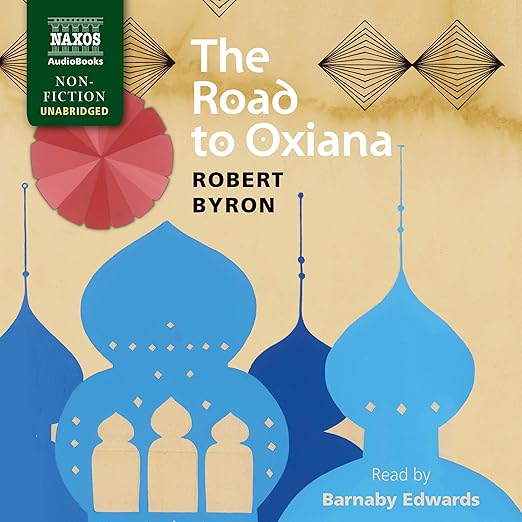
Quick Take
- Narration: Barnaby Edwards reads Byron’s arch, restless prose with the wit and architectural appreciation the material demands, a genuinely excellent match.
- Themes: the search for Islamic architectural origins, travel as intellectual obsession, the world between the wars as a vanishing horizon
- Mood: Erudite and alive, like being in the company of someone too opinionated to be comfortable and too brilliant to leave
- Verdict: One of the masterworks of English travel writing, translated beautifully into audio by a narrator who honors both the comedy and the scholarship.
I came to The Road to Oxiana by a longer route than most. I had been reading Bruce Chatwin for the first time, In Patagonia and The Songlines, and in an essay collection someone mentioned that Chatwin had cited Robert Byron’s 1933 account of traveling through the Middle East as the book that made him want to write. When a writer of Chatwin’s particular strangeness and precision credits a single source with that kind of influence, you pay attention. I spent a week with Barnaby Edwards reading Byron’s diary-form account of his journey from Venice through Cyprus, Jerusalem, Syria, Iraq, Persia, and Afghanistan to the region around the river Oxus. By the end I understood entirely why the book has the reputation it does, and also why it is not for everyone, and I want to be honest about both.
Byron’s Voice and the Particular Pleasure of Intelligent Rudeness
Robert Byron is not a pleasant travel companion in the conventional sense. He is impatient, opinionated, often mercilessly funny at the expense of the people and landscapes he encounters, and entirely uninterested in false diplomatic warmth toward cultures he finds dull or architecture he finds derivative. What saves this from mere period snobbery is the quality of his enthusiasm when something genuinely arrests him. Byron went to Persia and Afghanistan specifically to study Islamic architecture, and when he finds what he is looking for, the prose changes register entirely.
The sequence describing the Gumbad-i-Kabus tower in northern Iran, or the tilework at the Mashhad shrine, is some of the finest architectural writing in the English language. Byron sees buildings the way certain novelists see characters: as records of decisions, ambitions, and constraints, as historical arguments made in brick and tile. His ability to move between waspish social comedy and genuine aesthetic transport without either mode undermining the other is what makes the book remarkable rather than merely interesting.
One reviewer described Byron as a kind of cocktail of Richard Burton, Patrick Leigh Fermor, and Anna Comnena with a very sharp tongue, which is exact. He writes in the tradition of learned British traveler-scholars but with a contemporary energy that feels less dated than almost any of his contemporaries. The 1930s prose does not feel antiquated. It feels precise and, in places, genuinely sharp in ways that contemporary travel writing rarely achieves.
Barnaby Edwards and the Demands of Diary Form
The Road to Oxiana is structured as a diary, which presents narration challenges that a conventional travel narrative does not. The entries vary in length from a single paragraph to several pages. The tone shifts from comic dispatches to technical architectural analysis to genuine physical hardship. Byron and his companion Christopher Sykes travel by truck, camel, horse, and foot, and the diary catches the texture of that variability: boredom, extraordinary beauty, bureaucratic frustration, moments of genuine danger in regions where the infrastructure for travelers had not yet developed.
Edwards navigates all of this with impressive range. His Byron is acerbic without being cartoon-British, intellectually serious without becoming dry, and funny in the moments where Byron is genuinely funny rather than merely sardonic. The architectural passages, which could easily become soporific under a less engaged narrator, are given the same attention Edwards brings to the social comedy. He clearly enjoys the material, and that enjoyment is audible in every section of the performance.
What Is at Stake and What Has Already Disappeared
One of the most quietly devastating aspects of listening to The Road to Oxiana in the present is the knowledge of what has happened to the architectural monuments Byron saw and described. Much of the Islamic architecture he documented has been damaged, partially destroyed, or completely lost in the century since his journey. The tilework he could touch, the inscriptions he could read, the proportions he could measure: some of these exist now only in accounts like his.
This gives the book a documentary weight it did not originally have. Byron wrote a brilliant personal record of an architectural obsession. We are also now reading a record of things that exist in no other form. A reviewer noted that much of the architecture described no longer exists today, making it a window into a time that has passed and likely will never return. That framing is accurate and adds a dimension of historical loss to the aesthetic pleasure of the prose that Byron himself could not have anticipated.
There is also something to be said for the experience of listening to this book in the present, when many of the regions Byron traveled through are places that most Western listeners know primarily through the lens of conflict. Iraq, Afghanistan, Iran, Syria: the travel diary format restores these places to something closer to their own complexity rather than the flattened versions that contemporary news coverage tends to produce. Byron’s interest is in the architecture, not the geopolitics, and that focus is clarifying in ways that are difficult to anticipate before you begin listening. He is not naive about what he sees, but his primary register is aesthetic rather than political, and that provides a kind of relief from more familiar framings.
Who Should Listen, Who May Not Find the Right Frequency
This audiobook is essential for anyone who loves literary travel writing, the history of Islamic architecture, or the particular tradition of British scholarly travel between the wars. Listeners who have enjoyed Chatwin, Peter Matthiessen, Jan Morris, or Patrick Leigh Fermor will find their specific pleasure here. The humor is dry and period-specific, but it ages better than most humor does because it is based on observation rather than fashion.
One reviewer who came to the book without an existing interest in architecture found it a strict travel diary, almost quaint. That response is understandable. If Byron’s central obsession does not interest you even a little, the architectural analysis sections will slow you down considerably. The comedy and the adventure elements carry casual readers through, but the full experience requires some appetite for the argument at the book’s center.
Frequently Asked Questions
Do I need to know about Islamic architecture to enjoy The Road to Oxiana?
Prior knowledge enriches the experience considerably, but it is not required. Byron explains what he is looking for and why it matters with enough clarity that interested general readers can follow the argument. Some familiarity with the region’s history helps, but the social comedy and the adventure elements carry readers who lack architectural background.
How does Barnaby Edwards handle the shift between Byron’s comedy and his architectural scholarship?
With genuine skill. Edwards’ narration does not flatten the tonal shifts. He brings appropriate lightness to the comic social dispatches and appropriate seriousness to the architectural analysis, and the transitions between these registers feel natural rather than mechanical.
Why is The Road to Oxiana considered foundational to modern travel writing?
Its influence on Bruce Chatwin is the most direct line. Byron demonstrated that travel writing could be simultaneously personal and scholarly, funny and rigorous, without either mode compromising the other. The diary form he uses became a template for how subsequent writers structured literary travel accounts, trading conventional narrative arc for accumulated texture.
Is the book’s 1930s context a barrier for contemporary listeners?
Less than you might expect. Byron’s prose is sharp and contemporary in its energy even when the attitudes are period-specific. Some of his characterizations of people and places will read as dated, but the architectural passion and the quality of the observation transcend the era in ways that many of his contemporaries do not.