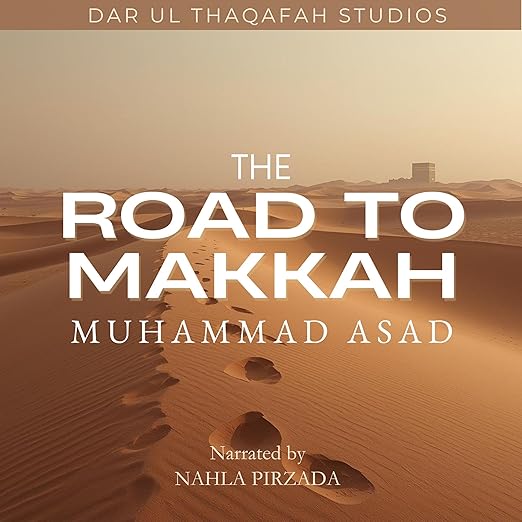
Muhammad Asad's The Road to Makkah is one of those rare audiobooks that earns the word 'life-changing' without exaggeration. Leopold Weiss arrived in the Middle East in 1922 as a young Austrian journalist on assignment. He left years later as Muhammad Asad, a Muslim convert, an Arabic speaker, and a figure trusted by Bedouin tribes and Arabian kings alike. What he wrote about that transformation is not a simple conversion narrative. It is something far richer: a record of a Western mind encountering Islamic civilization and finding in it, not what outsiders expected, but something that answered his deepest intellectual and spiritual questions.
Reviewer M.K. called this book one of the top three favorites of their entire reading life, describing Asad's eloquence as 'unmatched.' Even in the 1920s and 1930s, when European travel writers routinely flattened the Arab world into exoticism and danger, Asad was doing something genuinely different. He was paying attention. His account of desert nights under endless stars, of Bedouin hospitality, of the pilgrim road to Mecca, proceeds with a literary precision that makes the landscape feel immediate even a century later. Reviewer Sergey Shyndriayev, introduced to the book through his local mosque's Islam 101 group, found it more compelling than The Three Musketeers, which captures how fully Asad animates material that could easily have become merely documentary.
Son of Jewish Parents Who Mastered Arabic
What separates this memoir from the crowded genre of spiritual autobiography is Asad's intellectual rigor. He does not arrive at Islam through crisis or despair but through a sustained encounter with a civilization he came to understand from the inside. He traveled by camel across Arabia, sat with Bedouin elders whose way of life had not changed in centuries, and watched the Kingdom of Saudi Arabia take shape around him. Throughout, he was asking the kind of questions that most Western journalists of his era were not equipped to ask: not 'What is strange here?' but 'What is true here?' That distinction drives everything in this memoir and gives it a quality of intellectual honesty that is genuinely rare.
Reviewer nadav haber, noting that Asad was the son of wealthy Jewish parents who came to Palestine in the early 1920s, became an anti-Zionist, and mastered Arabic, points to just how unusual this trajectory was. Asad renders his own evolution with unflinching honesty, never tidying the contradictions into a cleaner story than he actually lived. The portrait of Islam that emerges is, as the synopsis describes, not Islam as dogma but as a lived experience of heart, intellect, and community. That framing reflects genuine understanding rather than convert's zeal, which is why this memoir has continued to matter to readers across cultures and generations.
Pirzada Navigates Desert Travel and Philosophical Argument
The audiobook format suits this memoir in ways that reading off a page does not quite capture. Nahla Pirzada's narration carries a natural register of respect and closeness that matches Asad's voice. The 16 hours and 53 minutes never feel indulgent because Asad does not waste a sentence. His prose moves between the sensory vividness of desert travel and the precision of philosophical argument with remarkable fluency. Pirzada navigates these two modes cleanly, slowing for the meditative passages and keeping rhythm during the more narrative-driven stretches.
The book's structure is deliberately layered: Asad weaves his physical journey through Arabia with memories, theological reflection, and a sustained examination of what he calls a perspective rare for its era. Listeners who come expecting straightforward adventure memoir will find the philosophical depth surprising. Those who come looking for a sophisticated treatment of Islamic theology, law, and ethics will find the travel sections add color and texture rather than distraction. It is an unusual balance, and Asad maintains it throughout with a control that marks the best literary nonfiction. Listening across multiple sessions rather than in a single sitting allows each section's ideas to settle before the next arrives.
A 1954 Book Doing Double Work
This memoir was published in 1954, and some of its framing, particularly around Western perceptions of Arab civilization, reflects mid-century intellectual debates that contemporary readers will need to contextualize. Asad writes as someone arguing against his era's dominant assumptions, which means the reader is often doing double work: following his argument and reconstructing the assumptions he is dismantling. That extra layer of engagement is rewarding rather than burdensome, but it requires patience and occasionally a pause for reflection.
There are moments in the middle portion where Asad's theological excursions become quite dense. He is genuinely interested in the juridical and ethical dimensions of Islamic thought, not just the spiritual or sensory ones, and he does not simplify for a general audience. Listeners unfamiliar with Islamic theology may want to treat those passages as introductory reading rather than comprehensive exposition, following the thread of his argument without expecting to master every nuance on a single listen. A second hearing of those chapters often rewards considerably.
The Outsider Who Became an Insider
This audiobook rewards listeners who approach it as an extended intellectual encounter rather than casual background listening. It suits anyone with a genuine interest in Islamic civilization, in the history of religious conversion, or in literary travel writing of the highest order. Readers who loved T. E. Lawrence's Seven Pillars of Wisdom will find a fascinating counterpoint here: the outsider who genuinely became an insider, telling a story Lawrence never could have told. Those who came to know Asad first through his Quran translation will hear a different but equally compelling voice in this memoir. It is not suited to listeners looking for brisk narrative; this is a book that requires you to settle in and travel at Asad's pace, which is generous, deliberate, and entirely worth the commitment.
Quick Take
- Narration: Nahla Pirzada brings an intimacy and vocal warmth to Asad's prose that feels like a genuine match for a memoir this personal and searching.
- Themes: Spiritual conversion, Western misunderstanding of Islam, desert travel and Bedouin culture
- Mood: Contemplative, luminous, and quietly revelatory
- Verdict: One of the twentieth century's great spiritual memoirs gets an audiobook treatment that honors its depth and literary authority.
Good to Know
Does the audiobook of The Road to Makkah work well for listeners unfamiliar with Islamic theology?
Yes, though with some patience. Asad writes for an intelligent general reader rather than a specialist, and Pirzada's narration makes the denser theological passages easier to absorb. Listeners new to Islamic thought will encounter concepts they may need to sit with, but the surrounding narrative context helps considerably.
Is The Road to Makkah better read or heard as an audiobook?
The audiobook format adds a meditative quality that suits the memoir's reflective pace. Pirzada's voice gives Asad's Arabic-inflected prose a natural intimacy that page reading can flatten. At nearly 17 hours, it rewards listening in longer, unhurried sessions.
Do I need any background in Middle Eastern history to follow this audiobook?
A basic familiarity with the region and the early twentieth century helps, but Asad is a skilled enough storyteller to bring readers up to speed without lengthy digressions. The political context, including the formation of Saudi Arabia, emerges naturally through his narration.
Is this audiobook suitable for listeners who are skeptical of religious memoirs?
Asad writes as a journalist and intellectual as much as a believer. His path to faith runs through sustained rational inquiry, and he never asks the reader to accept his conclusions. Skeptical listeners will find his process, rather than his destination, the more compelling part of this memoir.