In Brief
- Narration: Arthur Morey handles the meditative, philosophical passages with care, and the production note that David Brooks himself also reads portions gives the audiobook an added layer of authorial presence.
- Themes: Moral depth versus external achievement, the historical tradition of character formation, selflessness as a path to fulfillment
- Mood: Reflective and genuinely challenging, the kind of listen that asks something back of you
- Verdict: Brooks's most personally invested book is also his most useful, and the audiobook format fits its meditative ambitions well.
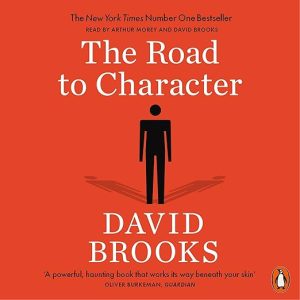
David Brooks's The Road to Character opens with a confession that few bestselling authors are willing to make: Brooks admits that he found himself, after years as a prominent cultural commentator, living in a shallow mode, focused on career advancement and public reward rather than genuine moral depth. That admission is the engine of the entire book, and in the audiobook format, with Arthur Morey's narration and Brooks's own voice in certain sections, it lands with an immediacy that makes the intellectual argument feel personal in the best sense. This is the kind of audiobook that asks you to take stock of your own life alongside the figures being profiled, and the format's intimacy is well-suited to that demand.
The book's structural premise is to examine historical figures who faced their weaknesses and transcended their limitations to develop what Brooks calls the road to character. Among them are St. Augustine, George Eliot, Dwight Eisenhower, and Samuel Johnson, each chosen because they built a life of significance not through self-promotion but through a specific kind of self-forgetting. The central argument, that genuine fulfillment requires learning to forget yourself in service of something larger, runs as a counterweight against what Brooks describes as a cultural moment that consistently rewards personal branding over the cultivation of virtue.
Samuel Johnson's Portrait Anchors the Case Studies
The strongest sections of the book are the biographical portraits. Brooks is a fluent prose stylist, and the sketches of each historical figure are illuminating not as hagiography but as case studies in how specific human beings, with specific flaws, chose the harder path toward moral seriousness. The chapter on Samuel Johnson is particularly striking, a portrait of a man riven by depression, physical difficulty, and moral self-doubt who nonetheless built a life of extraordinary usefulness and compassion. Brooks does not present these figures as perfect. He presents them as people who understood that their weaknesses were precisely the material from which character could be built.
One reviewer wrote that the book reads as if Brooks was speaking directly to their own life, and that quality of personal address is built into the writing rather than manufactured by the narration. A reviewer who spent twenty-one pages of notes on this book described it as raising the bar for nonfiction writing that takes seriously the question of how to live. That scale of response reflects something real about the book's ambitions and, largely, its achievements. Another reader described the experience as being unable to stop, which speaks to the audiobook's propulsive quality despite its meditative subject matter.
Brooks and Morey Share the Reading Duties
The audiobook is produced with both Arthur Morey and David Brooks reading sections of the text. Brooks has a distinctive, thoughtful voice that suits the material, and his direct presence in the recording adds a texture that strictly produced audiobooks often lack. Morey is a capable narrator with a clear, measured delivery that handles Brooks's denser philosophical passages without flattening them. The interplay between the two voices gives the production an unusual quality, somewhere between a traditional audiobook and a personal essay delivered aloud, which fits the book's confessional framing.
At just over twelve hours, the runtime is appropriate for the material. Brooks is not a writer who rushes his arguments, and the audiobook rewards patient listeners who are willing to stay with a biographical portrait across an extended listening session. This is not a book to absorb in ten-minute increments; it benefits from longer blocks of attention where the accumulation of examples and the development of the central argument can build properly. Those who are familiar with Brooks's New York Times column will recognize his characteristic movement from historical example to contemporary application, and the audiobook format makes that rhythm feel more like a lecture than a newspaper read, which suits it better.
Rooted in a Western Religious Tradition
The book's argument is grounded in a tradition of moral formation that is broadly Western and, in several of its case studies, explicitly religious. Brooks draws on St. Augustine, on Christian notions of humility and service, and on a tradition of moral reflection that some secular listeners may feel is culturally weighted. Brooks is not writing as a theological apologist, and the argument is framed in broadly humanistic terms, but the cultural lineage is evident throughout. Listeners who are strongly skeptical of that tradition may find the source material less persuasive than readers who share or are sympathetic to it.
The book has also been critiqued for an unevenness in its historical portraits. Some figures receive more fully developed treatment than others, and the unifying argument occasionally feels imposed on material that is more ambiguous than the framework allows. A reviewer who approached it as a profile-in-courage study noted the philosophical trajectory while observing that the argument does not always emerge cleanly from every biographical subject. These are minor structural issues in an otherwise coherent and significant work.
Offers Models Instead of a Five-Step Plan
This audiobook is well-suited for listeners interested in ethics, character formation, biography, and the broader question of what constitutes a meaningful life. Readers who enjoy books that sit at the intersection of intellectual history and personal reflection will find it particularly engaging. It is not primarily a self-help book in the prescriptive sense: Brooks does not offer a five-step plan. He offers a set of historical models and a sustained argument for taking the interior life more seriously than contemporary culture tends to encourage. Listeners who require actionable frameworks and concrete tools will find the book operating at a more essayistic register. For everyone willing to sit with a serious argument about moral depth and the two natures Brooks identifies in all of us, this audiobook delivers something more lasting than its bestseller status might suggest.
Common Questions
Does David Brooks himself narrate the audiobook of The Road to Character?
The audiobook notes that both Arthur Morey and David Brooks read the text. Brooks's presence in sections of the narration adds an autobiographical texture to portions of the recording, given how personally invested the book's argument is.
Is The Road to Character audiobook appropriate for book clubs or group listening discussions?
It is very well suited to group discussion. The biographical portraits raise specific, discussable questions about moral choices and the trade-offs between external success and internal integrity. The book generates the kind of extensive personal note-taking among individual readers that typically signals strong group discussion potential as well.