Quick Take
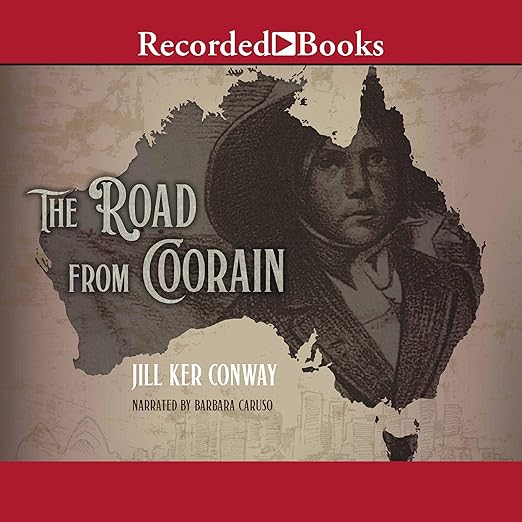
- Narration: Barbara Caruso reads with precise, measured authority that honors Conway’s formal prose without turning it cold – a well-matched pairing, and the inclusion of an author afterword adds a documentary dimension.
- Themes: The Australian outback as character and adversary, a daughter’s reckoning with a consuming mother, the gendered ceilings of mid-century intellectual life
- Mood: Austere and lyrical – the emotional restraint of the writing is its own kind of intensity
- Verdict: One of the finest Australian memoirs in print, and an audiobook that earns its keep through Caruso’s faithful, intelligent reading and Conway’s exceptional prose.
I read The Road from Coorain first in print, years ago, and came back to this audio version on a long drive through flat country – the kind of landscape where the horizon just keeps receding and you start to understand viscerally why the western plains of New South Wales in a drought year would break a family. Conway’s prose has that effect on you. She describes the land with a precision that is not romantic and not brutal but somehow both at once, and in the car with Caruso reading, the distance between me and that 1944 landscape collapsed in a way it had not quite done on the page.
Jill Ker Conway’s memoir follows her from early childhood on Coorain, a sheep station deep in western New South Wales, through the devastating drought that destroyed the family’s livelihood and killed her father, into Sydney and eventually to the intellectually suffocating milieu of the Sydney establishment in the 1950s. It is a book about landscape, about a formidably difficult mother, about a woman trying to build an intellectual life in a society that had no particularly comfortable place for women who thought the way she did. It is also, quietly, one of the most controlled pieces of autobiographical prose written by an Australian in the twentieth century.
The Land as the Book’s True Subject
The opening chapters – set on Coorain before the drought – are among the most beautiful passages of landscape writing I have encountered in memoir. Conway is not sentimentalizing the outback. She is describing a genuinely harsh and alien environment with the clarity of someone who grew up inside it rather than visiting it. The sheep, the dust storms, the seasons, the astronomical distances between properties – all of it lands with the weight of real knowledge rather than literary effect. When the drought arrives and the country begins to die around the family, it reads not as pathetic fallacy but as documented catastrophe, which is harder to write and more devastating to absorb.
What the audio format adds to this section is a quality of sustained attention. These passages are dense with specific observation, and the temptation in print to skim landscape description is harder to indulge when Caruso is reading them at the pace they deserve. She does not rush the land chapters. That is the right decision.
The Mother, the Relocation, and What Sydney Cost
The book’s second movement – Sydney, the University of Sydney, the social protocols of a class-conscious city – is where some readers have found Conway’s restraint frustrating. Her mother is a dominating, ultimately destructive presence, and Conway writes about her with a control so precise that it occasionally reads like withholding. One reviewer noted that the impact of her life story is sometimes slowed by her mother’s wants and needs. I read that differently: the slow, grinding weight of an emotionally dependent parent is exactly what Conway is trying to convey, and the memoir’s pacing enacts rather than just describes that experience.
What does come through clearly, and what makes this book essential beyond its Australian specificity, is the portrait of institutional gender discrimination at mid-century. Conway wanted an intellectual life on her own terms. The Sydney establishment was not designed to accommodate that desire. She documents the obstacles – condescension, blocked appointments, the expectation that her role was to support others’ work rather than produce her own – with the same precision she brings to the land. It is not angry writing. It is something colder and more accurate than anger.
Barbara Caruso and the Author Afterword
Caruso has the kind of voice that suits formal autobiographical prose: clear, cultivated, neither warm nor cold but genuinely attentive. She reads Conway’s long, architecturally elaborate sentences without letting the subordinate clauses become obstacles, and her control of the book’s emotional register – which asks for restraint where a less careful reader might reach for emphasis – is impressive throughout. The inclusion of an audio afterword by Conway herself is a genuine addition. Hearing the author’s voice after nine hours of Caruso is not disorienting; it is illuminating. Conway’s own delivery is quieter and more clipped than Caruso’s, which tells you something about the gap between the writer’s private voice and the public-facing prose. It is worth staying for.
Who This Is For, and Who It Is Not
This is not a fast or easy listen. It requires the kind of sustained attention that long landscape passages and controlled emotional restraint demand. Readers looking for dramatic narrative arc or catharsis will find the memoir unsatisfying – Conway does not give you the emotional release you might expect from a story with this much loss in it. What she gives you instead is something rarer: an account of how a particular mind was formed by a particular place, and what it cost to leave both the place and the mind’s first assumptions behind.
Frequently Asked Questions
Does this audiobook include the author’s afterword, and is it worth listening to?
Yes, the audio edition includes an afterword read by Jill Ker Conway herself. It is brief but adds genuine documentary value – hearing Conway’s own voice after Barbara Caruso’s reading makes the relationship between author and narrator audible, and Conway’s clipped delivery is its own kind of revelation.
How does Caruso handle Conway’s long, formally structured sentences?
Very well. Conway writes in complex, architecturally elaborate prose that some narrators would simplify by placing stress incorrectly or losing the thread of long subordinate clauses. Caruso tracks the syntax reliably and maintains the emotional restraint the writing demands throughout.
Is this memoir primarily about the Australian outback, or about gender and intellectual life?
Both, and inseparably so. The opening chapters are dominated by landscape and the drought that destroyed the family’s station. The second half shifts to Sydney and the gendered obstacles Conway faced as she tried to build an academic career. The two sections form a coherent argument: the land shaped who she was, and Sydney tried to contain what that person became.
The book is described as memoir but has won awards as history – what genre does it actually belong to?
It reads as literary memoir. Conway writes in retrospective first person about her own life, but the level of historical and sociological observation about Australian society in the 1940s and 1950s gives it the texture of social history. Readers who enjoy Tim Winton’s Australian landscapes or literary biography will find the register familiar, even though this is nonfiction.