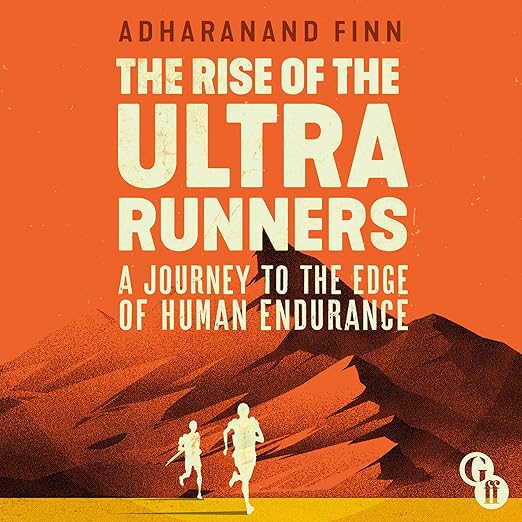
Key Details
- Read by: Adharanand Finn narrating his own book brings the self-doubt and wonder of a participant-observer directly into the listening experience, with conversational delivery that suits first-person journalism.
- At its heart: The psychology of extreme endurance, the line between passion and compulsion, sport as a search for meaning beyond the finish line
- Vibe: Curious and self-questioning, with bursts of competitive intensity during race passages that pull against the reflective tone
- Short version: Finn's self-narrated account of entering the ultra running world is the best kind of sports memoir: one where honest uncertainty about motivation carries as much weight as the races themselves.
Adharanand Finn's premise in The Rise of the Ultra Runners begins from a position of genuine incomprehension, and the audiobook is better for it. Marathons are no longer impressive, the synopsis announces, and Finn explores that sentence not as a provocation but as an honest puzzle. He narrates his own ten-hour-and-twenty-six-minute audiobook, and the self-narration works because Finn writes in the first person with the candor of someone who genuinely did not know whether he would complete a 105-mile mountain race when he started training for it. That uncertainty is present in his voice throughout, and it distinguishes the book from the category of sports memoirs that arrive already knowing their conclusions.
The book takes Finn from Oman's deserts to the Rocky Mountain peaks, from a twenty-four-hour track race in Tooting to his eventual goal: the Ultra-Trail du Mont-Blanc, one of the most demanding ultramarathons in the world. Along the way he profiles the community of ultra runners, a group that reviewer Alliouga describes as including colourful characters whose lives Finn captures with his usual great sense of humor. Finn's earlier book about running in Kenya established him as a writer who approaches sport through both personal immersion and cultural curiosity, and The Rise of the Ultra Runners extends that method into terrain where the sport itself raises genuine questions about what it means to push the body past every rational limit it possesses.
Disjointed in Architecture, Compulsively Readable
Reviewer Duane Schneider's note that the book initially jumps from topic to topic before Finn finds his voice is an accurate structural observation. The early chapters move between character profiles, race histories, and Finn's own training narrative without a clear organizing principle, and this can feel loose to listeners accustomed to the tighter structure of narrative nonfiction. But Schneider also devoured the book in only a few settings, and that tension describes precisely the book's appeal: slightly disjointed in formal architecture but compulsively readable in execution, a book whose pleasures are in the quality of individual scenes and observations rather than in the clarity of the overall shape.
The central question Finn pursues is the one his synopsis frames most directly: is ultra running an antidote to modern life or a symptom of a modern illness? He pursues that question through encounters with runners whose motivations range from spiritual to competitive to self-destructive, and he never lets himself off the hook by arriving at a comfortable answer. Reviewer James McKinstry praises the insight into how the mind works, and the psychological dimension of the book, the hallucinations during night races, the way pain stops registering as pain above a certain threshold, the social ecosystem that sustains athletes through impossibly long efforts, is handled with genuine curiosity rather than either glorification or alarm.
Finn's account of the twenty-four-hour track race in Tooting is one of the most affecting sections of the book, precisely because the setting is so unglamorous: no mountain backdrop, no dramatic landscape, just a loop of track in south London and hundreds of hours of accumulated effort. The contrast with the UTMB's cinematic terrain makes a point about what ultra running actually is at its core, separate from its most photographable expressions, and Finn's narration of his own confusion and exhaustion during that race is where the self-narration earns its keep most fully.
Uncertainty in His Voice Nobody Could Fake
Self-narration is particularly effective in participant-observer sports writing because the uncertainty is real, not performed. When Finn describes his own physical limits during training, or the moment during the UTMB when he has to make a decision about whether to continue, the listener hears the same person who made that decision describing it. That specificity cannot be replicated by a hired narrator reading from a completed manuscript, and Finn's conversational delivery keeps the performance accessible even when the subject matter becomes physically extreme.
Reviewer Alliouga, who describes not being an ultra runner and not being able to aspire to the levels of Finn or any of the other runners in the book, finds the audiobook inspiring regardless. That response to a sports memoir, being moved by a world you do not participate in and could not enter, is a test of writing quality rather than audience-identification, and The Rise of the Ultra Runners passes it consistently. The characters Finn encounters are rendered specifically enough that their performances carry emotional weight even for listeners who have never run more than a few miles at a stretch.
A Misleading Title for Personal Journalism
The structural looseness that reviewer Duane Schneider identifies is a genuine consideration for listeners who prefer tightly organized narrative nonfiction. The book moves between Finn's personal training narrative and broader cultural and psychological analysis without always signaling clearly which mode it is operating in, and the early chapters particularly reflect this. Listeners comfortable with that kind of essayistic movement will not find it disruptive, but those who want a linear race-to-race structure should know the form in advance.
The title also overpromises slightly on coverage. Schneider flags it as a misleading title, and that caveat holds: this is Finn's personal account of entering the sport and encountering its community rather than a comprehensive survey of ultra running's global growth and cultural significance. The book is personal journalism rather than cultural history, and its pleasures are consistently in the specific, observed, and felt rather than in the comprehensive and analytical.
Suited to Runners Past the Marathon Distance
This audiobook is well-suited for runners who have exhausted the marathon distance and are curious about what comes next, for sports memoir readers who appreciate participant-observer writing, and for anyone interested in the psychology of extreme endurance rather than just its mechanics and records. Non-runners who enjoyed Finn's Kenyan running book or similar works of embedded sports journalism will find the same qualities here in a more extreme context. Listeners wanting a comprehensive overview of ultra running as a sport rather than one writer's honest account of stumbling into and through it should look for other sources to supplement this one.