Quick Take
- Narration: Jonathan Haidt reads his own work with the clarity of a practiced lecturer, though the delivery occasionally prioritizes explanation over emotional engagement.
- Themes: Moral psychology, political tribalism, the evolutionary roots of groupishness
- Mood: Intellectually bracing, occasionally unsettling in the best sense
- Verdict: One of the more genuinely illuminating social psychology audiobooks of the past decade, and more urgent now than when it was published in 2012.
I finished The Righteous Mind on a long flight, somewhere over the Atlantic, which felt appropriate. There is something clarifying about being suspended between continents when you are listening to a book that argues we have all been systematically wrong about why we believe what we believe. I had assigned excerpts from this to a journalism seminar I once ran, but I had never experienced Haidt reading it himself, and that turned out to matter more than I expected.
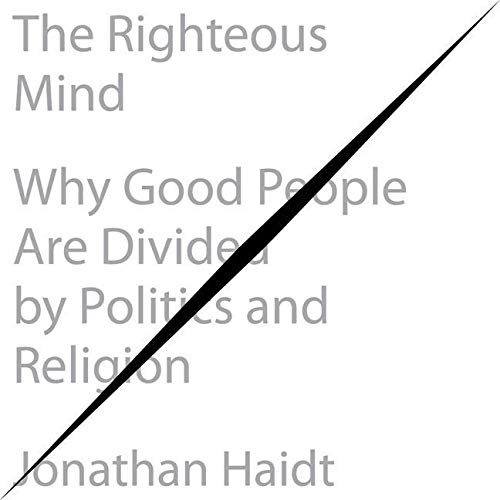
The Righteous Mind, published in 2012, is social psychologist Jonathan Haidt’s investigation into the psychological architecture underlying moral and political disagreement. His core argument is structured in three parts: that moral reasoning functions primarily as post-hoc rationalization of intuitions rather than as deliberate analysis; that moral intuitions differ across cultures in ways that map onto a set of identifiable foundations; and that human beings are fundamentally groupish, and that this groupishness shapes everything from religion to political affiliation.
Our Take on The Righteous Mind
What makes this book unusual is its willingness to extend genuine charity to positions across the political spectrum while still landing on clear empirical claims. Haidt’s argument that conservatives navigate the full moral domain more fluently than liberals, because liberals tend to overweight care and fairness while underweighting loyalty, authority, and sanctity, is the kind of observation that makes ideologically committed readers uncomfortable regardless of which side they occupy. That discomfort is the point, and the audiobook format, with Haidt reading the argument in his own measured voice, preserves the sense that you are listening to someone working through an idea rather than selling one.
One reviewer with a political science background described it as an unusually difficult review to write because of mixed feelings, which captures something real about the experience. The book is brilliant on mechanism and occasionally frustrating on implication. The final chapter on ideology and civility is the weakest, reaching for practical conclusion in territory that the preceding analysis has deliberately complicated. But the analytical core is genuinely original and holds up.
Why Listen to The Righteous Mind
Author-narrated non-fiction lives or dies on whether the author can speak rather than just write, and Haidt passes that test. His background as a teacher is evident in how he telegraphs structure and summarizes key claims before expanding them. The lecture quality that one reviewer labeled military-instructor-education rhetoric is present, but it works in audio because it helps the listener hold a complex argument across eleven hours. The blend of research from anthropology, evolutionary psychology, and political science requires consistent orientation, and Haidt provides it.
The book also rewards the full listen rather than selective sampling. The three-part structure is cumulative. The moral foundations framework in the middle section only fully lands once you have absorbed the elephant-and-rider metaphor from the first section, and the groupishness argument at the end requires both prior sections as foundation. Dipping in and out will cost you the argument’s architecture.
What to Watch For in The Righteous Mind
Several reviewers noted that the book is written from a scientific rather than political or sensational perspective, which is accurate but also worth contextualizing. Haidt’s conclusions about what conservatives get right that liberals miss have been read as endorsement rather than analysis by some audiences, and while that reading misrepresents his argument, it is worth knowing the controversy exists before you recommend this to someone in a polarized context. The science is careful; the politics of the science are more complicated.
The 2012 publication date also means some of the political landscape Haidt references has shifted. His observations about liberal and conservative moral psychology remain empirically supported, but the specific party structures and cultural flashpoints he references have evolved considerably since the book appeared.
Who Should Listen to The Righteous Mind
Anyone curious about why political conversations feel so intractable despite both sides believing they are being reasonable will find this the most useful 11-hour investment they can make in understanding that problem. It rewards listeners with some background in psychology or sociology but is fully accessible to interested general readers. Those looking for a book that confirms their existing political views will be disappointed regardless of which direction they lean, which is probably the clearest possible endorsement of the book’s honesty.
Frequently Asked Questions
Does Jonathan Haidt narrating his own book add or detract from the experience?
Largely adds. Haidt has the structured clarity of a practiced lecturer, and hearing him deliver his own argument preserves nuances of emphasis that a professional narrator might miss. The delivery is more explanatory than expressive, but for a social science text of this density, that is the appropriate register.
Is The Righteous Mind now outdated given how much the political landscape has shifted since 2012?
The empirical claims about moral psychology remain well-supported and are arguably more relevant now than when the book was published. Specific political references have dated, but the underlying framework for understanding moral disagreement has held up across the intervening years.
Does Haidt favor one political side over the other in his analysis?
No, though he argues that conservatives tend to draw on a wider range of moral foundations than liberals, which some readers interpret as bias. His goal is descriptive accuracy rather than political advocacy, and the final chapter explicitly calls for insights from both left and right.
Is this audiobook suitable for listeners with no background in psychology?
Yes. Haidt builds his framework from first principles and defines key concepts as he introduces them. A background in psychology enriches the experience but is not required to follow or benefit from the argument.