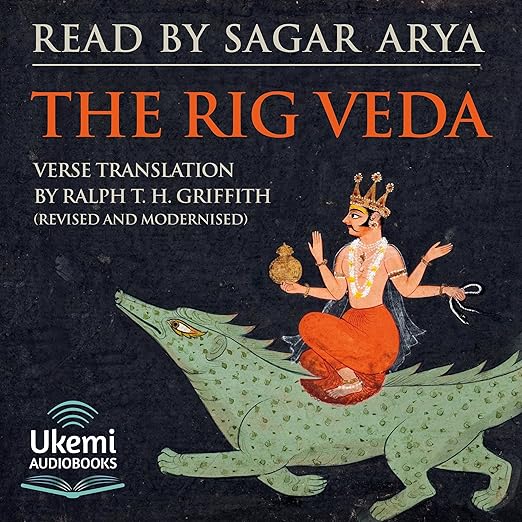
Quick Take
- Narration: Sagar Arya reads from within the Rgvedic tradition, responding to the ritual and poetic character of the verses with genuine attentiveness; his performance is one of the production's strongest assets.
- Themes: cosmic order and ritual, the origins of Hindu theology, the intersection of nature and the sacred
- Mood: Meditative, ancient, and demanding, requiring patience and an appetite for poetry at scale
- Verdict: A serious and respectful audio presentation of one of humanity's oldest surviving texts, essential for those approaching the Rig Veda directly, but not casual listening.
Forty-one hours is a long time to spend with any text. Forty-one hours spent with the Rig Veda is something else entirely: an immersion in the oldest surviving layer of the Sanskrit literary tradition, a collection of 1,028 hymns composed around 1500 BCE and preserved initially through oral recitation before being written down some twelve hundred years later. I came to this Ukemi production having already spent time with other Vedic texts in translation, and I will say plainly that the experience of hearing these poems rather than reading them is more appropriate to their nature. They were composed to be sounded, not read silently from a page.
Sagar Arya reads throughout, and the decision to cast a narrator who comes from within the tradition is the right one. Translator Anwesha Arya, who revised and modernized the Ralph T. Griffith 1896 translation that forms the basis of this recording, also newly translated the more explicitly worded verses that Griffith avoided, making this the most complete English audiobook version of the text available. That matters for listeners approaching the Rig Veda as a primary source rather than a purely devotional encounter.
Our Take on The Rig Veda
The ten books, or mandalas, move through hymns to Agni the fire deity, Indra the storm lord, Varuna the keeper of cosmic order, and dozens of other divine figures. The Suryasukta in the tenth mandala, the model marriage of the Sun to the daughter of the Moon, remains part of every Hindu wedding ceremony today. Hearing it in audio gives a sense of why: the verses have a rhythmic insistence that print representation cannot fully convey. One reviewer, approaching the text as part of a lifelong study of ancient belief systems alongside Egyptian and Sumerian works, called this a substantial and important listen. Another described the translation as clear and comprehensive, presented as clearly as translation will permit.
Why Listen to The Rig Veda
The Ukemi production gives the material room. Sagar Arya does not rush the hymns, responding instead to what the production describes as the varying character of the verses, their ritual intensity, their lyrical flights, their more practical and sometimes explicitly earthy passages. Listeners who have approached ancient texts through academic translations will find this a significantly more engaging medium. The original emphasis was always on sounding the words correctly, and a recording honors that intention in a way that a printed page cannot. This is the format these poems were made for, and the production is aware of that responsibility.
What to Watch For in The Rig Veda
This is an English translation only. There is no Sanskrit text or transliteration, a limitation one reviewer noted with mild disappointment. Listeners who want to follow the Sanskrit alongside the English will need to supplement with another resource. The text is also dense by nature: these are ritual hymns addressed to deities across a highly specific cosmological framework, and listeners unfamiliar with Vedic mythology may find the early mandalas demanding without some contextual reading. This is also, at forty-one hours, a commitment that requires intentional listening rather than background audio.
Who Should Listen to The Rig Veda
This audiobook serves scholars, students of comparative religion and mythology, and practitioners within the Hindu tradition who want to encounter the foundational text in a format close to its oral origins. Listeners drawn to primary sources, who have worked through Egyptian or Mesopotamian religious literature and want to continue into the Vedic tradition, will find this production a serious and worthwhile undertaking. Casual listeners approaching this as background audio or without prior context will find the material opaque. The investment in preparation pays off in depth of experience for those who bring the necessary patience. The Rig Veda is not a text that rewards speed or distraction. It was composed by people who believed sound itself carried meaning, and listening to it slowly, attentively, across many sessions is the closest a modern listener can come to the conditions under which these poems originally lived and moved through the world.
Frequently Asked Questions
Does this audiobook production of the Rig Veda include the Sanskrit original or just the English translation?
This is an English translation only, based on Ralph T. Griffith's 1896 version revised and modernized by translator Anwesha Arya. There is no Sanskrit text or transliteration included. Listeners wanting the Sanskrit alongside the English will need a supplementary printed edition.
How does translator Anwesha Arya differ from the original Griffith translation?
The Griffith translation, completed in 1896, avoided the more explicitly sexual verses. Anwesha Arya newly translated these passages for this Ukemi recording, making it a more complete English version of the full 1,028 hymns than earlier translations.
Is prior knowledge of Hinduism or Sanskrit necessary to appreciate this audiobook?
Some familiarity with the basic framework of Vedic mythology helps considerably, particularly the major deities and the cosmological structure of the mandalas. Without that grounding, the early hymns can feel repetitive and opaque. Supplementary reading alongside the audio is recommended for listeners new to the tradition.
Why is Sagar Arya particularly suited to narrate the Rig Veda?
Sagar Arya comes from within the Rgvedic tradition, which the production notes explicitly. Translator Anwesha Arya also comes from a family of Rgvedic priests. This background gives the narration a relationship to the material that extends beyond technical performance, and listeners familiar with the tradition have noted the difference.