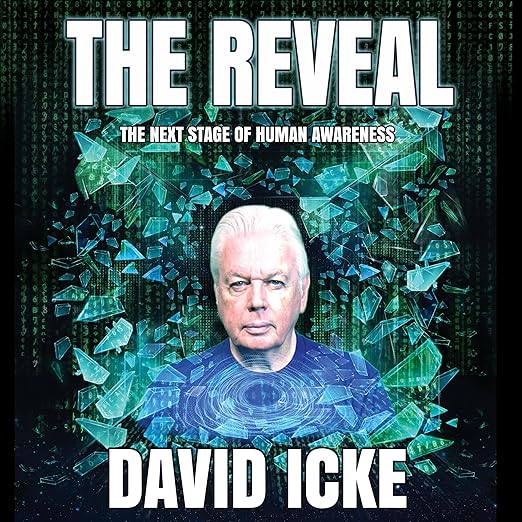
Quick Take
- Narration: David Icke reading his own work gives the performance an unmistakable authority and commitment – for believers in his worldview, hearing Icke himself is the main draw; for critical listeners, the self-narration amplifies the persuasive register throughout.
- Themes: Simulated reality and consciousness, global power structures, spiritual awakening and perception
- Mood: Urgent and expansive, with the rhetorical conviction of a speaker who considers himself a messenger
- Verdict: The third installment in Icke’s Reality Trilogy will satisfy his established readership completely – and represents a twenty-one-hour commitment that is unlikely to convert skeptics or reward listeners approaching without prior familiarity with his framework.
Twenty-one hours is a significant commitment, and I think honesty requires me to set the context clearly before anything else. David Icke is one of the most widely read conspiracy theorists in the English-speaking world, and The Reveal is the third book in his Reality Trilogy, following The Trap and The Dream. It is published by his own imprint, Ickonic Enterprises, and narrated by Icke himself. The audience it is written for is the audience that has already read the first two books and wants to go further in the same direction.
I am reviewing this book because it appears in our data and has a genuine readership – 189 ratings with a 4.6 average is not trivial – and those readers deserve a clear-eyed assessment of what they are getting. But I am also reviewing it as a literary critic and former editorial professional who takes seriously the question of what a book is claiming and on what basis.
Our Take on The Reveal
The book positions itself as the culmination of Icke’s thirty-five-year research project into what he describes as the big questions of human existence: who we are, where we are, and who or what is actually in control. The framework is that we live in a simulated holographic matrix controlled by entities Icke identifies variously as Yaldabaoth, Saturn, or forces he has written about in prior books. The Reveal promises to take this further than he has gone before, covering questions about the nature of the afterlife, the mechanisms of global control, and what he calls the next stage of human awareness.
For Icke’s readership, this is exactly what they came for. Reviewer Jason Stratos described listening to it three times and counting, calling it the most accurate account he has encountered on these topics. Reviewer Patrick Peterson called it a must-read for understanding how to escape what he describes as the simulated trap. These responses reflect a reader community that finds Icke’s framework explanatorily powerful and spiritually meaningful.
Why Listen to The Reveal
Icke reading his own book is the genuine draw for his audience. His performance carries the conviction of someone who has been making these arguments in public for three decades and whose certainty has never visibly wavered despite sustained criticism and, as he frequently notes, ridicule. For listeners who are already within the worldview, that certainty is reassuring and galvanizing. Reviewer Jason Stratos specifically recommended the audio version for exactly this reason.
The book’s scope is genuinely ambitious. Icke covers a broad range of interlocking subjects – from geopolitical power to consciousness to what he presents as the true nature of reality – and his connecting-the-dots method, as reviewer KC described it, is internally consistent within its own premises. KC offered one of the more measured assessments in the review set, acknowledging that most people would reject Icke’s theories while also noting the structural coherence of his argument on its own terms.
What to Watch For in The Reveal
I am not in a position to review this book in the way I would review a conventional work of nonfiction, because the factual claims it makes are not supported by verifiable evidence in the conventional sense. Icke presents as fact conclusions about the nature of reality, the existence of specific controlling entities, and the history of human civilization that are not substantiated by mainstream scholarship, scientific research, or historical documentation. His self-description as having been proved right decade after decade is asserted rather than demonstrated.
This does not mean the book has no value for its intended audience, who may approach it as spiritual cosmology rather than empirical argument. But readers who are new to Icke’s work and considering this as an introduction to his ideas should be aware that the Reality Trilogy operates as a closed system – Icke cites his own prior books extensively, and the framework is self-reinforcing in ways that limit external verification. KC’s review describes this clearly: the question is not whether the book is internally coherent but whether its premises connect to external reality in ways that can be tested.
Who Should Listen to The Reveal
Listeners who have read The Trap and The Dream and found those books meaningful and illuminating will find The Reveal a satisfying conclusion to the trilogy. For Icke’s established audience, the self-narration, the expanded scope, and the culminating framing of the Reality Trilogy make this the obvious next listen. Those new to Icke’s work should begin with his earlier books rather than here, as the trilogy builds progressively on concepts established in prior volumes. Listeners approaching with academic interest in how conspiracy cosmologies are constructed, argued, and sustained will find twenty-one hours of primary material. Those looking for investigative journalism, peer-reviewed research, or verifiable claims about global power structures will need to look elsewhere.
Frequently Asked Questions
Is The Reveal the right starting point for someone who has never read David Icke before?
No. This is the third book in Icke’s Reality Trilogy and builds directly on The Trap and The Dream. Icke references his own prior framework extensively throughout, and many of the conceptual terms and conclusions are established in earlier books. New readers would benefit from starting with The Trap, or with one of Icke’s earlier, more foundational titles, before approaching this one.
Does David Icke narrating his own work change the listening experience compared to a professional narrator?
Significantly. Icke’s self-narration gives the book the quality of a live lecture or manifesto delivery – his rhetorical conviction, the specific emphases he places, and his familiarity with his own material create an authoritative listening experience for those already within his worldview. For listeners approaching critically, the same qualities can feel more persuasive than a disinterested narrator would be, which is worth factoring into your listening experience.
How does The Reveal relate to The Trap and The Dream – can it be read independently?
Icke describes the three books as the Reality Trilogy, and The Reveal is positioned as the culminating synthesis of the framework developed in the first two. Reviewers who have read all three describe it as blowing them away as an ending to the series. It can technically be listened to independently, but the framework it presupposes is built across three books, and much of what Icke presents as established will be unfamiliar to listeners coming in cold.
At nearly twenty-one hours, is the audiobook’s length appropriate to its content, or does it feel padded?
For Icke’s audience, the length reflects the scope of what he is attempting to cover – interconnected topics ranging from consciousness and reality to geopolitics and the nature of the afterlife. Reviewers who are enthusiastic about the content describe the runtime as necessary for the depth of material. Critical or neutral listeners are more likely to find the length challenging, particularly given the repetitive structural elements of the connecting-the-dots method. Your experience of the runtime will scale directly with your engagement with the framework.