Quick Take
- Narration: Martin Freeman brings a dry, world-weary Englishness to Adams’ material that feels perfectly calibrated, he understands that the jokes land better when nobody seems to think they’re funny.
- Themes: Cosmic absurdism, the futility of plans, bureaucratic indifference to catastrophe
- Mood: Gleefully unhinged with moments of genuine philosophical vertigo
- Verdict: If you loved The Hitchhiker’s Guide, this second installment sustains everything that worked about the first, Freeman’s narration makes the whole enterprise feel fresh even for repeat visitors.
I was somewhere in the middle of a very long train delay, sitting on a platform with a lukewarm coffee going cold beside me, when I decided to start this one. The timing turned out to be perfect. There is something about waiting for a transport that was never going to arrive on schedule anyway that puts you in exactly the right frame of mind for Douglas Adams. By the time I was fifteen minutes in, the delay had stopped mattering entirely.
The Restaurant at the End of the Universe is the second entry in the Hitchhiker’s Guide to the Galaxy series, picking up almost directly from where the first book left off. Arthur Dent and the crew of the Heart of Gold are still adrift in a universe that operates on a principle of fundamental hostility toward their convenience. The destination this time is Milliways, a restaurant that sits at the literal end of all existence, where diners can watch the heat death of the universe while ordering a decent meal. Getting there requires surviving Vogons, visiting the most evil planet in the galaxy, and somehow teaching a spaceship to make tea that Arthur doesn’t find offensive. The novel also introduces the Total Perspective Vortex, a device that shows you exactly how small you are in relation to everything, and which constitutes perhaps the most brutal joke Adams ever constructed.
What Martin Freeman Understands About Douglas Adams
The audiobook landscape for Adams is complicated by the existence of previous recordings, including Adams’ own readings, which carry a kind of irreplaceable authority. Martin Freeman doesn’t try to replicate that authority. Instead, he brings something different: a studied, patient bewilderment that suits Arthur Dent in particular. When Arthur observes something catastrophic or cosmically absurd, Freeman delivers the line with exactly the register of a man who has stopped being surprised but retains the capacity to be mildly irritated. That is, in essence, the entire emotional architecture of these books.
Freeman is also careful with the other characters. Zaphod Beeblebrox gets a slightly sunnier, more oblivious energy. Marvin the Paranoid Android, possibly the most beloved creation in the entire series, is rendered with a mournful patience that never tips into parody. The footnote-style asides that Adams frequently deploys, those long parenthetical observations about the nature of telephones or the bureaucratic tendencies of distant civilizations, are handled with comedic timing that makes clear Freeman has read the material carefully before stepping into the booth.
The Illustrated Edition and What It Means for Listeners
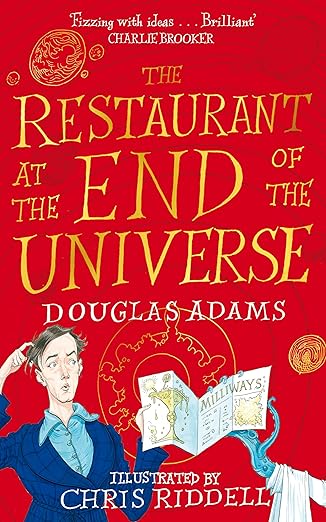
This particular recording is tagged as part of the Hitchhiker’s Guide to the Galaxy Illustrated series, the edition illustrated by Costa Award-winning artist Chris Riddell. The illustrations are not described or narrated, which means audio listeners are receiving the full text of the novel without any of the visual material. This is not a deficiency, Adams’ prose needs no supplemental imagery, but it is worth noting for listeners who might be wondering whether the illustrated edition alters the audio experience in any meaningful way. It does not. What you are getting is the novel, cleanly read.
Series Entry and Where This Fits
One reviewer noted the book is much underrated, and there is something to that observation. The first Hitchhiker’s Guide tends to absorb all the cultural oxygen, and the subsequent volumes are sometimes treated as diminishing returns. That assessment undersells this second entry. The Restaurant at the End of the Universe contains some of Adams’ sharpest material, including the sequence on Magrathea’s history, the entire Milliways set piece, and a genuinely unexpected structural move in the final act that lands harder on a reread than the first time through.
It is possible to listen to this without having heard the first book, but I would not recommend it. The relationships between the characters and several of the running gags acquire their full weight from prior context. If you are new to Adams, start at the beginning. If you have already made your way through the first volume, this continues without any noticeable dip in quality. Freeman’s narration gives the whole enterprise a cohesion it might not have had with a less thoughtful reader.
Who Should Listen / Who Should Skip
Listen to this if you have already enjoyed any version of The Hitchhiker’s Guide, you appreciate British comic science fiction that is more interested in ideas than plot momentum, and you respond well to narrators who deliver absurdist material with genuine commitment. Skip this if you have no tolerance for plotlines that meander as a feature rather than a bug, or if you need a story to build toward a conventional resolution. Adams has never been in the business of conventional resolutions, and this book doesn’t change that.
Frequently Asked Questions
Does this audiobook work as a standalone, or is the first Hitchhiker’s Guide required listening first?
You can technically follow the plot without the first book, but several jokes and character relationships assume familiarity with what came before. Start with The Hitchhiker’s Guide to the Galaxy for the full experience.
How does Martin Freeman’s narration compare to Douglas Adams’ own recordings of these books?
Adams’ recordings have a singular authority since he is reading his own material. Freeman takes a different approach, leaning into Arthur’s befuddled Englishness with considerable skill. Most listeners find Freeman’s version excellent on its own terms rather than a replacement for Adams’.
Does the ‘illustrated edition’ label affect the audio content in any way?
No. The audio is the complete novel read by Freeman. The Chris Riddell illustrations are in the print edition only and are not described or referenced in the recording.
Is the Total Perspective Vortex sequence as funny in audio as it is on the page?
Arguably funnier. Freeman’s timing in that sequence is one of the highlights of the recording, and Adams’ joke structure benefits from having a reader who knows when to pause.