
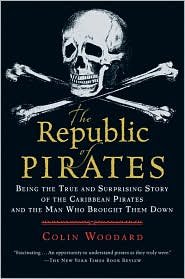
Pirate democracy sounds like a contradiction until you hear the terms. In the Bahamas in the early eighteenth century, according to this audiobook, servants were free, black people could be equal citizens, and captains were chosen and deposed by a vote of the crew. Colin Woodard spends thirteen and a half hours arguing that the Flying Gang was not a criminal aberration but a functioning political alternative, one that severed Europe from its New World empires for long enough to frighten everybody who mattered. The pirates are the hook. The constitution is the story.
Blackbeard, Black Sam Bellamy and Charles Vane are all here, and Woodard has no interest in pretending they were gentle. What the book does instead is explain where they came from, and the answer reframes everything: former sailors escaping naval discipline, indentured servants escaping indenture, and runaway slaves escaping the plantations that supplied the trade these same ships were attacking. Given that origin, the arrangement they built in the Bahamas looks less like lawlessness and more like the only place in the Atlantic world where those three groups could vote on the same question.
The most useful entry in the written column is also the one that raises a flag about the format. Its writer reports listening to the book first, then buying the paperback afterward, because so much of it was material they wanted to be able to look up easily, and has since given copies away as gifts. That is an enthusiastic entry describing a real limitation: this is a book dense enough in names, dates and places that a listener will want an index. It is also the only entry that mentions hearing the book at all, and it says nothing whatsoever about who was reading it.
Performance Would Sink It
Another entry gets the appeal into one phrase, praising the amount of research and calling the result "a coherent and digestible buffet of epic pirate facts and fictions from the times they dominated." That word fictions is doing real work. A large part of what anyone knows about this period is invention, and separating the record from the legend is most of the pleasure here. The same entry, filed in the summer of 2020, notes that the book made the present moment feel tame by comparison, which is either a compliment or a diagnosis.
Lewis Grenville is handed the trap that comes with every pirate book. The subject invites performance, and performance would sink it, because the argument only works if you take these crews seriously as political actors rather than as costumes. What the material needs is a reader who delivers a vote at a ship's council with the same weight as a boarding action, and who lets the names sit as names rather than as an invitation. Thirteen hours is a long time to sustain that discipline, and the whole thesis rests on it being sustained.
The politics are what make the book worth the time. A crude but distinctive democracy, deliberately assembled by people who had been on the receiving end of every hierarchy the Atlantic had to offer, is a genuinely startling thing to find in the early eighteenth century, and Woodard traces its influence outward to revolts in colonial outposts elsewhere. Heard rather than skimmed, the argument accumulates, and by the second half the trade routes and the sacked slave ships stop being incidents and start being strategy.
A Review of a Transaction, Sitting on This Page
The metadata on this listing belongs to a printed book. The publisher field names a books imprint rather than an audio house, and it opens with a stray invisible character that should have been stripped before the page went live. The release date attached is from 2008, which is well before this recording. None of that changes what you receive, and all of it explains why the page reads as though it is selling two different products at once.
The written column has the same problem in a more visible form. One entry from the United Kingdom praises the condition on arrival and the seller's helpful communication, and contains not a single word about the contents. That is a review of a transaction, sitting on a page selling a recording, which is worth remembering before you treat this column as a guide to anything you actually want to know.
On the book itself, the honest caution is that it is arguing a case rather than surveying one. The copy describes a heroic band and calls their republic a success, and that framing runs through the narrative. It is a defensible position and Woodard supports it, but a listener who wants the account with the sympathies removed should know which direction this one leans before starting. The violence is present and not minimized; the interpretation of what the violence was for is very much the author's.
A Good Book If You Are Into Pirates
Take it home if you like history that overturns something you thought you knew, and if the phrase political experiment interests you more than the phrase buried treasure. The four-star entry on the page manages the whole recommendation in six words, saying it is a good book if you are into pirates, and that is honest as far as it goes. The wider audience is anyone drawn to the eighteenth-century Atlantic, to the origins of revolt in the colonies, or to the question of who gets counted as a citizen and why.
Pass on it when you want swashbuckling, a single-figure biography, or naval tactics described in detail. It is also a difficult listen if you need to keep a large cast straight without a reference to hand, which is a real constraint on a book this dense with names. And if you already know this period well, expect a synthesis rather than new archival discovery: the achievement here is in the assembly and the argument, not in unearthing material nobody had seen.
- Voice: Lewis Grenville reads documented history whose cast includes Blackbeard, which makes restraint rather than color the whole assignment.
- Big ideas: an experiment in Caribbean self-government, imperial trade routes cut, runaway slaves as citizens, the making of a legend
- Atmosphere: Sunlit and violent, argued with conviction rather than distance
- Worth it?: Thirteen and a half hours of genuinely surprising history, on a listing that has been welded to the printed edition.
Good to Know
Is this audiobook mainly about Blackbeard?
No. He is one of several captains the book follows, alongside Black Sam Bellamy and Charles Vane, and the real subject is the settlement they operated from rather than any one figure. If you want a single biography this will feel diffuse; if you want the system around them, it is exactly right.
Is this audiobook narrative history or an academic account?
Narrative, and firmly so. It is structured around people, voyages and confrontations rather than around historiographical debate, and it moves at the pace of a story. The research is substantial and the book shows its work, but the delivery is built for general listeners rather than for specialists.
What period and place does it actually cover?
The early eighteenth century, centered on the Bahamas, where the so-called Pirate Republic operated. The reach extends outward to the Atlantic trade routes the crews attacked and to the colonial outposts where their defiance was noticed, but the Caribbean base is where the book keeps returning.
How does the book handle slavery?
Directly, and it is central rather than peripheral. Runaway slaves were among the people who made up these crews, the copy states that black people could be equal citizens in the settlement, and the ships attacked included slave ships. That combination is a large part of why the author treats the republic as politically significant.






