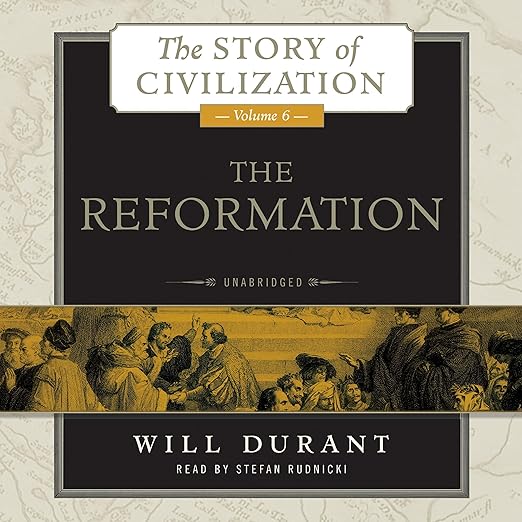
Quick Take
- Narration: Stefan Rudnicki is one of the most experienced voices in the audiobook world, and his 50-hour delivery of Durant’s rich, discursive prose is a genuine achievement – he calibrates the erudite grandeur of Durant’s style without tipping into pomposity.
- Themes: religious schism and institutional collapse, the theology of Luther and Calvin, humanism and the limits of reason, European imperialism and conquest
- Mood: Erudite, sweeping, and intermittently magnificent
- Verdict: Volume six of Durant’s Story of Civilization remains one of the greatest works of popular historical synthesis ever written – Rudnicki’s narration makes the 50-hour commitment genuinely worthwhile for serious listeners.
I was a few chapters into The Reformation when I remembered what it felt like to read real historical prose – writing that doesn’t just report the past but actually inhabits it. Will Durant was a Pulitzer Prize winner, and by the time he and Ariel Durant completed The Story of Civilization it ran to eleven volumes and covered human history from ancient Mesopotamia to Napoleon. Volume six, covering 1300 to 1564, remains among the most intellectually generous entries in the series. I found myself pulling out earbuds to replay specific passages, which hasn’t happened to me in years of audiobook listening.
The Reformation is, in Durant’s treatment, not primarily a theological drama – though theology is everywhere in it. It is a story about the conditions under which a major institution loses its grip on the people it governs. The Catholic Church of the late Middle Ages was spectacularly successful and spectacularly corrupt, and Durant traces both dimensions with equal engagement. He is not anti-Catholic; he is not pro-Protestant. He is interested in why things happen, and the why of the Reformation is a layered answer that runs through printing presses, political fragmentation, popular discontent with indulgences, the personal psychology of Luther and Erasmus, and the structural ambitions of German princes who found theological independence extremely convenient.
The Luther and Erasmus Counterpoint
The book’s intellectual center is the extended contrast between Luther and Erasmus – the volcanic reformer and the careful humanist who saw what Luther was doing and could not follow him. Durant gives both men their full weight. Luther emerges as a figure of enormous conviction and occasionally troubling rage, a man whose certainty about grace and scripture produced both liberation and new forms of coercion. Erasmus, the elegist of moderation, believed in reform through reason and example, found Luther’s methods brutal, and spent his final years watching the moderate Christianity he had hoped to cultivate destroyed by zealotry on both sides. Durant’s sympathy appears to lie with Erasmus, though he never says so directly. He doesn’t need to. The weight of the prose arrangement says it for him.
One reviewer writes that every page is a treat – which may sound like the hyperbole of enthusiasm but is accurate in a specific way: Durant writes the kind of prose that produces what you might call compound interest on attention. Each sentence that you follow carefully makes the next one more rewarding. It is not an easy read, but it earns its difficulty.
The 50-Hour Scope and Its Contents
At 50 hours, this is not a casual listening commitment. Durant covers the entire European Reformation – not only Luther and Calvin, but the Bohemian revolution, the Anabaptists, the social upheaval of the Peasants’ War, the English Reformation under Henry VIII, the Counter-Reformation, the Council of Trent, the Jesuits. He also covers the imperial expansion of Spain and Portugal and the discovery of the Americas, which Durant treats as the Reformation’s material counterpart: while Europeans were fighting over the soul of Christianity, other Europeans were encountering and frequently destroying civilizations that had developed without any of those categories. The scale is staggering.
Listeners should be honest with themselves about whether 50 hours of European intellectual and political history is actually what they want. One reviewer describes it as a long experience that is abundantly rewarding – and that balance is real. The rewards are substantial and the effort is genuine. If you’re approaching this series for the first time, reading the prior volumes in sequence will help; if you’re beginning here, the density will be manageable but the accumulated context of the earlier volumes will be missing.
Stefan Rudnicki and the Problem of Grandeur
Stefan Rudnicki has been narrating audiobooks for decades and holds multiple Audie Awards. The challenge here is sustaining Durant’s characteristic voice – a prose style that is at once scholarly and grandiloquent, precise and ornate, always conscious of itself as a performance of erudition. A lesser narrator would either over-dramatize (making Durant sound pompous) or under-deliver (making him sound merely pedantic). Rudnicki navigates between those failures with real skill. His voice has the warm depth appropriate for material of this weight, and his delivery of long scholarly sentences – Durant is particularly given to sentences that accumulate clause after clause before arriving at a measured judgment – is the work of someone who has read the whole book carefully before recording.
One reviewer mentions specifically having encountered a Kindle version and notes the experience mismatch. The audio version does not have the Kindle’s limitations; what it has instead is Rudnicki’s voice carrying the prose for the full 50 hours, which for this material is close to the ideal format. Durant’s prose was written to be heard as much as read.
Where This Sits in the Larger Project
The Story of Civilization series is, among other things, a monument to the idea that a single pair of minds could comprehend and synthesize the whole of human civilization. That idea has been criticized as hubristic and as inevitably shaped by its 20th-century Western perspective. Both criticisms have merit. Durant’s treatment of non-Western civilizations reflects the limitations of his sources and his formation, and some sections feel dated by contemporary historiographical standards. None of that diminishes the achievement of the prose or the structural intelligence of the synthesis. Approaching this volume alongside more recent scholarship on specific aspects – Diarmaid MacCulloch’s Reformation is the standard modern scholarly account – gives listeners both the magnificent synthesis and the corrective depth that Durant’s sweep inevitably compresses.
Who Should Listen, Who Should Look Elsewhere
Listen if: you’re a serious history reader who wants to spend extended time with one of the 20th century’s great historical stylists; you have background knowledge of the period and want Durant’s grand synthetic view; or you’ve been working through The Story of Civilization series and want the natural continuation.
Look elsewhere if: you want the modern scholarly consensus on the Reformation without the 20th-century synthesis mode – MacCulloch is the answer. Or if 50 hours is simply more than the subject is worth to you right now.
Frequently Asked Questions
Do you need to have read the earlier volumes of The Story of Civilization before The Reformation?
You can follow it standalone, but volumes one through five provide the accumulated context that makes Durant’s method and recurring analytical concerns easier to identify. If you’re new to the series, you could start here, but beginning with an earlier volume gives you Durant’s characteristic voice at a less demanding runtime before committing to 50 hours.
How does Durant’s treatment of the Reformation compare to more recent scholarship like MacCulloch’s Reformation?
They are complementary in different ways. Durant writes in a grand synthetic style with strong aesthetic and philosophical sensibility; MacCulloch is the modern scholarly standard with more reliable historiographical foundations. Durant’s Protestant/Catholic framing shows its age in places; MacCulloch is more precise about doctrinal distinctions and European regional variation. Reading Durant and then MacCulloch is not a bad sequence.
The runtime is 50 hours – is this better suited to a dedicated listening period or long-term incremental listening?
Several reviewers mention sustained multi-week engagement, and that seems to be the natural pace for this material. The chapters are self-contained enough that you can re-enter after a day or two without losing the thread. Trying to listen in concentrated bursts risks the kind of oversaturation that flattens the prose quality that makes Durant worth the effort.
Does Stefan Rudnicki’s narration handle the theological and philosophical vocabulary fluently?
Yes. Rudnicki’s familiarity with complex academic vocabulary and his command of European proper names – Latin theological terms, German reformers, Italian humanists – is consistent throughout. He does not slow down or stumble on the scholarly register, which is essential for a text as intellectually dense as this one.