Quick Take
- Narration: Daniel Loh York brings appropriate gravity and measured pacing to Sheridan’s dense political biography, though the narration is functional rather than distinctive across the 10-hour runtime.
- Themes: Authoritarian consolidation, Chinese dynastic power cycles, geopolitical ambition
- Mood: Chilling and compulsively readable, the tone of a long-form foreign correspondent dispatch
- Verdict: A richly detailed portrait of Xi Jinping that works best as a character study embedded in political history, though listeners should be aware that some reviewers flag factual and editorial concerns.
I listened to The Red Emperor during a week when China’s economic policy was dominating the news cycle, which gave the material an immediacy that felt almost uncomfortable. Michael Sheridan has spent two decades as a foreign correspondent covering Asia, and the vantage point shows. This isn’t an academic treatment or a policy analysis. It’s closer to narrative biography in the tradition of long-form journalism, and it reads accordingly.
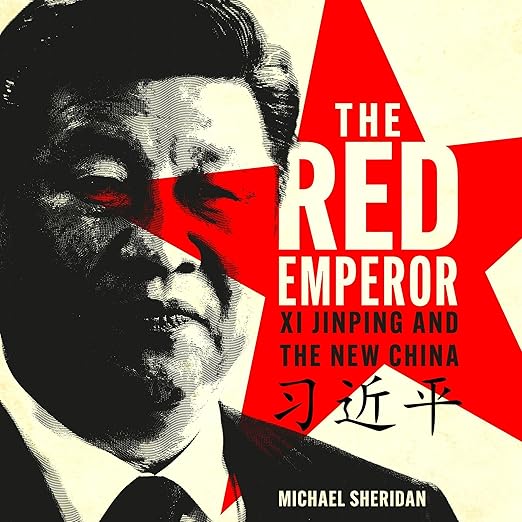
The book’s central argument is captured in its subtitle-adjacent framing: behind the architecture of the Chinese Communist Party, there is a functioning dynasty, and Xi Jinping is its emperor in all but name. Sheridan traces this thesis through Xi’s biography from his earliest years, including the period of his father’s disgrace and Xi’s own exile during the Cultural Revolution to rural Shaanxi province. That period of forced labor and social humiliation is presented as foundational to the man who eventually outmaneuvered rivals including Bo Xilai to claim leadership of the party in 2012.
Our Take on The Red Emperor
The biographical sections are where Sheridan is strongest. His access to sources within elite Chinese political circles, however indirect and cautious that access must necessarily be, gives these passages a texture that distinguishes the book from purely external analysis. The account of the interconnecting family dynamics within Zhongnanhai, the leadership compound in Beijing, reads at times like the political section of a novel, with its account of competing “family mafias,” purges, and strategic marriages. Reviewer K. Dekleva accurately describes these sections as both interesting and gossipy, comparing the book favorably to Li Zhisui’s Private Life of Chairman Mao as a companion read for those interested in the interior dynamics of Chinese communist leadership.
The geopolitical analysis is harder-edged. Sheridan presents Xi’s ambitions in the South China Sea, regarding Taiwan, and in global trade as coherent long-term strategy rather than reactive nationalism. His framing of Xi as seeking to displace Western democratic models as the dominant global paradigm is stated plainly and without the hedging that more cautious analysts tend toward. Whether you find this persuasive or overstated will depend partly on your existing priors about Chinese foreign policy.
Why Listen to The Red Emperor
Reviewer A. Menon, who specifically noted reading too much ideologically-focused Xi analysis elsewhere, makes the key point about this book’s value: it offers a character-driven approach where much of the existing Xi literature is systems-focused. Understanding how the person was formed, and what that formation might mean for how he makes decisions, is a different analytical lens than measuring institutional structures, and Sheridan’s journalistic background makes him better suited to the former.
Chris Patten’s endorsement, quoted prominently, carries real weight. Patten served as the last British governor of Hong Kong and has been one of the most outspoken Western critics of Beijing’s approach to the territory. His description of Sheridan as “one of the best informed and wisest writers on China” is not a marketing blurb from a politician with no relevant expertise.
What to Watch For in The Red Emperor
The critical review in this batch, from reviewer Thomas Cheong, alleges both editorial bias and factual errors. These are not trivial concerns to dismiss. Cheong’s critique touches on a real tension in all Western-authored biography of Chinese political figures: the question of whether the author’s framing, even unconsciously, reflects a foreign correspondent’s perspective shaped by a particular set of assumptions about authoritarian governance. Sheridan’s book does have a clear analytical posture, which is explicit rather than hidden, but listeners should be aware that some details and characterizations are contested.
Daniel Loh York’s narration handles the complex Chinese names and political terminology competently, which matters in a book this dense with proper nouns. The 10-hour runtime moves steadily through the material without padding.
Who Should Listen to The Red Emperor
This works best for listeners who want an accessible but substantive narrative account of Xi’s rise and the political culture that produced him. Readers of Evan Osnos’s Age of Ambition or Minxin Pei’s work on Chinese politics will find the framing here complementary rather than redundant.
Listeners who want a more neutral or academically rigorous treatment should look elsewhere. Sheridan is writing engaged journalism, not dispassionate scholarship. For those who understand that distinction and want a deeply reported narrative character study, this is among the more compelling Xi biographies in English.
Frequently Asked Questions
Does The Red Emperor cover Xi Jinping’s handling of COVID-19 and his current foreign policy positions?
Yes. The synopsis specifically mentions Xi’s campaign against COVID-19 as part of the techno-security state chapter, and Sheridan addresses contemporary geopolitical ambitions including trade dominance and Taiwan throughout the book.
Is prior knowledge of Chinese history necessary to follow this book?
Helpful but not required. Sheridan explains the Cultural Revolution and post-Mao political dynamics as he goes. Listeners with no background in modern Chinese history will need to pay closer attention to early sections, but the narrative is written for a general audience.
How does Daniel Loh York’s narration handle the extensive Chinese names and political terminology?
Competently. The narration is measured rather than expressive, which suits the biographical and analytical content. Pronunciation of Chinese names is handled consistently throughout the 10-hour runtime.
One review mentions factual errors in the book. How seriously should listeners weigh that concern?
With genuine consideration. The critique from reviewer Thomas Cheong is the kind of challenge that warrants awareness, particularly for listeners using the book as primary source material. Pairing it with other China analyses, including more sympathetic or academic accounts, will give a more complete picture.