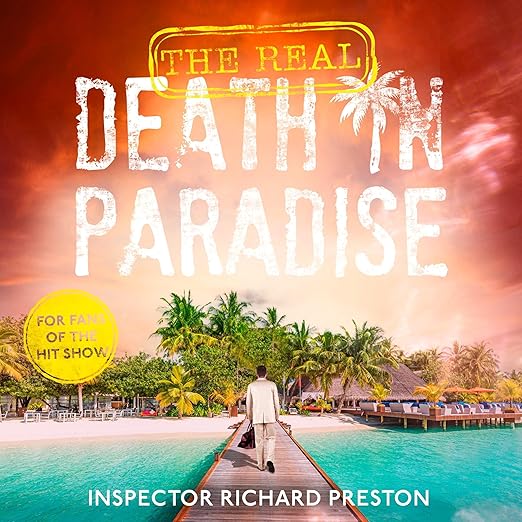
Quick Take
- Narration: Richard Preston narrates his own memoir with the natural, self-deprecating warmth of a good storyteller at the pub, which suits the material far better than a professional narrator would.
- Themes: Fish-out-of-water policing, Caribbean island culture, the gap between expectation and reality
- Mood: Breezy and anecdotal, with genuine crime narrative threaded through the local color
- Verdict: An entertaining true-life companion to the TV show, at its best when Preston lets the strangeness of his Caribbean posting speak for itself.
I came to this one as someone who has watched a fair amount of Death in Paradise but who is not what you would call a devoted fan of the show. That position, I think, made me a slightly more useful reader than someone arriving with deep attachment to the fictional version of Caribbean policing. Richard Preston’s memoir of his two years as one of twelve young British officers seconded to the Cayman Islands is not trying to be the show, exactly, but it is clearly conscious of that audience, and the book makes the most sense when you hold that context lightly rather than lean on it hard.
Preston was a young officer when he received the posting, and the book opens with the kind of expectation-setting that anyone who has ever moved somewhere they imagine to be paradise will recognize: a tropical island, a speedboat share, scuba diving qualifications, and the working assumption that policing in a place this beautiful will involve manageable amounts of actual policing. The reality, as Preston puts it, was far more interesting than he ever could have imagined, which is a slightly understated way of describing drug raids, kidnappings, and murders that are as genuinely strange as anything in the fictional version.
Our Take on The Real Death in Paradise
What makes this audiobook work is Preston’s voice, both as narrator of his own story and as the literal voice in your ears. He narrates it himself, which was clearly the right call. The memoir’s texture is conversational and anecdotal, full of the kind of self-deprecating English humor that plays well when the person telling the story was actually there and is clearly not taking himself too seriously. A professional narrator would have smoothed that quality out rather than preserved it.
The best sections are the ones where Preston leans into the genuine strangeness of Cayman Islands policing in the 1990s: the cultural dissonances, the moments where the British procedural approach met local reality and neither quite won, and the handful of cases that were genuinely alarming rather than merely unusual. One UK reviewer described it as full of amusing anecdotes about the locals and their often quirky personalities alongside some dramatic moments, which is a fair summary of the tonal range Preston achieves.
Why Listen to The Real Death in Paradise
At eight and a half hours, it is the right length for what it is. This is not a deep investigative memoir of the kind that would reward the close analytical attention you might give to, say, an account of a high-profile miscarriage of justice. It is a collection of Caribbean policing stories told with warmth and good humor by the person who lived them, and it lands best when you approach it on those terms.
Preston’s narration has an unrehearsed quality that works in its favor for most of the book’s runtime. He sounds like someone who has told these stories many times at dinner parties and has found the right shape for each of them. The pacing is relaxed in a way that mirrors the setting, which will be exactly right for some listeners and slightly loose for others.
What to Watch For in The Real Death in Paradise
At least one reviewer made an observation worth taking seriously: the narrative prose is not particularly engaging on its own terms. The material is excellent, but the writing sometimes struggles to find a through-line between anecdotes, and the result is a book that is more episodic than cumulative. In audio format, this reads as a slight unevenness of texture rather than a structural failure, but listeners expecting a shaped narrative arc rather than a collection of memorable incidents may find themselves occasionally wondering where the book is heading.
The memoir is also clearly positioned for fans of the BBC show, and some of the framing feels slightly labored when it reaches for connections between Preston’s actual experience and the fictionalized island of Saint Marie. Those comparisons are light touches rather than a sustained parallel, but they are slightly self-conscious in a way that the best memoir writing tends to avoid.
Who Should Listen to The Real Death in Paradise
Perfect for fans of the television series who want a real-world anchor for the genre’s pleasures, and for readers who enjoy British police memoir with a generous helping of local color and genuine oddity. Also recommended for listeners who want a tropical-setting audiobook that delivers genuine intrigue alongside the sun-drenched atmosphere.
Skip it if you are expecting either the depth of investigative true crime or the narrative coherence of a well-plotted memoir. This is something more casual and affectionate than either of those things, and it is good at what it is.
Frequently Asked Questions
Do you need to be a fan of the Death in Paradise TV show to enjoy this memoir?
No, though it helps. The memoir stands on its own as a Caribbean policing story and does not require familiarity with the fictional version. Fans of the show will find the real-world context interesting as a counterpoint to the fictional Saint Marie, but non-fans lose nothing essential.
How does Richard Preston’s self-narration affect the listening experience?
Positively, on the whole. The conversational quality of the memoir is amplified rather than smoothed away, and his self-deprecating delivery fits the material. The trade-off is a slightly more uneven pacing than you would get from a professional narrator, but the authenticity outweighs that.
Is there genuine crime content or is this primarily a light travel memoir?
Both, in proportions that shift throughout. The early chapters are primarily tonal and cultural, establishing Preston’s adjustment to island life. Drug raids, a kidnapping, and several murders appear as the book progresses, and those sections have genuine narrative tension rather than being treated lightly.
When was Preston seconded to the Cayman Islands, and does the historical setting affect the story?
The posting was in the early-to-mid 1990s, and the pre-internet, pre-forensic-technology context is present throughout. Several cases benefit from being understood in that era’s limitations, and Preston is aware of how different the policing landscape was from what a contemporary officer would encounter.