The Short Version
- Voice: Eric Conger handles Reagan's voice with care and appropriate restraint, capturing the informal, private register of diary prose without slipping into impersonation. The performance serves the document rather than competing with it.
- Big ideas: Presidential privacy and public persona, Cold War decision-making from the inside, the intersection of personal faith and political leadership
- Atmosphere: Intimate and historically dense, with unexpected warmth and occasional sharp wit
- Worth it?: The only daily presidential diary in American history, delivered in a narration that respects what the document actually is.
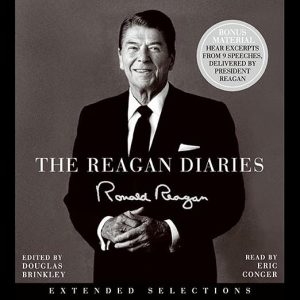
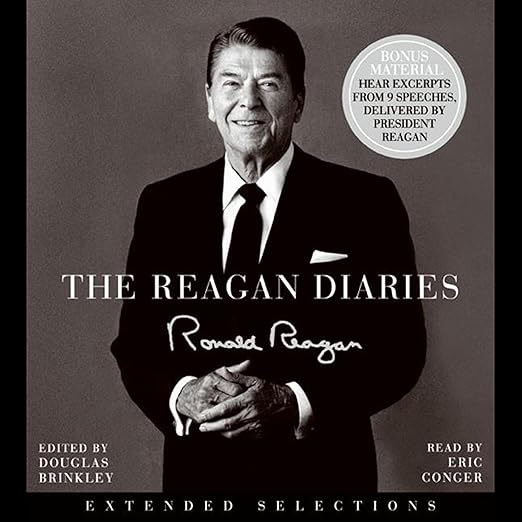
Ronald Reagan's handwritten daily diaries, kept throughout both terms of his presidency, represent something genuinely rare in American political history: an unmediated record of a president's private thoughts written in real time rather than reconstructed in retirement. The audiobook of The Reagan Diaries Extended Selections, narrated by Eric Conger and running just over thirteen hours, draws on the edited collection assembled by historian Douglas Brinkley from Reagan's original journals. The "extended selections" designation matters: this version includes more material than the standard abridged edition, giving listeners a fuller picture of both the historic events and the private man behind them.
Touching, Unperformed Feeling for Nancy Reagan
Presidential diaries are inherently interesting documents, but most don't exist. Reagan's do, and their survival is itself historically significant. He kept them by hand, in his White House residence study or aboard Air Force One, across eight years of some of the most consequential events in twentieth-century American politics. The entries cover his relationships with Mikhail Gorbachev and Margaret Thatcher, his account of surviving John Hinckley Jr.'s assassination attempt, the Iran-Contra period, the closing stages of the Cold War, and his love for Nancy Reagan, which surfaces in entries throughout the journals with a directness that is touching rather than performed. Reagan had a reputation as a performer; what the diaries reveal is that, in private, he was a man who wrote with feeling about the people he cared about and the responsibilities he carried.
The historical record here is the primary draw. Reagan's description of nearly drowning at a Hollywood friend's home, his account of the specific diplomatic maneuvering around the Intermediate-Range Nuclear Forces Treaty, his frank assessments of other world leaders, these are not cleaned-up retrospective judgments but real-time reactions, which makes them considerably more revealing than most memoir. One reviewer, clearly a political admirer of Reagan's, noted that reading the diaries deepened rather than complicated that admiration, which is itself an interesting data point. The diaries do not reveal a man hiding something. They reveal a man who was roughly the same person in private as he appeared to be in public, which is actually unusual.
Brinkley's editorial work is evident in the selection and sequencing of entries. The "Extended Selections" version gives listeners more of the connective tissue between the major events, the routine entries about White House staff, congressional relations, and daily logistics that provide context for the more dramatic moments. These everyday entries are, in their own way, as revealing as the crisis ones: they show a president who paid attention to the texture of his days rather than treating the diary as a record only of significance.
Conger's Voice Skips the Reagan Impression
Eric Conger's narration navigates a genuine challenge. Reagan's diary prose is informal, sometimes elliptical, and written for an audience of none, not polished for public consumption, not written to be read aloud. Conger finds a voice that is conversational without being casual, preserving the private register of the entries while keeping the listening experience from feeling like eavesdropping. He does not attempt a Reagan impression, which is the right decision: the point is the words, not a vocal performance.
The thirteen-hour runtime is sustained by the diary's own variety. No two entries read quite alike because no two days of the Reagan presidency were alike, and the format means the audiobook has an inherent rhythm, entry follows entry, each one complete in itself, that prevents the fatigue that can set in during a sustained narrative nonfiction listen. This is particularly well suited to audio: you can listen in stretches corresponding to specific periods of the presidency, returning to different chapters as historical interest draws you.
Reviewers have consistently described the diaries as providing genuine insight into Reagan's character rather than confirming preexisting impressions. One described discovering "his humanity" through entries about his devotion to Nancy and his belief in prayer. Another highlighted the wit that runs through the journal, Reagan had a diarist's eye for the absurd detail, and his descriptions of diplomatic encounters occasionally read as comedy without intending to.
Interested in the History, or in the Man
Listeners should be aware that the diary entries are Reagan's personal perspective on the events of his presidency, not a balanced historical account. His assessments of Gaddafi, Castro, and the Cold War adversaries he faced are recorded from inside a specific political framework, and Brinkley's editorial notes provide some context without substantially challenging Reagan's framing. This is a primary source document, which means it rewards listeners who bring their own historical context rather than those looking for a dispassionate account of the Reagan era.
The extended selections version is longer than the standard edition, which is a clear advantage for listeners who want depth. However, some of the additional entries document the more routine dimensions of White House life, and listeners who prefer a tighter narrative of the major historical moments may occasionally wish for the sharper selection of the abbreviated version. The choice depends on whether you're primarily interested in the history or in the man.
A Companion Piece to the Scholarly Record
This audiobook is well suited to listeners interested in American political history from 1981 to 1989, regardless of their political alignment with Reagan's policies. The diaries function as a primary source, and their historical value is independent of whether you find Reagan's politics admirable. Biographers, history enthusiasts, and those interested in how political leaders process their own decisions in real time will find this genuinely rewarding.
Skip this one if you're looking for a critical biography or a multi-perspective account of the Reagan presidency. The diaries show you one man's view of his own administration, and that view is consistently favorable. For a complete historical picture, these selections function best as a companion to rather than a replacement for scholarly accounts of the period.
Questions Listeners Ask
What makes this the 'Extended Selections' version of the Reagan Diaries audiobook, and is it worth the extra length?
The extended version includes more of the daily diary entries beyond the major historical events, covering routine White House operations, congressional meetings, and personal reflections that the standard abridged edition condenses or omits. For listeners primarily interested in Reagan's character and inner life, the additional material is valuable. For those focused mainly on the major Cold War and diplomatic moments, the standard version may be sufficient.
Is this audiobook appropriate for listeners who are critical of Reagan's politics?
The diary is Reagan's unfiltered personal record, so his political assessments reflect his worldview without significant counterargument. Listeners who disagree with his politics will encounter those politics as Reagan actually held them, which is historically useful. The audiobook is not a defense or a prosecution of his presidency; it is a document.
Does the audiobook cover the assassination attempt and Reagan's recovery?
Yes, and the entries from that period are among the most striking in the collection. Reagan wrote in the immediate aftermath of the Hinckley shooting with characteristic brevity and faith, and those entries reveal a great deal about how he processed the experience privately versus how it was managed publicly.