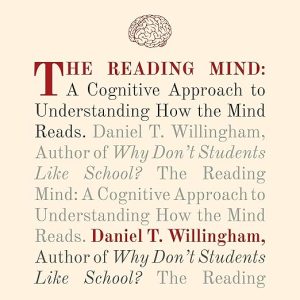
Willingham's central argument in this audiobook cuts against a lot of comfortable assumptions about reading. The Reading Mind, written by Daniel T. Willingham and narrated by James Gillies, arrives at a particularly charged moment for literacy education: the debate over phonics versus whole-language instruction has returned to the center of policy conversation, and Willingham's cognitive science background positions him to cut through the noise with actual experimental evidence rather than pedagogical tradition. At six hours and three minutes, this is a focused listen that rewards anyone who has wondered why some children struggle with reading while others pick it up almost effortlessly - and why the answer matters for how we teach.
Willingham Builds Reading Comprehension Like a Ladder
Willingham, the author of Why Don't Students Like School?, applies his signature approach here: take findings from cognitive psychology, translate them honestly for a non-specialist audience, and resist the urge to oversimplify. The result is a book that covers an impressive range without feeling scattered. He walks through the distinction between reading by sight and reading by sound, explains why alphabetic decoding matters even for fluent readers, and then builds upward toward reading comprehension at progressively more demanding levels - from early literal understanding all the way to inferring subtext in complex literary texts. That structural arc is one of the book's real strengths. Each chapter feels like a rung on a ladder rather than a self-contained topic dropped in at random.
The sections on motivation are particularly welcome. Willingham does not treat motivation as a separate, fuzzy concern to be handled by counselors - he treats it as cognitively relevant, as something that shapes whether a child even attempts to decode text in the first place. That integration of affect and cognition is more sophisticated than most reading guides aimed at teachers. One reviewer describes it as opening up their eyes to the exact breakdown of how reading actually occurs in the brain, and that is an accurate description of what Willingham achieves: the book makes visible a process so automatic in fluent readers that its complexity becomes invisible.
Heavy on Research, Light on Practical Steps
A fair critique, noted by at least one reviewer, is that the book is heavy on research and citations and lighter on direct practical application. That is accurate. Willingham is not writing a classroom intervention manual with lesson scripts and assessment rubrics. He is building conceptual understanding that educators can then carry into their own instructional decisions. Whether that orientation satisfies depends entirely on what you bring to the listening. A new teacher looking for immediate, step-by-step guidance may find the book under-prescriptive. A literacy coach who already has practical tools but wants the research architecture to evaluate them will find the book exactly right.
Gillies Handles Dense Vocabulary Without Sounding Stuffy
Gillies's narration supports the material's academic register without making it feel stuffy. He handles technical vocabulary - phonemic awareness, orthographic mapping, working memory load - without stumbling or making those terms sound more intimidating than they are. His pacing is measured rather than rushed, which is appropriate for content that rewards following the argument rather than absorbing isolated facts. At six hours, this is the kind of audiobook that can be completed in a long weekend of driving or running, and the relative brevity compared to other education titles means there is no point where Willingham's argument begins to feel padded.
The PDF companion included with the audiobook purchase reportedly contains visual materials referenced in the text. Nothing in the audio rendering is fatally lost without the PDF, but listeners who want to revisit specific research citations or data points after listening will find the text version easier to navigate. Willingham's book is dense with references to specific studies, and the audio naturally cannot footnote itself.
Screen Reading Questions Predate Full Smartphone Saturation
Willingham's chapter on technology and reading is worth particular attention. He wrote this before the full saturation of smartphone use among children, but the core questions he raises about screen reading, attention fragmentation, and what reading actually means on a digital interface remain entirely unresolved. His caution is measured and evidence-based rather than alarmist, which makes it more useful than the typical technology-panic framing that dominates this conversation in popular media. A 2016 copyright date means some of the specific research cited has been extended or complicated by subsequent work. Listeners who are active classroom practitioners should treat some of the technology claims as starting points for further investigation rather than settled conclusions.
The book also treats writing as inseparable from reading, and Willingham spends meaningful time on how writing instruction affects reading comprehension - a connection that is often severed in curriculum design but that cognitive research consistently supports. For administrators and literacy coaches evaluating curriculum programs, that section may be among the most practically consequential in the entire six hours. The connection between writing practice and reading comprehension gains is underused as a lever in most school literacy programs, and Willingham explains the cognitive mechanism clearly enough that the practical implication is hard to miss.
Parents of Struggling Readers Will Find Clarity
Teachers, reading specialists, literacy coaches, and school administrators will get the most from this audiobook - it is evidently written for that audience, and the conceptual tools it provides are immediately applicable to instructional decisions and curriculum evaluation. Parents of struggling readers will also find it genuinely clarifying, particularly the early chapters on decoding and phonemic awareness that explain why a child might read fluently aloud and still fail to comprehend what they just said. Casual readers curious about how their own brains process text will find the book interesting throughout, though the density of research citation may occasionally slow the experience for listeners primarily there for the science story. Skip it if you want a prescriptive classroom handbook with lesson plans and implementation guides - Willingham's goal is understanding, not prescription. A companion PDF is available with the audiobook purchase for those who want the supporting data visuals alongside the audio.
In Brief
- Performance: James Gillies delivers a clear, measured academic tone that complements Willingham's research-forward prose without becoming dry; pacing is steady and well-suited to a six-hour cognitive science survey.
- What it covers: cognitive science of reading, literacy development, technology and reading attention
- Feel: Intellectually engaging and methodical
- Our call: Educators and parents who want research grounding for reading instruction will find this audiobook more substantive than most popular-science alternatives.
Does the audiobook cover both early reading instruction and advanced literary comprehension?
Yes. Willingham structures the book as a developmental arc, starting with phonemic awareness and alphabetic decoding for beginning readers and working up through inference, literary analysis, and reading for deep meaning in more advanced texts.
Is this audiobook accessible to non-specialists, or does it assume a background in cognitive science?
Willingham has built a reputation for translating cognitive research for general audiences, and that skill is evident here. Technical terms are introduced carefully and in context. Listeners without a psychology background should be able to follow the argument throughout.
Does the audiobook address the phonics versus whole-language debate directly?
It addresses it implicitly by presenting the cognitive research on how decoding works. Willingham does not frame it as a debate to adjudicate, but the evidence he presents strongly supports explicit phonics instruction - which some educators and parents may find either confirming or challenging depending on their existing views.
Is the companion PDF necessary to get full value from this audiobook?
The PDF contains supporting materials and visual aids referenced in the text. The audio is self-contained and no argument requires the PDF to follow, but listeners who want to revisit specific citations or visual data will find the PDF a useful supplement available with the audiobook purchase.