Quick Take
- Narration: L.J. Ganser brings composed intellectual authority that holds the cumulative argument together across 13 demanding hours.
- Themes: Trade and prosperity, cultural evolution, data-driven optimism
- Mood: Confident and expansive, with a sweep from the Stone Age to the digital age
- Verdict: A landmark argument for human progress that holds up historically even if some 2010-era projections have since been complicated.
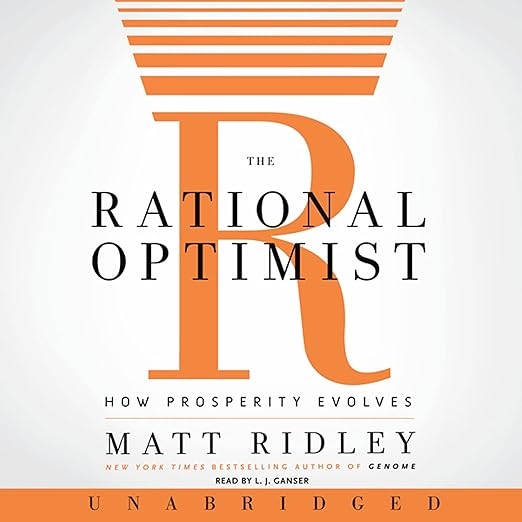
I started listening to Matt Ridley’s The Rational Optimist on a long train journey, which turned out to be the right environment for it. Ridley is working at a sweep of argument that requires uninterrupted attention, he moves from Stone Age trade networks to the internet in thirteen-and-a-half hours, making a cumulative case that resists summary but rewards sustained engagement. L.J. Ganser narrates with the kind of composed authority that suits an intellectual argument of this scale, and by the time I reached my destination I had missed my stop by two stations.
The book’s premise is simple and deliberately provocative: despite two centuries of dominant pessimism in public discourse, life has been getting better at an accelerating rate, and the mechanism driving that improvement is trade and what Ridley calls cultural evolution. Food availability, income, and life expectancy are up globally. Disease, child mortality, and violence are down. Africa is following Asia out of poverty. These claims are not presented as opinion, they are marshaled with historical data and argued with the kind of intellectual confidence that either energizes or irritates readers depending on their priors.
Our Take on The Rational Optimist
Ridley is a science writer before he is an economist or historian, and that background shows in the best possible way. He has the ability to make sweeping claims without losing evidential grounding, and his prose has the clarity of someone who has spent years translating complex ideas for general audiences. The Steven Pinker endorsement on the jacket is well-earned and also somewhat predictive of the book’s limitations, both writers operate in the tradition of data-driven optimism that tends to underweight systemic risk and structural inequality in favor of long-run trend lines. Ridley is honest about this to a degree, but readers who want a more dialectical treatment will need to supplement.
Why Listen to The Rational Optimist
The primary virtue of this book is its scope and its willingness to take a unified argument seriously across time. Ridley does not treat individual chapters as separate essays, the argument about trade, specialization, and cultural evolution builds continuously from the earliest human societies through the industrial revolution and into the digital age. That cumulative structure is more satisfying in audiobook form than it might seem, because Ganser’s narration maintains the thread across what could otherwise feel like a survey of disconnected data sets. For listeners who have grown habituated to default pessimism in news and public conversation, the historical corrective is genuinely useful and, as one reviewer puts it, actually cheerful.
What to Watch For in The Rational Optimist
The book was published in 2010, and while its long-run historical arguments remain largely intact, some of its projections about global development and technology have been complicated by subsequent events, the 2008 financial crisis’s aftermath, the resurgence of nationalism, climate disruption’s increasing material costs, and the structural failures revealed by COVID-19. Ridley’s optimism about spontaneous market order is more confident than the subsequent decade fully justified. Readers who already align with Ridley’s worldview will find this validating; readers who come from different traditions of political economy will find the ideological assumptions worth interrogating even where the data points hold. The 13-hour runtime is also genuinely demanding, this is not a casual listen.
Who Should Listen to The Rational Optimist
Intellectual nonfiction listeners who enjoy big-history argument in the tradition of Jared Diamond, Niall Ferguson, and Steven Pinker. People who feel that public discourse leans too heavily into catastrophism and want a rigorously argued counter-narrative. Listeners from economics, history, or anthropology backgrounds will find the interdisciplinary range satisfying. Those looking for something more balanced between optimism and structural critique, or more current on climate economics, should treat this as one side of a conversation rather than the definitive word.
It is also worth saying directly that Ridley’s argument is more intellectually honest than its critics sometimes allow. He does not claim that all problems are solved or that pessimism is always irrational, he argues that the baseline trend of human welfare has been consistently upward, and that the mechanisms driving that trend are underappreciated relative to the mechanisms driving publicized setbacks. Whether you find that convincing depends substantially on which data you weight and which time horizon you adopt, and Ridley is transparent enough about his framing to allow that disagreement to be productive rather than simply frustrating.
Frequently Asked Questions
Is The Rational Optimist still relevant given it was published in 2010?
The long-run historical arguments about trade, specialization, and human prosperity remain largely intact. However, some of Ridley’s projections about global development have been complicated by subsequent events, including climate disruption costs and the structural failures revealed by COVID-19. Treat it as foundational argument that benefits from being read alongside more recent work.
Is L.J. Ganser a good fit for this style of intellectual argument?
Yes. Ganser has the composed authority that long-form intellectual nonfiction requires. He keeps the thread of Ridley’s cumulative argument clear across the full 13-hour runtime without either flattening the prose or over-dramatizing the data.
Does Ridley address climate change, and is the treatment balanced?
Ridley addresses environmental concerns as part of his broader optimism argument, but his treatment of long-run climate risk has been criticized as insufficiently weighted given subsequent developments. Listeners specifically interested in climate economics should supplement with more current sources.
How does this compare to Steven Pinker’s Enlightenment Now for someone who has read both?
The two books share intellectual DNA and a data-driven optimism framework. Ridley focuses more specifically on trade and cultural evolution as mechanisms, while Pinker casts a wider net across Enlightenment institutions. They are complementary rather than redundant, with Ridley being the more focused and Pinker the more comprehensive.