Quick Take
- Narration: Edoardo Ballerini brings authority and texture to Radzinsky’s dense historical prose, his measured delivery suits the archival weight of the interrogation documents.
- Themes: Historical myth versus documented record, the Romanov collapse, religious charisma and manipulation
- Mood: Dense and revelatory, like reading a cold case reopened after eighty years
- Verdict: For listeners serious about Russian history who want the documentary evidence rather than the legend, this 22-hour deep dive rewards the time investment considerably.
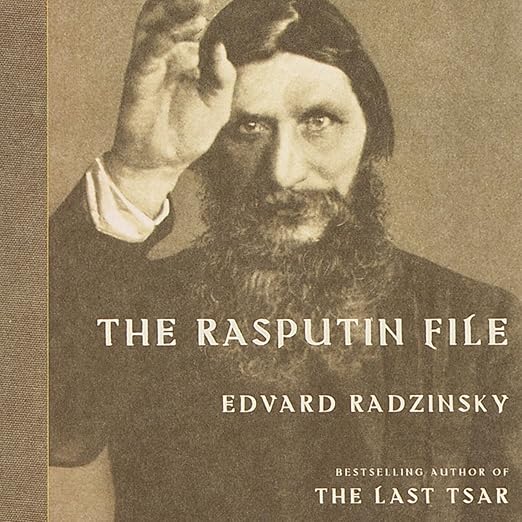
I have a complicated relationship with books about Rasputin. The man has been so thoroughly mythologized, through documentaries, films, and the occasional pop song, that approaching any biographical account requires a certain willingness to unlearn. When I came to Edvard Radzinsky’s The Rasputin File, I had already spent an afternoon with a Russian history documentary that left me more confused than informed. The contrast was immediate. Radzinsky works from primary sources that were genuinely lost for decades, and that distinction shapes every page.
The book is built around a discovery: a file of interrogations from the Russian State Archives that surfaced in 1995 after vanishing for nearly eighty years. These are the actual words of people who knew Rasputin intimately, his daughter, Tsaritsa Alexandra’s closest friends Yulia Dehn and Anna Vyrubova, Prince Felix Yussupov, Rasputin’s housekeeper, and a constellation of court figures. Radzinsky, already known for his biographies of Stalin and the last tsar, uses this material to build a definitive account that challenges decades of assumption and propaganda.
Our Take on The Rasputin File
What Radzinsky does that most Rasputin biographies fail to do is separate the documented from the fabricated. The supernatural aura, the alleged political control over the tsar, the stories of almost superhuman influence over Alexandra, all of these get scrutinized against what the interrogation files actually record. The result is a Rasputin who is still fascinating, still a genuine historical force, but considerably more human and considerably more disturbing than the cartoon villain of popular imagination. One reviewer described the biography as challenging and refuting a number of tales about the supposedly powerful supernatural peasant, and that is precisely accurate. Radzinsky is rigorous without being dry.
The audiobook runs 22 hours and 26 minutes, published by Random House Audio in 2016. That runtime reflects the depth of the source material and Radzinsky’s exhaustive treatment. This is not a book that condenses, it reconstructs, and the reconstruction requires patience from the listener.
Why Listen to The Rasputin File
Edoardo Ballerini’s narration is a significant asset. He handles the Russian names and court titles with fluency rather than the hesitant approximations that plague some Western narrations of Russian history. His delivery treats the interrogation excerpts differently from Radzinsky’s analytical passages, there is a shift in register that helps distinguish direct historical record from authorial interpretation. At 22 hours, this matters enormously. A narrator who could not differentiate texture and register would flatten the layered sourcing into an undifferentiated wall of sound. Ballerini does not make that mistake.
The translation from Judson Rosengrant is noted in the product description, and at least one reader found the translated prose occasionally stilted in the print edition. In audio, those moments smooth out more readily because Ballerini’s pacing absorbs any awkwardness in the sentence-level translation choices.
What to Watch For in The Rasputin File
Listeners new to pre-revolutionary Russian history may find the early chapters demanding. The court relationships, the political factions, and the Romanov family dynamics require some baseline familiarity to follow without confusion. Radzinsky does provide context, but this is not a book that hand-holds through the setting. A brief introductory read on the late Romanov period would make the listening experience considerably more rewarding. The book also leans heavily on the interrogation documents, which means long stretches of quoted testimony. Some listeners find this exactly what they came for; others expecting a narrative biography in the conventional sense may find it more archival in texture than anticipated.
Who Should Listen to The Rasputin File
Ideal for listeners who have already encountered the Rasputin legend through popular media and want the documented reality. Also suited to anyone interested in the collapse of tsarist Russia, the psychology of religious charlatanism, or the mechanics of historical myth-making. Listeners expecting a brisk popular biography with dramatic flair over scholarly rigor will find the pacing challenging. At 22 hours, this demands a committed listener, but it rewards that commitment with a genuinely rare kind of historical clarity.
Frequently Asked Questions
Do I need prior knowledge of Russian history to follow The Rasputin File?
Some baseline familiarity with the late Romanov period helps considerably. Radzinsky provides context, but the court relationships and political dynamics are numerous and complex. A short overview of Nicholas II’s reign will make the listening experience much smoother.
How much of the audiobook draws directly from the lost interrogation documents?
A substantial portion. The interrogation files from 1995 are the spine of the biography, and Radzinsky quotes them extensively. You will hear direct testimony from Rasputin’s daughter, close court figures, and his housekeeper, material unavailable to earlier biographers.
Is Edoardo Ballerini’s narration well suited to the dense historical material?
Yes, Ballerini handles Russian names with confidence and differentiates between quoted testimony and Radzinsky’s analysis in a way that keeps the layered sourcing clear across a very long listen.
How does Radzinsky’s account compare to popular documentary treatments of Rasputin?
One reviewer came to this book specifically after finding a YouTube documentary inaccurate and propagandistic. Radzinsky’s work is significantly more rigorous and challenges many of the most dramatic popular claims, the political control over the tsar, the supernatural stories, the near-invincibility narrative, against what the primary sources actually say.