Quick Take
- Narration: Jim McCarty, one of the three original participants in the channeling sessions, reads with an almost ceremonial stillness that suits the material; his familiarity with Ra’s cadences is evident and largely irreplaceable.
- Themes: Spiritual evolution, unity consciousness, extraterrestrial philosophy
- Mood: Slow, meditative, and genuinely unlike anything else in the audiobook catalog
- Verdict: If you approach it with patience and genuine curiosity about metaphysical philosophy, this is one of the most singular listening experiences in the spirituality genre.
I came to The Ra Contact on a Sunday in late October, stretched out on my couch with the curtains half open and a cup of tea gone cold on the table beside me. I had been reading around the Law of One material for months, drawn in by how seriously certain philosophers and researchers take it, and I wanted to hear it rather than read it. The audiobook format turned out to matter more than I had anticipated.
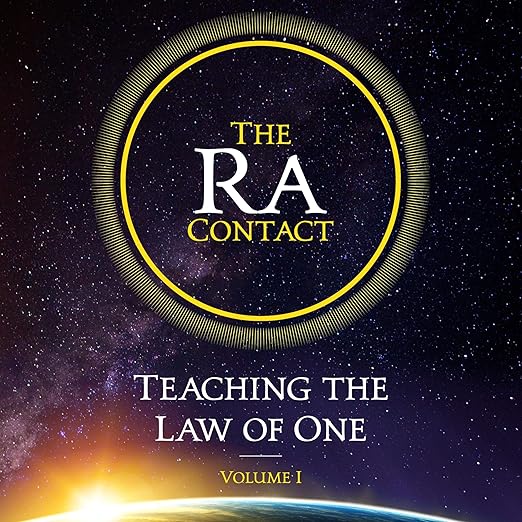
What you are getting here is not a narrative in any conventional sense. The Ra Contact is a transcribed channeling session, a dialogue between physicist Don Elkins and a nonhuman intelligence identifying itself as Ra, with Carla L. Rueckert serving as the instrument and Jim McCarty recording. The content ranges across cosmology, the nature of consciousness, healing, free will, the structure of densities of experience, and what Ra calls the Law of One: the principle that all things are one, that separation is the fundamental illusion we are here to see through.
What the Transcript Format Does and Does Not Do
The question-and-answer structure is both the book’s greatest strength and its most significant demand on the listener. There are no transitions, no narrative breathing room, no authorial hand guiding you through difficult passages. Elkins asks a question. Ra answers. The answer is sometimes a single sentence, sometimes a sprawling philosophical elaboration that loops through cosmology and metaphysics before landing somewhere unexpected. One reviewer who holds a PhD in International Relations described being genuinely shaken by the material after a lifetime of skepticism about channeling. That reaction makes sense. The ideas are dense and in places startlingly coherent, and the absence of narrative scaffolding means you either stay with them or you do not.
Jim McCarty’s narration deserves careful consideration here. He is not a professional voice actor in the sense Audible listeners are accustomed to, and listeners expecting the kind of polished performance that characterizes most audiobook productions will notice the difference. What he brings instead is something harder to manufacture: authority. He was there. He transcribed these sessions. When he reads Ra’s words, there is no performative distance, and that stillness functions as its own kind of commentary on the text. The pacing is slow by design, and at nearly sixteen hours, this is not an audiobook you rush through.
The Cosmology Behind the Questions
Ra describes itself as a soul group that originally inhabited Venus and spent eons attempting to share the Law of One with Earth. The cosmological system that emerges through Elkins’s questions is remarkably consistent across sessions: densities of consciousness, the nature of the harvest between densities, the role of free will, the meaning of polarity between service-to-others and service-to-self. Reviewers who found the material life-changing tend to describe the same experience, that Ra explains the unexplainable in ways that leave no lingering doubts, that fear of what is unknown is replaced by a lasting peacefulness. That is a strong claim, and I want to be honest about the fact that the material is not scientifically verifiable and its origins remain contested. What I can say is that as a piece of philosophical literature, the internal coherence of the system Ra describes is genuinely impressive, and the questions Elkins brings are wide-ranging and often penetrating.
This is the first volume of what L/L Research has released as the updated Ra Contact series, and it covers the opening sessions of the original five-book Law of One canon from the 1980s. If you are unfamiliar with that older publication, the synopsis notes that this version supersedes it. One longtime reader of the original sessions described this newer edition as superior in every way, which gives some reassurance that the production decisions serve the content.
Who Will Get the Most from This, and Who Will Walk Away
The listeners who describe transformative responses to this material share certain traits: they tend to be serious readers with eclectic intellectual backgrounds, they approach the text with an openness to metaphysical possibility, and they are patient enough to sit with ideas that do not resolve quickly. Listeners who want narrative propulsion, a personal story, or anything resembling conventional religious instruction will likely find this slow going. At least one reviewer described it as potentially the most important book ever written, placing it above conventional scripture in their personal canon. I would not frame it in those terms, but I understand how someone arrives there after spending real time with the material.
The free audiobook availability through Audible makes this a low-barrier entry point into a body of work that has circulated in spiritual communities for decades. Whether you find it revelatory, philosophically interesting, or simply too strange to engage with will depend almost entirely on what you bring to it.
A Word on Listening Conditions
I want to say something about how you listen to this one, because it matters more than usual. This is not background audio. The question-and-answer format requires active attention, and the absence of narrative momentum means your mind will wander if you put it on during a commute or a workout. The reviewers who find it life-changing consistently describe reading it in small sections, sitting with it, returning to passages. The audio format translates that meditative quality well, but only if you give it the same kind of quiet attention you would a serious philosophical text. On a long, still afternoon with nowhere to be, it opens up in ways that genuinely surprised me.
Frequently Asked Questions
Do I need to be familiar with the original five-volume Law of One series before listening to The Ra Contact?
No. This updated edition from L/L Research is designed as a standalone entry point and is considered by longtime readers to be superior to the original 1980s publication. If anything, starting here is the recommended approach.
Why does Jim McCarty narrate instead of a professional voice actor, and does that affect the listening experience?
Jim McCarty was one of the three original participants in the sessions and served as transcriptionist. His narration is slower and less polished than typical audiobook performances, but many listeners find his direct connection to the material gives it an authority that a professional actor could not replicate.
Is this audiobook appropriate for listeners who are skeptical of channeling or extraterrestrial contact as spiritual frameworks?
The material is philosophically rich enough that several skeptical, academically trained listeners describe being genuinely moved by it. However, if you have no tolerance for the channeling premise, the format will be a consistent barrier since the entire text is presented as communication from an extraterrestrial source.
At nearly 16 hours and in a pure question-and-answer format, is this practical to listen to straight through?
Most reviewers explicitly advise against that. The dense cosmological content rewards listening in smaller sessions with time to reflect between them. The audio format suits the material well, but it is not designed for passive, continuous listening.