Quick Take
- Narration: Michael Hatak reads Thomas Cleary’s translation with measured reverence, the pace is deliberate and unhurried, which suits the meditative quality of the text but demands patient listening.
- Themes: Divine revelation and moral guidance, poetic rendering of sacred text, Islam’s intellectual and spiritual tradition
- Mood: Contemplative and solemn, demanding and rewarding in equal measure
- Verdict: Cleary’s translation is widely considered among the most lucid and literary in English, and this audiobook is the most accessible way to encounter it in full.
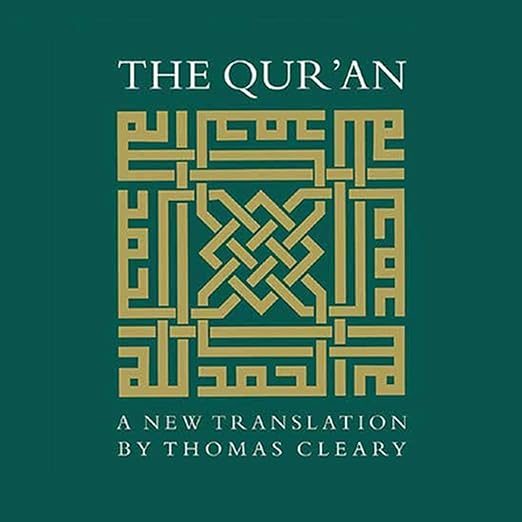
There is a particular challenge in reviewing a sacred text in translation, and I want to be honest about the specific thing this audiobook does and does not attempt to do. Thomas Cleary’s rendering of the Qur’an is not an interpretive commentary, it is a translation made by one of the most accomplished translators of religious and philosophical texts in the English language, a man whose work on Zen and Taoist classics set a high standard for how to carry sacred material across language barriers without flattening it into mere information. This audiobook presents that translation read aloud, and for the right listener, that combination is a genuinely significant thing.
I came to this knowing Cleary’s work on The Essential Koran, which has been a touchstone for English-speaking readers curious about Islamic scripture since its publication in the 1990s. The full translation, which took him another decade to complete, is a different scale of undertaking. Fourteen hours of carefully translated scripture is not a casual listen. It asks something of the listener, and in return it offers something that most translations do not: the sense of the text as literature as well as law and revelation, Cleary’s subtle poetic touches allow the architecture of the original Arabic to surface in English in a way that more literal translations obscure.
Our Take on The Qur’an: A New Translation
Multiple reviewers across different backgrounds, Muslim readers who grew up with other translations, Christian readers approaching the text out of curiosity, and comparative religion enthusiasts, converge on the same assessment: this is among the most readable and beautifully rendered English translations available. One reader made the useful comparison that among several translations consulted side by side, Cleary’s renderings are consistently more lucid and flow more gracefully. That assessment matches my own experience of the text. The absence of a commentary, which several reviewers note, is a genuine limitation for newcomers to the scripture, but it is also a deliberate choice, Cleary is giving readers the text itself, and trusting them to bring their own questions to it.
Why Listen to The Qur’an: A New Translation
The audio format serves this material in a way that is worth thinking through explicitly. The Qur’an was revealed orally and recited before it was written down, it is a text that has always been meant to be heard as well as read, and its structures of repetition, address, and narrative have an acoustic dimension that print can diminish. Michael Hatak’s reading does not perform the text in the manner of a Quranic reciter, this is not tilawah, but he delivers Cleary’s English with enough care and steadiness that the rhythm of the prose can be appreciated. For listeners approaching the text primarily as literature or as an act of cross-cultural understanding, this is a meaningful advantage.
What to Watch For in The Qur’an: A New Translation
The runtime is substantial at over fourteen hours, and the text does not follow a narrative arc in the conventional Western literary sense. The Surahs are organized by length rather than chronologically or thematically, which can disorient first-time listeners expecting a linear story. The translation’s beauty is in individual passages and accumulation rather than in plot or argument. Listeners would benefit from approaching this over multiple sessions rather than as a continuous listen, and pairing it with an introductory commentary, several reviewers suggest Cleary’s own Essential Koran as a companion, will significantly deepen the experience.
Who Should Listen to The Qur’an: A New Translation
Best suited to listeners who want an English encounter with Islamic scripture that prioritizes literary quality and accessibility over academic literalism. It is a strong choice for interfaith readers, students of comparative religion, and anyone who has bounced off more formally rendered translations and wants to try again with a translator known for making difficult material approachable. Muslim listeners who read primarily in English and have relied on translations like Yusuf Ali’s will find Cleary’s version a worthwhile comparison. Not the right entry point for listeners who need extensive contextual notes integrated into the text.
Frequently Asked Questions
How does Thomas Cleary’s translation compare to other popular English translations of the Qur’an like Yusuf Ali or Pickthal?
Readers who have compared multiple translations describe Cleary’s as more lucid and poetically fluid than Yusuf Ali’s archaic English or Pickthal’s formal diction. Cleary is not a Muslim scholar but a translation specialist with deep experience in sacred texts across traditions, which gives his rendering a literary quality that more doctrinally oriented translations sometimes sacrifice for precision.
Is this audiobook appropriate for non-Muslim listeners approaching the Qur’an for the first time?
Yes, and several reviewers come from exactly that background. A Christian reader notes finding the text beautiful and recommends it to anyone wanting to read the Qur’an in English. However, newcomers to the scripture would benefit from pairing it with an introductory commentary, as the translation itself does not include explanatory notes.
Does Michael Hatak’s narration bring any particular approach to the reading, or is it straightforward recitation?
Hatak reads with measured, respectful pacing appropriate to the material. This is not a dramatic performance, it is a careful, steady delivery that allows Cleary’s prose to carry the meaning. The narration prioritizes comprehension and flow over theatrical expression, which is the right call for sacred text.
How should listeners structure their listening given the 14-hour runtime and non-narrative structure?
The Qur’an is organized by Surah length rather than chronologically or thematically, which means it rewards episodic listening over extended sittings. Individual Surahs vary significantly in length and register. Most reviewers who engaged with it seriously did so across multiple sessions, treating it as a meditative practice rather than a story to be consumed continuously.