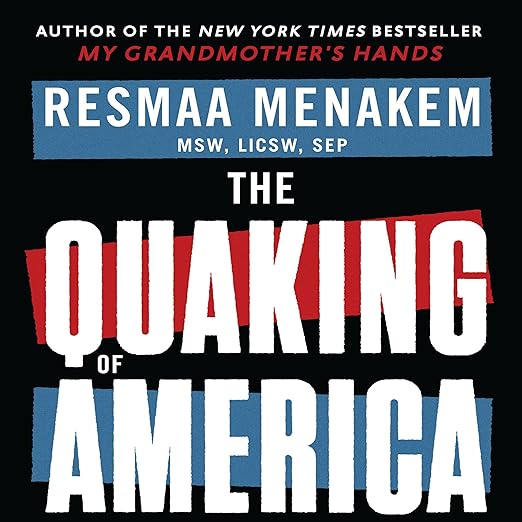
Resmaa Menakem's craft as a writer is inseparable from his craft as a therapist. In The Quaking of America, narrated by Cary Hite in this audiobook across 12 hours and 56 minutes, Menakem does something structurally unusual for a book about political violence and democratic fragility: he refuses to address it primarily as a political problem. Instead, he addresses it as a somatic one. The body, in Menakem's framework, is where racialized trauma lives and where racialized chaos is manufactured by those who want to incite it. The book is therefore not a political analysis in any conventional sense. It is a set of embodied practices, including somatic exercises, grounding techniques, and presence-building disciplines, designed to make individuals and communities more resilient against what he calls organized collective trauma response.
This comes from the author of My Grandmother's Hands, a New York Times bestseller that established Menakem's framework for understanding racial trauma as a body-held rather than mind-held phenomenon. The Quaking of America applies that framework to a specific and urgent context: the growing threat of white-supremacist political violence and the mass radicalization campaigns designed to generate fear and compliance in American bodies. The 4.8 rating across 163 listeners is one of the stronger scores in the sociology and trauma space, and the review language is consistently emphatic.
Cary Hite's Gravity, Compared to Baldwin's Energy
Cary Hite's narration carries the weight of the material with appropriate gravity. Menakem's prose has a rhythm that sits somewhere between clinical precision and near-prophetic urgency. Reviewer Per drew the comparison to James Baldwin's literary energy, which is apt for the oratorical quality of the best passages. Hite does not impose drama; he delivers the text with enough solemnity to honor its stakes without tipping into performative intensity. For 50 short chapters of densely layered content, that restraint is the right choice.
The 50-Chapter Structure Is Built for Practice
The structural decision to organize the book in 50 short chapters is itself a somatic one, in a sense: Menakem is not writing a sustained argument designed to be absorbed in long sessions. He is writing material designed to be practiced with and returned to. Reviewer JAL described it as a book that "connects the dots" in 50 powerful chapters, and that episodic quality is by design. The somatic practices embedded throughout, including guidance on building presence and discernment in the body, settling during conflict, and maintaining safety and stability in dangerous situations, require active engagement rather than passive reception. Listeners who treat this as a continuous listen rather than a practice guide will extract less than those who pause, attempt the exercises, and return.
Menakem's positioning of the audiobook as a guide to be practiced rather than consumed in one sitting has real implications for how you approach the listening experience. Treating it as background audio while driving or walking is likely to return less than it requires. The 50-chapter structure means you can take it in genuine installments, working through five or six chapters and their associated somatic practices before returning for the next batch. Reviewers who described it as "game-changing" and "essential" were describing a cumulative effect that builds over multiple sessions rather than a single revelatory listen. That context is worth knowing before you start.
Somatic Practice Meets Careful Political Framing
The audio format suits the material in ways that are not immediately obvious. Menakem's somatic practices are experiential, and listening while in a body rather than reading while sitting at a desk creates a different relationship to the content. Several of the exercises he describes are designed to be done in real time, and an audio format allows for that engagement in a way that reading alone does not facilitate as naturally. Reviewer Clouded Compass drew the comparison to Gabor Mate's work on addiction and trauma, which frames the broader intellectual neighborhood this book occupies: it is trauma scholarship that is also meant to be practiced.
The political context is treated with care. Menakem is clear about what he believes is happening in American society, including the coordinated repetition of lies, the incitement of mass radicalization, and the manufacturing of chaos, but the book does not dwell on political argument. It quickly redirects from diagnosis to practice. Robin DiAngelo's endorsement in the synopsis situates the book within antiracist practice, and that framing is accurate, but listeners across political backgrounds who are primarily interested in the trauma-science framework will find the somatic content substantive regardless of how they engage with the political framing.
Conviction Over Evidence in the Democracy Claim
The book makes significant claims about the relationship between somatic practices and political resilience that some readers will want to evaluate critically. The argument that embodied practices can "possibly prevent further destruction" of democratic norms is a large claim, and Menakem presents it with conviction rather than systematic evidence. Reviewer Per noted that "much of the book prophetically reads like a dystopic nightmare" while also praising the meticulousness of each chapter, which captures the tension: the diagnosis is often more specific than the treatment prescription.
Listeners who engage with Menakem's previous work will arrive with the conceptual framework already in place and will find The Quaking of America an application and extension of it. Those who come to this book first without My Grandmother's Hands as context may find some of the somatic terminology unfamiliar, though Menakem builds enough scaffolding within the text to make it accessible as a standalone. Starting with the prior work would enrich the experience significantly and make the somatic vocabulary feel grounded before the more politically urgent material begins.
Mental Health Practitioners and Organizers Are the Audience
This audiobook is for readers engaged with antiracist practice who want resources that go beyond intellectual analysis into embodied action. Mental health practitioners, community organizers, educators, and individuals who have found Menakem's previous work useful will get the most from the full 12-hour experience. Listeners who are new to somatic frameworks for trauma should not be deterred, but should expect to engage actively with the practices rather than consume the book passively. Those looking for conventional political analysis or policy argument will find the genre does not match their expectations.
Do I need to read My Grandmother's Hands before this audiobook?
The book is structured to function as a standalone, and Menakem builds enough context for newcomers. But listeners who start with My Grandmother's Hands will arrive with a richer understanding of his somatic framework, which makes The Quaking of America's applications land with more precision.
Is this audiobook politically neutral?
No. Menakem is explicit about his diagnosis of white-supremacist political violence as a systemic threat, and the book is written from an antiracist perspective. The content redirects quickly from political argument to somatic practice, but the political framing is present and intentional.
Can the somatic exercises in this audiobook be practiced while listening?
Yes, and the audio format may actually suit this better than reading. Several of the presence-building and grounding exercises Menakem describes are designed to be done in real time, and having the guidance in audio allows for engaged practice without having to hold a book.