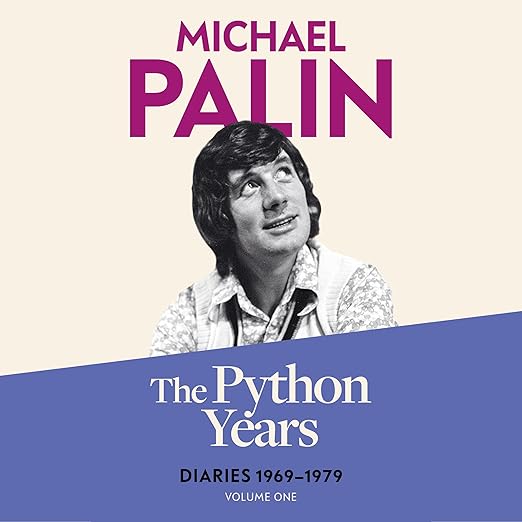
Quick Take
- Narration: Michael Palin reading his own diaries is an extraordinary piece of audio, not because he performs them, but because he doesn’t; the understatement is everything.
- Themes: Creative collaboration, the mechanics of comic genius, peripatetic domestic life in 1970s Britain
- Mood: Warm, intelligent, and quietly hilarious, like spending time with someone much funnier and better-read than you
- Verdict: Nearly thirty hours of diary entries from one of the most observant writers to come out of British comedy, narrated with an authenticity only the author can bring. Don’t approach this expecting pace.
I started The Python Years on a Sunday morning with the intention of listening to an hour before doing something productive. I surfaced six hours later having accomplished nothing on my list and feeling genuinely, unreservedly happy about it. Palin’s diaries are the kind of writing that makes you feel accompanied rather than entertained, a distinction that matters a great deal over a nearly thirty-hour runtime.
The setup is simple: Michael Palin began keeping diaries in the late 1960s, when he was newly married and struggling to establish himself in television comedy. What he didn’t know at the time was that he was also on the edge of something that would reshape British humor entirely. Monty Python was just around the corner, as the synopsis understates with characteristic British restraint. These diaries cover the formation, the ascent, the cult status in North America, and the eventual dispersal of the group, ending somewhere around Life of Brian. They are not celebrity tell-alls. They are the records of a working man who happened to be working on something extraordinary.
The Ordinariness That Makes Everything Extraordinary
One reviewer describes Palin as sensible, intelligent, warm, courteous, and hard-working, and finds this surprising given his Python characters, most of whom are absurd maniacs. The contrast is exactly the point. Reading these diaries, you encounter someone for whom the funniest thing about comedy was often how much it resembled ordinary work, the negotiations, the scheduling conflicts, the anxiety about whether the new sketch was actually funny, the unglamorous business of making art with a group of other people who all have opinions. There is a scene early on where Palin records a Python writing session with the same matter-of-fact tone he uses to describe a trip to the dentist. The effect is repeatedly wonderful.
The Three-Day Week, the Miners’ Strike, and the Texture of a Decade
These diaries are not just about Python. They’re about living in Britain during the 1970s, which was an objectively bizarre and difficult time, power cuts, labor disputes, political instability, and a general national mood that oscillated between gallows humor and genuine alarm. Palin records all of this with the same mild attention he brings to his creative life. The Python Years works as social history almost without meaning to. The texture of daily life in that particular period is preserved here because Palin was writing for himself rather than for posterity, which means he didn’t editorialize about what seemed significant. He simply recorded what happened.
The Group Dynamic Heard in Real Time
What you don’t get with Python biographies written after the fact is the experience of watching the relationships develop without knowing how they’ll end. Palin’s diaries give you that. The entries about John Cleese, Terry Gilliam, Eric Idle, and Terry Jones accumulate over hundreds of pages, and you develop a sense of the working relationships that no retrospective account could replicate. The tensions are present but so is the pleasure, the accounts of particularly good writing sessions, of things that made the whole group laugh, of performances that they knew were working in the room. This is where the nearly thirty-hour length stops feeling indulgent and starts feeling like the only appropriate format.
Who Should Listen / Who Should Skip
At 29 hours and 48 minutes, this is a serious commitment that rewards patience rather than pace. If you’re looking for a brisk biographical account of Monty Python’s rise, there are shorter books that will serve you better. If you want to spend time inside the experience of living that period from within, written by one of the most naturally appealing writers in British comedy, this is exceptional. Palin’s narration is the only version that exists for a reason: no one else could deliver the entries about his own children, his own anxieties, and his own quiet wonder at the Python phenomenon with anything approaching this register of earned feeling.
Frequently Asked Questions
At nearly 30 hours, what’s the best way to approach this audiobook? Is it designed to be listened to straight through?
It works best in longer sessions that allow the cumulative effect of the diary format to build. Short daily listens work too, though you lose some narrative momentum. Think of it less like an audiobook with chapters and more like an ongoing correspondence from someone you genuinely like.
Do the diaries cover all of Monty Python, or only a specific period?
The Python Years covers the formation and peak years, ending around the time of Life of Brian. Palin’s subsequent diaries cover his travel years and are published separately. This first volume focuses specifically on the Python period and its immediate aftermath.
How much Python insider material is there? Is this primarily a comedy history or a personal memoir?
Both. There are substantial sections about the writing and filming of Holy Grail, Life of Brian, and the American touring shows. But these are embedded in a much larger personal record that includes his family, his non-Python projects, and the broader texture of his life. The proportion of Python material is generous but not exclusive.
One review mentions OCR errors in the Kindle version, does this affect the audiobook?
That reviewer was discussing the e-book edition specifically. The audiobook, narrated by Palin himself, is a separate recording and would not be affected by text conversion issues. The self-narration is clean and consistent throughout.