Quick Take
- Narration: Pete Cross delivers the transcribed interview text with appropriate neutrality, neither editorializing nor dramatizing. The format requires restraint and he supplies it.
- Themes: Russian foreign policy and national identity, US-Russia relations, the self-presentation of power
- Mood: Analytical and sometimes surreal, with an undertow of geopolitical urgency
- Verdict: A document of historical record that demands critical reading alongside its listening. Essential for anyone who wants to understand how Putin frames his own story, with the understanding that the frame is itself the subject.
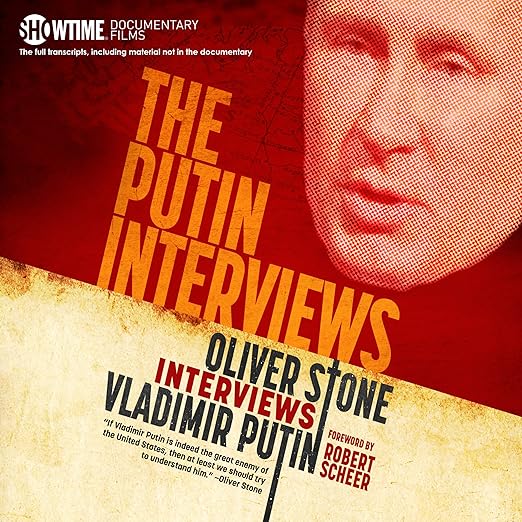
I came back to The Putin Interviews during a particularly dense period of reading about Russia and Ukraine, and what struck me most on this revisit is how much the 2017 publication date matters. Oliver Stone conducted these interviews over two years, culminating after the 2016 US presidential election, and the document reads differently now than it did then. The conversations with Putin about the Clinton, Bush, Obama, and Trump relationships, about election interference allegations, about Syria and Ukraine, carry a weight that time has considerably complicated.
Pete Cross narrates the transcribed text, and the format creates an unusual audiobook experience. This is not a narrative; it is a written record of spoken exchanges, rendered in audio. Cross’s job is essentially to perform a transcript without imposing interpretation, which he does with the right degree of restraint. There are moments, particularly in the longer exchanges where Putin’s answers are dense and policy-heavy, where a less skilled narrator might allow the listener to disengage. Cross keeps the attention appropriately tethered.
Our Take on The Putin Interviews
Stone explicitly positions these interviews in the tradition of the Frost-Nixon conversations, and the comparison is instructive in more than one direction. David Frost approached Nixon as an interviewer trying to extract accountability from a man who had already lost power. Stone approaches Putin as a filmmaker whose relationship to his subjects has always been complex and not always comfortable for those who expect adversarial journalism. One reviewer noted that Stone seemed at times to have something against either Putin or the US, which captures the particular strangeness of the book’s stance: Stone is neither a propagandist for Putin nor a conventional Western critic, and the interviews reflect that ambiguity.
The scope of the conversations is genuinely remarkable. More than a dozen interviews over two years with no topics declared off-limits is an access level that no Western journalist had previously achieved with Putin. The discussions cover his rise to power, his relationships with world leaders, Russia’s position in global conflicts, and the interference allegations that were actively unfolding during the interview period. The moment where Stone introduces Putin to Dr. Strangelove and they watch it together is exactly the kind of scene that could only exist in this format.
Why Listen to The Putin Interviews
The audiobook includes substantial material that did not appear in the documentary, which is the primary reason to choose this format over simply watching the film. The additional context, references, and sources that Dreamscape Media’s edition includes give listeners more to work with than the screen version provides. For anyone who saw the documentary and wants deeper engagement with the source material, the audio transcript is the appropriate next step.
One reviewer described the book as helping “go some distance in refuting the demonization” of Putin, while another found it illuminating Putin as a Russian Nationalist whose self-presentation is consistent and controlled. Both responses point to the same quality: the interviews reveal something true about how Putin understands and presents himself, regardless of how you evaluate that understanding. That is inherently valuable as historical material, even if the interpretation of what is revealed will vary sharply by political orientation.
What to Watch For in The Putin Interviews
The critical reading this audiobook demands is not optional. These are Putin’s own words, and they are the words of a skilled political actor who has been managing his public image for decades. Stone does probe, and there are moments where the exchanges become genuinely tense, but the format of a voluntarily granted extended interview means Putin retains significant control over what he chooses to say and how he says it. The interviews tell you a great deal about Putin’s self-framing; they are not a substitute for independent analysis of the actual events he describes.
Listeners who want a critical biographical account of Putin’s rule, the kind that includes perspectives from people who have opposed or suffered under him, will need to supplement this with other sources. The Putin Interviews is exactly what its title announces: his words, his framing, his account of his own history and intentions.
Who Should Listen to The Putin Interviews
This audiobook is essential listening for anyone trying to understand how Putin narrates his own legacy, which is a prerequisite for understanding the gap between that narrative and the documented record. It is best approached alongside independent historical analysis rather than as a standalone source. Listeners who want access to the extended material that the documentary could not accommodate will find the audio format provides the most complete version of the conversation Stone assembled. Those who need critical framing built into the text itself will find the book’s neutrality of presentation frustrating.
Frequently Asked Questions
Does Oliver Stone challenge Putin on the substantive allegations, or does he give him a platform without pushback?
Stone does push on several issues, including asking directly why Russia hacked the election, and there are exchanges the book describes as personal and provocative. But Stone is a filmmaker, not an investigative journalist, and the format of extended voluntary access means the balance of control in the interviews leans toward Putin. Critical readers will want to come with independent knowledge of the events discussed.
How much material in the audiobook was not included in the documentary?
The book is specifically marketed as containing substantial material not included in the documentary, suggesting the additional content is significant rather than marginal. The references, sources, and contextual information also provide depth that the documentary format could not accommodate.
Is The Putin Interviews still relevant given that it was published in 2017?
More relevant, not less. The conversations about US-Russia relations, election interference, Ukraine, and Syria are all live issues that have developed considerably since 2017. Reading the 2017 document now reveals what Putin was saying at a specific political moment, which provides useful context for how those situations have since evolved.
How does Pete Cross’s narration handle the back-and-forth interview format?
Cross maintains appropriate neutrality throughout, which is the right call for transcribed interview material. He distinguishes between Stone’s questions and Putin’s responses clearly enough that the exchanges are followable without visual formatting cues, and he avoids editorializing through vocal tone, which preserves the document’s primary value as a record rather than an interpretation.